

More news on this day
Thousands of cruise passengers who expected sun-soaked Gulf itineraries are instead stranded in Abu Dhabi and Doha this week, trapped aboard immobilised vessels or in overflowing hotels as the Iran war shuts regional airspace, grounds flights and slows already stretched evacuation efforts.
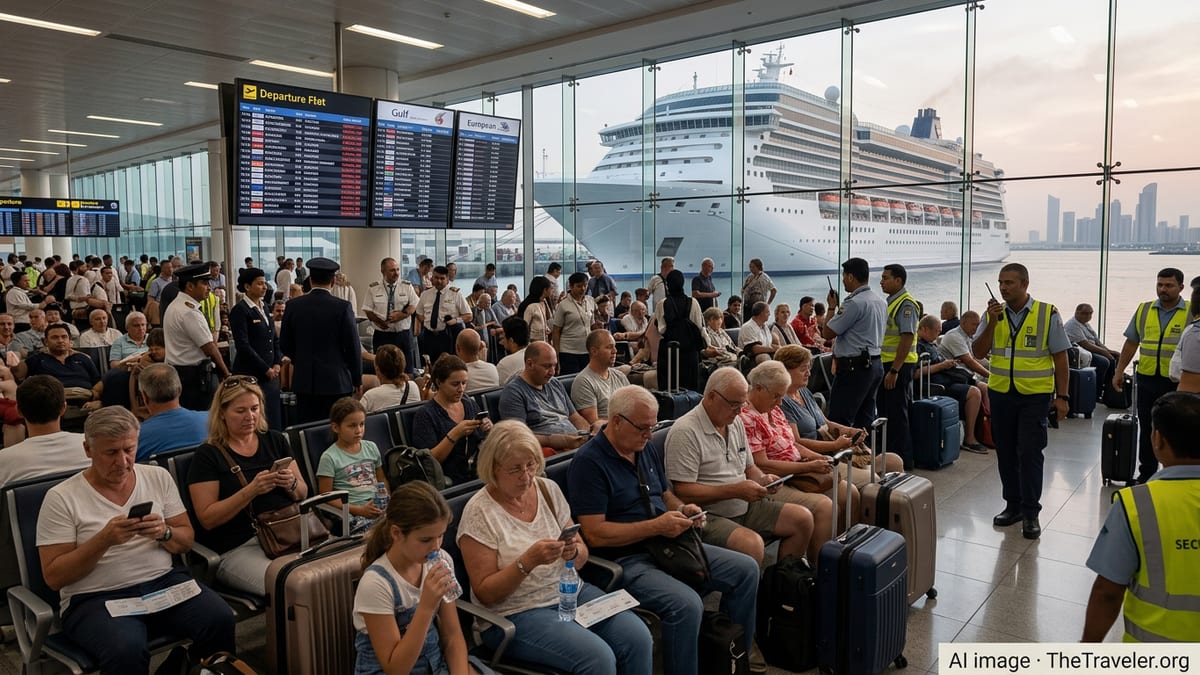
Gulf Cruise Holidays Turn Into Sudden Warzone Lockdown
What began as a routine winter cruise season in the Gulf has turned into a logistical and emotional ordeal for thousands of holidaymakers caught in the crossfire of a widening conflict between Iran, the United States and Israel. With Iran imposing a de facto blockade around the Strait of Hormuz and missile strikes triggering sweeping airspace closures, cruise lines have frozen itineraries and converted ships into floating hotels in ports across the region.
Ships from major brands, including MSC Cruises, Celestyal, TUI’s Mein Schiff fleet and Saudi-backed Aroya, are now sitting idle in Abu Dhabi, Dubai and Doha with their voyages abruptly terminated. Industry estimates suggest that several thousand cruise passengers and crew remain stuck aboard at least half a dozen large vessels in the United Arab Emirates and Qatar alone, while broader aviation cancellations have left more than 20,000 travellers across the region unable to move on.
Port authorities have allowed limited disembarkation in some cases, but for many guests the only realistic accommodation remains their ship. Operators have extended hotel-style services on board, issuing new key cards, keeping restaurants and entertainment open where possible, and assuring travellers that safety remains their top priority while they wait for onward travel options.
The crisis has effectively shut down the Gulf’s fast-growing winter cruise market overnight. Lines that only weeks ago were touting record bookings for voyages out of Abu Dhabi and Doha have now cancelled upcoming departures well into March as they pivot resources to emergency repatriation instead of tourism.
Abu Dhabi and Doha Become Unexpected Holding Zones
With Dubai International, Abu Dhabi’s Zayed International and Doha’s Hamad International airports operating at a fraction of normal capacity, the adjacent ports have turned into holding zones for displaced travellers. Abu Dhabi’s cruise terminal, normally a smooth gateway for guests flying in from Europe and Asia, is now crowded with confused passengers clutching suitcases and phones as they refresh airline apps that rarely bring good news.
In Doha, Germany-based TUI Cruises has kept the Mein Schiff 5 alongside while it negotiates evacuation corridors with regional carriers. In Abu Dhabi, the Mein Schiff 4 is in a similar position, with a limited number of passengers gradually being moved onto specially arranged flights in cooperation with Emirates and Etihad. MSC vessels that would normally be rotating through Dubai and Doha are instead anchored or berthed for days at a time while their crews manage an unfolding emergency rather than a holiday.
Local authorities have tightened security perimeters around port districts and restricted access roads to travellers with confirmed bookings or official transport to the airports. Inside the terminals, cruise staff, ground handlers and consular officials are attempting to triage cases, prioritising elderly passengers, families with small children and those with urgent medical needs for the earliest available seats out of the country.
Hotels in both cities are nearing capacity as diverted airline passengers, cruise guests who have disembarked and expatriate residents returning from interrupted trips all vie for rooms. Several cruise lines are offering to cover at least part of the cost of shore accommodation for those able to clear immigration, though policies differ widely and many travellers are learning that their travel insurance does not fully cover war-related disruptions.
Evacuations Hampered by Grounded Fleets and Closed Airspace
The main obstacle for stranded cruise passengers is not a lack of willingness by cruise lines or governments to evacuate them, but the hard limits imposed by flight bans and damaged infrastructure. Authorities in the United Arab Emirates, Qatar, Bahrain and Kuwait have imposed severe restrictions on airspace, effectively grounding most commercial services in and out of their flagship hubs at the height of the crisis. Where aircraft are able to operate, they do so through narrow emergency corridors with strict curfews and reduced capacity.
MSC Cruises and other operators have announced dedicated repatriation plans, working with Emirates, Etihad and other carriers to secure blocks of seats on any available services and to charter additional aircraft from secondary gateways such as Muscat and Riyadh. Some lines are busing small groups of passengers overland from the UAE and Qatar into neighbouring countries where airports remain partially open, a journey that can take more than ten hours before check-in even begins.
Even these efforts are constrained by the sheer scale of the broader aviation shutdown. Aviation data shows that more than 20,000 flights have been cancelled across the Middle East in recent days, including thousands of services at Dubai, Abu Dhabi and Doha, which normally act as vital bridges between Europe, Africa, Asia and Australasia. Airline call centres are overwhelmed, with reports of travellers spending hours on hold only to be offered departure dates weeks away or refunds that do little to help them leave immediately.
Repatriation flights that do take off are heavily over-subscribed, with airlines and cruise lines forced to implement priority lists based on original travel dates and vulnerability. Governments including those of the United Kingdom, Germany, Indonesia and India have started organising their own limited evacuation flights, adding state-backed capacity to an already complex patchwork of private-sector rescue attempts.
Anxious Passengers Juggle Safety Fears and Practical Realities
On board the ships and in hotel lobbies across Abu Dhabi and Doha, the dominant mood among stranded cruise passengers is a mix of anxiety, fatigue and quiet resilience. Many recount being woken by overnight emergency alerts on their smartphones warning of potential missile threats just hours after enjoying formal dinners and deck parties. For some, the first sign that their holiday had transformed into a crisis was a message from the captain announcing that the vessel would remain in port indefinitely.
Families with school-age children worry about missed classes and mounting costs as they extend their stays. Older passengers fret over running low on medication and the prospect of enduring long overland transfers followed by packed evacuation flights. Younger travellers are glued to news alerts and airline notifications, trying to piece together the fastest route home, often combining partial refunds from cancelled flights with expensive one-way tickets on whatever services might still be operating.
Despite the tension, many guests say they feel comparatively safe on board, where security has been tightened and crew members provide regular briefings. Cruise operators have reinforced that ports in the UAE and Qatar are not on the front line of the fighting and that they are coordinating closely with local authorities and international militaries to assess risks before authorising any movements. Some passengers have chosen to venture into the cities to make the best of an unwanted extended stopover, while others prefer to remain on the ship, where familiar routines provide some comfort.
For crew members, the crisis poses an additional layer of uncertainty. Many are far from their home countries and reliant on the same air corridors as guests to complete their contracts or return to families. While lines have promised to continue paying staff and to provide accommodation and food throughout the disruption, crew are acutely aware that the longer the conflict drags on, the more it will test the financial resilience of the cruise industry and their own job security.
What Comes Next for Gulf Cruising and Regional Travel
With the military situation around Iran and the Gulf still volatile, there is little clarity on when normal cruising and flight operations might resume. Regional aviation authorities have signalled that any reopening of airspace will be gradual and tightly controlled, with repatriation and essential cargo flights likely to take precedence over leisure travel for weeks to come. Cruise lines have already cancelled near-term sailings out of Abu Dhabi, Doha and Dubai and are reviewing deployment plans for the rest of the season.
Industry analysts expect that even after airspace restrictions ease, traveller confidence in Gulf cruise itineraries will take time to recover. Questions about war risk insurance, port security and the vulnerability of key maritime choke points such as the Strait of Hormuz are now firmly in the spotlight. Lines may seek to reposition ships to less volatile regions or design itineraries that avoid the most exposed waters, at least until there is a durable ceasefire and credible guarantees for commercial traffic.
For now, focus remains on the immediate humanitarian and logistical challenge of getting stranded passengers home from Abu Dhabi, Doha and other Gulf hubs. As limited evacuation flights begin to trickle out and emergency corridors open and close with little notice, travellers are urged to stay in close contact with their cruise lines, airlines and embassies, to avoid heading to airports without confirmed seats, and to brace for a slow and uneven return to normality.
The ordeal has laid bare how quickly globalised travel networks can seize up when a major conflict engulfs key aviation and shipping crossroads. For the thousands of cruise passengers still confined to cabins or camped out in hotels, the only certainty is that the end of their journey now depends less on cruise brochures and more on diplomacy, military calculations and the fragile reopening of the skies.