

More news on this day
Severe fuel shortages across Cuba are increasingly reshaping the island’s tourism landscape, disrupting air links, ground transport and hotel operations at the height of the winter travel season.
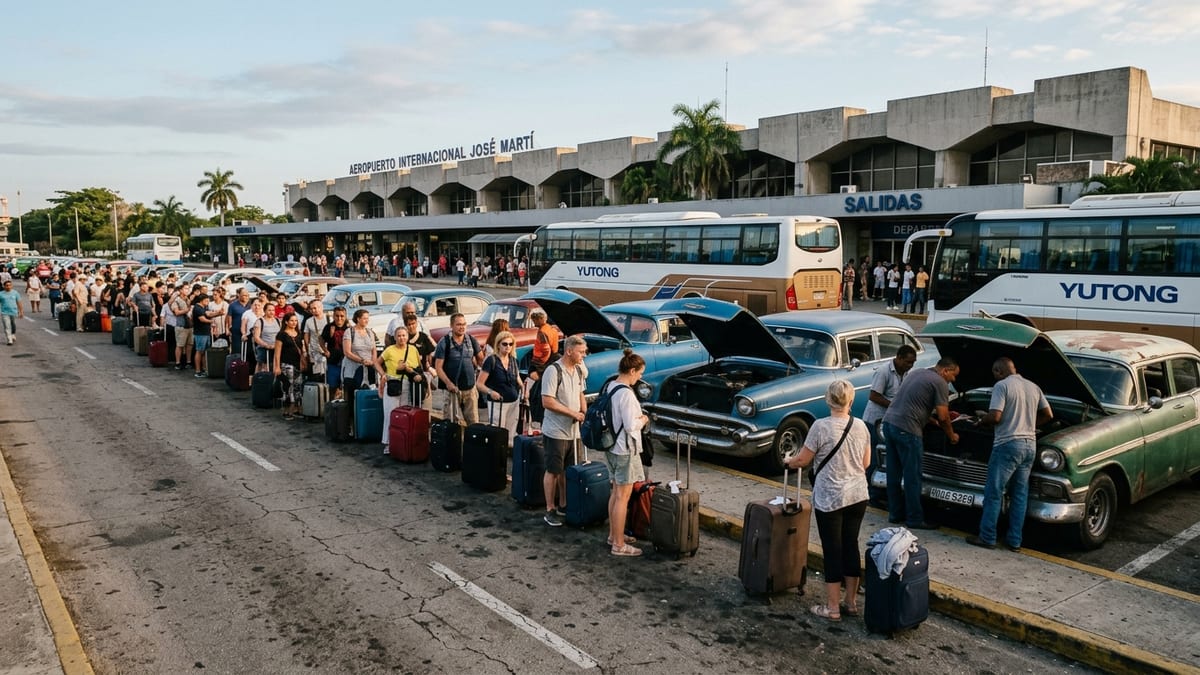
Flight Cuts and Aviation Fuel Shortages Hit Island Access
The most visible impact of Cuba’s fuel crunch is unfolding in the skies. Publicly available information shows that a shortage of jet fuel has forced authorities to warn airlines of limited supplies at multiple airports, triggering cancellations and route suspensions on key international links. Recent coverage indicates that Air France plans to suspend its Paris–Havana service for several weeks, citing the knock-on effects of the energy crisis on both aviation and tourism.
Reports from industry-focused outlets detail that Cuban officials notified carriers in early February that jet fuel would not be available at nine airports, including Havana’s José Martí International. This has complicated operations for European and Canadian airlines and constrained flights serving popular resort hubs in the northern keys. Parallel reporting on the broader 2026 Cuban crisis highlights that several international airlines, including major Canadian and Russian operators, have either suspended services or shifted to evacuation-only flights as the fuel situation worsened.
These disruptions are arriving on top of an already weakened demand profile. Tourism data cited by regional media indicate that Cuba received roughly 1.8 million visitors in 2025, less than half the pre-pandemic peak in 2018 and significantly below regional competitors in the Caribbean. Industry analysts note that limited airlift, combined with uncertainty around fuel availability, makes it harder for tour operators to package the island reliably, encouraging travelers to divert to destinations such as the Dominican Republic or Mexico’s Caribbean coast.
The aviation squeeze is also affecting domestic connectivity. With fuel prioritized for essential services and limited stock for internal flights, links between Havana and outlying tourism enclaves have become more fragile. Publicly available advisories from travel trade publications urge visitors to prepare for last-minute schedule changes and potential route consolidations as airlines attempt to conserve scarce fuel.
Ground Transport and Blackouts Disrupt Visitor Movement
On the ground, the fuel shortage is rippling through every layer of Cuba’s transport system. International and regional coverage of the 2024 to 2026 blackouts describes a pattern of reduced public transport, curtailed bus services and long queues for private fuel purchases. For visitors, this translates into longer waits for airport transfers, fewer long-distance buses between cities and more difficulty arranging excursions to outlying beaches or rural attractions.
Evidence from tourism and mobility reports suggests that rental cars have become harder to obtain and more expensive, with some providers only confirming vehicles “on request” and, in some cases, restricting fuel sales or payments. In parallel, the national energy crisis has led to rolling electricity cuts that can affect traffic signals, fuel station operations and digital payment systems, creating further bottlenecks for both residents and tourists.
Humanitarian and regional risk assessments released in early March describe a sharp contraction in food transport capacity within Cuba, in some provinces reportedly falling to a fraction of normal routes. While the primary impact is on local food security, visitors are encountering knock-on effects in the form of limited menu options, occasional restaurant closures and interruptions to supplies at all-inclusive resorts. Multi-hour or daily power outages in some areas add another layer of unpredictability to transport, refrigeration and basic services.
Travel advisories from international media and specialty travel publications now flag Cuba’s energy shortage as a key operational risk. Prospective visitors are urged to anticipate delays, carry backup essentials and consider flexible itineraries centered on a small number of bases rather than complex, island-wide routes heavily dependent on road and intercity transport.
Hotel Closures, Relocations and Strained Services
Fuel scarcity is also reshaping where visitors sleep. According to published coverage from regional news agencies, Cuban authorities have begun temporarily closing some hotels and relocating guests to other properties as part of an emergency response to reduced oil shipments and chronic power shortfalls. These measures are particularly evident in resort areas in the northern keys, where air links and logistics chains for imported supplies are under pressure.
Industry-focused analysis highlights a sharp deterioration in hotel performance indicators over the past year, including low occupancy rates and declining revenue per available room for major Spanish operators such as Meliá and Iberostar. The combination of fewer arrivals, higher operating costs and intermittent access to fuel for generators has led some properties to scale back services. Reports describe reduced dining options, limited air conditioning, constrained laundry services and shortened operating hours for pools and entertainment.
Travel trade outlets note that charter flights serving all-inclusive resorts have had to adjust schedules or consolidate services, forcing hotels to juggle arrivals and departures with unreliable transport links. Some resorts are reportedly prioritizing essential operations, such as basic room comfort and water supply, over non-essential amenities in order to conserve fuel and power.
For visitors, these adjustments can translate into last-minute hotel changes, downgraded room categories or altered itineraries arranged through tour operators. While many travelers still report enjoying Cuba’s beaches and cultural offerings, publicly available feedback suggests that expectations for consistent, resort-level comfort are increasingly difficult to meet in the current energy environment.
Tourism Numbers Slide as Travelers Reroute
The fuel crisis is landing on a tourism sector that was already struggling to regain momentum after the pandemic. Official data cited by independent Cuban and international outlets show that international arrivals fell markedly in 2024 and 2025, with 2025 visitor numbers described as the lowest in more than two decades outside the pandemic period. Early 2026 figures reported by the National Office of Statistics and Information and summarized in local media indicate a further year-on-year decline, with tens of thousands fewer arrivals in January alone.
Analysts point to a combination of factors behind this slide. In addition to the energy crunch, the island faces tighter United States sanctions, reduced oil shipments from Venezuela and broader economic instability that affects everything from food supplies to healthcare. Travel industry reports note that key source markets, including Canada, Germany and Russia, recorded double-digit drops in arrivals in 2025, even before the most recent wave of flight suspensions tied directly to jet fuel shortages.
Comparative regional data compiled by tourism economists and think tanks underscore how far Cuba has fallen behind its Caribbean peers. While destinations such as the Dominican Republic have posted record visitor numbers, Cuba’s total international arrivals remain a fraction of pre-2019 levels. This divergence is eroding one of the island’s main sources of hard currency at a time when foreign exchange is badly needed to import fuel and other essentials, creating a feedback loop between tourism weakness and the broader energy crisis.
Travel market observers note that tour operators are quietly rebalancing their portfolios, shifting capacity toward more predictable destinations. Some package providers continue to promote Cuba but now emphasize flexible booking conditions, travel insurance and clear communication about potential service disruptions on the ground.
Visitor Experience: From Idyllic Getaway to High-Risk Adventure
For many travelers, the combined effect of flight uncertainty, ground transport disruption and strained hotel services is changing the character of a trip to Cuba. Where the island once marketed itself as an accessible Caribbean escape, current conditions more closely resemble a high-risk, low-infrastructure destination that rewards flexibility and tolerance for discomfort.
Recent travel features and first-hand accounts collected by international media describe visitors facing longer queues for basic services, irregular housekeeping, and occasional difficulty finding taxis or fuel for private excursions. Some highlight the resilience and hospitality of local communities, but also recount the practical challenges of navigating blackouts, patchy mobile coverage and last-minute itinerary changes driven by logistics constraints.
Publicly accessible travel advisories now recommend that visitors carry printed copies of travel documents, allow extra transit time between airports and resorts, and prepare for intermittent air conditioning and limited hot water. Those with mobility issues or specific medical requirements are being urged by some governments and tour operators to reconsider non-essential travel until Cuba’s energy and transport situation stabilizes.
At the same time, there remains a segment of travelers for whom Cuba’s current reality is part of the attraction. Niche operators report interest from visitors seeking to understand the island’s crisis first-hand or to engage in community-based tourism. However, as fuel shortages deepen and transport systems strain, even these travelers are confronting a more complex, less predictable environment than in previous years, underscoring the extent to which energy scarcity now shapes the Cuban travel experience.