

More news on this day
Cape Verde’s long-troubled inter-island air network is set for a major shake-up as new state-owned carrier CVsky prepares to roll out expanded domestic routes ahead of the 2026 summer season, promising more reliable links for residents and tourists across the Atlantic archipelago.
New State Airline Steps In to Fix a Fractured Network
Operating as the commercial face of Linhas Aéreas de Cabo Verde (LACV), CVsky has been created specifically to serve the domestic market, with a mandate from the government to guarantee regular, safe and continuous air links between the country’s nine inhabited islands. The airline received its Air Operator Certificate from Cape Verde’s Civil Aviation Agency on December 24, 2025, clearing the way for full-scale inter-island operations.
The launch follows several turbulent years for domestic aviation in Cape Verde, marked by the exit of private operator Bestfly, capacity gaps and frequent schedule disruptions that made it difficult for locals and visitors alike to move between islands. By building a dedicated, 100 percent state-owned operator, authorities aim to treat domestic connectivity as an essential public service rather than a purely commercial venture.
Government officials have framed CVsky as a strategic tool for territorial cohesion, arguing that reliable inter-island flights are critical for economic integration, equitable access to services and the overall social fabric of the country. In practice, that means prioritising stable schedules, sufficient seat capacity and better coordination with international arrivals during peak travel months.
CVsky’s brand messaging leans heavily on morabeza, Cape Verde’s famed spirit of warmth and hospitality, presenting the new airline as both a logistical solution and a showcase for national identity in the skies.
New Domestic Routes Connect Tourism Hubs and Remote Islands
According to CVsky’s booking platform, the airline is gearing up a web of domestic services designed to knit together both major tourism hubs and smaller, less-served islands. Key routes include Praia to Maio, Praia to Fogo, Praia to Boa Vista, São Vicente to São Nicolau, Sal to Boa Vista and Sal to São Vicente, alongside links between the capital region and the central gateway of Sal.
These routes are particularly significant for islands like Maio, São Nicolau and Fogo, which have historically suffered from thin and unreliable air service despite their tourism potential and local mobility needs. Promotional fares being advertised for Praia–Maio and São Vicente–São Nicolau suggest CVsky is targeting both residents and budget-conscious travelers eager to explore beyond the better-known resort islands.
The airline is also leaning into point-to-point tourism flows between Sal and Boa Vista, two of Cape Verde’s busiest holiday destinations. A direct air bridge between the archipelago’s main resort islands is expected to make multi-island itineraries far easier, allowing visitors to combine Sal’s established infrastructure with Boa Vista’s quieter beach escapes without transiting through Praia.
By structuring its network around both the capital Santiago and the tourism-heavy northern and eastern islands, CVsky is positioning itself as the backbone of domestic travel at precisely the moment demand is projected to surge for summer 2026.
Modern ATR Fleet Tailored to Short Island Hops
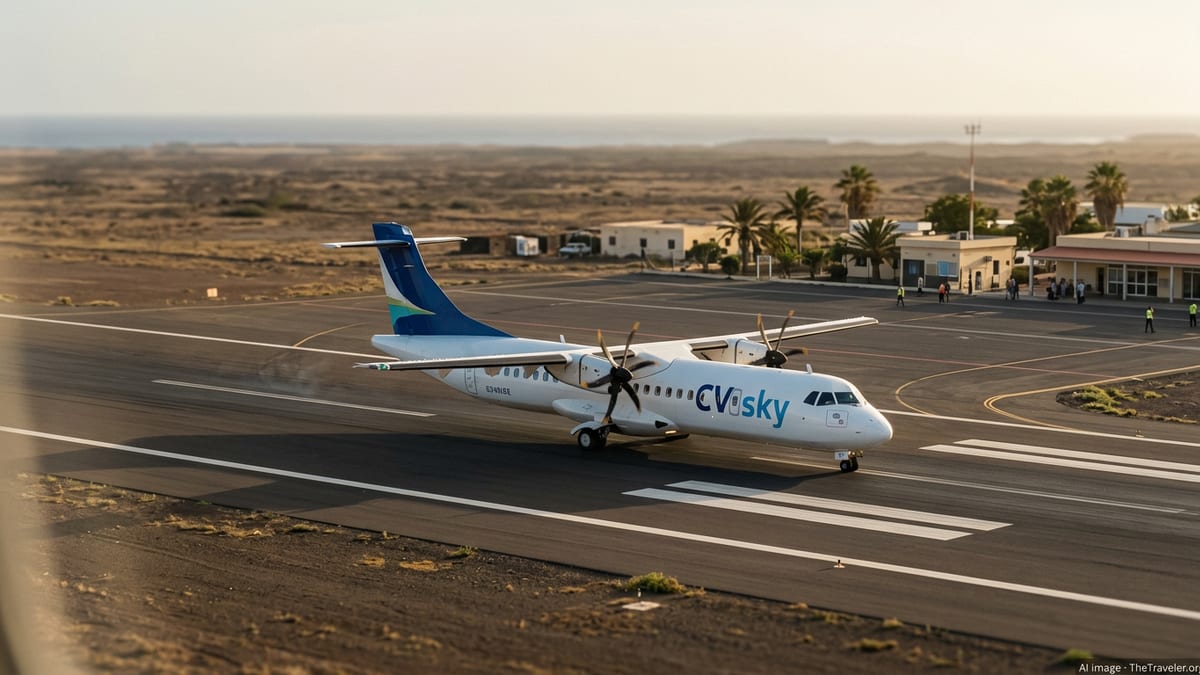
To operate these routes, CVsky is deploying a fleet built around the ATR 72-600, a turboprop aircraft widely used in short-haul regional markets. The first of these aircraft arrived in Cape Verde in September 2025, with a second unit following shortly after under a long-term lease arrangement, according to aviation industry reports.
The ATR 72-600 is well suited to Cape Verde’s geography and infrastructure: its performance allows safe operations on relatively short runways, and its fuel efficiency helps keep operating costs down on sectors often under an hour in duration. Cabin layouts typically accommodate around 70 passengers, a capacity that aligns closely with inter-island demand patterns outside the absolute peak days of the season.
Initially, the new aircraft were flown under the banner of national carrier TACV (Cabo Verde Airlines) while LACV completed its certification process. With that milestone now passed, the ATRs are being transitioned to full CVsky operation, making them the core of the new domestic brand as it scales up its schedule in the run-up to summer.
Industry observers note that the use of modern, standardized turboprops could also simplify maintenance, crew training and spare parts logistics within the archipelago, all of which have historically been weak points contributing to cancellations and delays.
Booking Opens as Residents and Tourists Eye Summer Travel
In late February, CVsky quietly opened its online booking system to the public, allowing customers to purchase tickets on a growing list of domestic services set to ramp up from April. The move follows weeks of speculation from travelers and tour operators who had been awaiting clarity on Cape Verde’s internal flight schedule beyond the spring shoulder season.
The timing is crucial. International demand for Cape Verde typically peaks between June and September, with European leisure travelers seeking reliable connections from beach resorts to cultural centers such as Santiago and São Vicente, and onward ferries to destinations like Santo Antão. Tour operators have long complained that late scheduling and patchy availability on domestic legs made it difficult to package multi-island holidays.
By putting seats on sale several months before the height of the summer rush, CVsky is signaling that it intends to operate to a more predictable, seasonally adjusted timetable. For local residents, earlier booking also offers the chance to secure lower fares and firmer plans around major events, family visits and essential medical or administrative trips between islands.
Travel forums and social media posts in recent months have highlighted widespread frustration with last-minute changes and limited options for inter-island travel. The early opening of CVsky’s booking platform is already being read by many as a test of whether the new airline can reverse that narrative in time for the busiest months of 2026.
High Hopes and Cautious Optimism for a New Era of Connectivity
While CVsky’s arrival is being welcomed as a turning point, expectations are tempered by years of inconsistent service from previous operators. Frequent travelers in Cape Verde often advise building extra buffer days into itineraries to account for possible disruptions, a habit that may take time to unlearn even if the new network performs as promised.
Officials argue that state ownership and a clear public-service mandate will allow CVsky to prioritize continuity over short-term profit, maintaining lifeline routes to smaller islands that might not be commercially attractive on their own. The airline’s stated mission of “connecting our islands, uniting our people” underlines that broader ambition.
For the tourism industry, much is riding on the success of this model. Hoteliers, guesthouse owners and tour providers across islands such as Maio, São Nicolau and Fogo are hopeful that more stable air links will finally unlock the potential of experiences that go beyond sun-and-sand tourism, from volcano treks to village homestays and cultural festivals.
As the 2026 summer season approaches, all eyes will be on CVsky’s performance. If the new carrier can deliver on its promise of reliable, frequent and fairly priced flights across the archipelago, it could fundamentally reshape how visitors and residents experience Cape Verde, turning once-complex island hops into routine journeys and setting a new standard for domestic air travel in West Africa.