

More news on this day
Cyprus has been thrust into the center of the widening Middle East air travel crisis after a brief alert over a suspicious object near Lebanese airspace prompted the scrambling of Greek fighter jets and temporary disruption over Larnaca, adding to days of flight cancellations and diversions across Israel, Gulf hubs and key European routes.
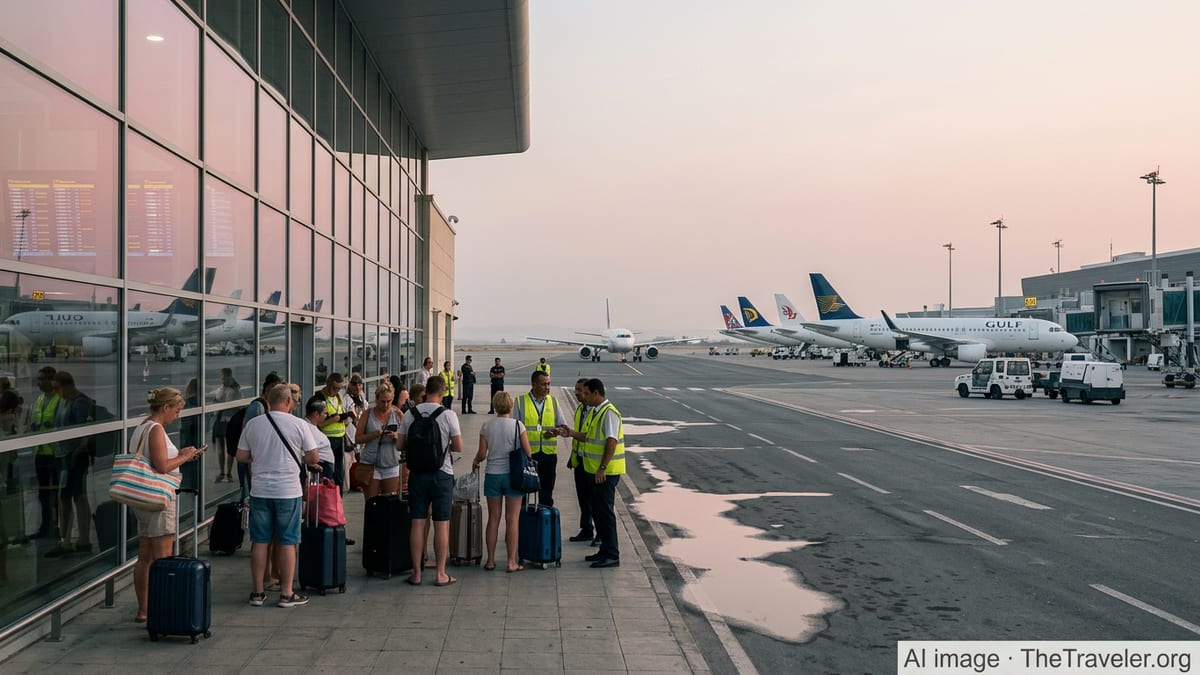
Cyprus Pulled Into Expanding Conflict Zone Skies
Cyprus officials confirmed on Wednesday that a suspicious object was detected near Lebanese airspace, triggering established security protocols and a short-lived alert that rippled through the island’s already strained aviation system. A government spokesperson said authorities activated “all appropriate measures” and that two Greek F 16 fighter jets based in Paphos were scrambled to investigate, amid heightened concern that drones linked to the US Israel Iran conflict could again threaten civilian operations.
The government later announced that the immediate threat had passed and the alert was lifted, describing the incident as closed while insisting that Cypriot airspace technically remained open. However, aviation sources in Nicosia acknowledged that sections of airspace over Larnaca were briefly restricted for safety, forcing airlines to alter flight paths and holding patterns while the military operation was under way.
The scare came less than 48 hours after an Iranian made drone struck the UK’s RAF Akrotiri base and triggered a full evacuation of nearby Paphos International Airport, underscoring how Cyprus has moved from a perceived safe haven to a frontline state in the wider regional confrontation. With further drones reported intercepted off the island’s coast, every new radar anomaly is now treated as a potential threat to both military and civilian aviation.
Flight Diversions Hit Larnaca as Airlines Scramble
During Wednesday’s alert, at least two commercial aircraft on approach to Larnaca were forced to divert, according to government and airline sources. One Aegean Airlines service from Athens abandoned its descent and returned to its origin after the captain informed passengers that airspace above Larnaca would remain unavailable for a period due to military activity. Another incoming flight was placed in a holding pattern before being cleared to land once the immediate security concern had eased.
Travel industry insiders said the partial airspace restriction, while brief, added a fresh layer of uncertainty for carriers already juggling diversions around conflict zones and ad hoc no fly areas stretching across parts of Lebanon, Syria, Iraq and western Iran. Dispatchers for European and Gulf airlines have spent days recalculating fuel loads and re plotting routings to avoid the most volatile air corridors while still serving Cyprus, Israel, Qatar, the United Arab Emirates, Bahrain and Saudi Arabia.
By Wednesday afternoon, schedules at Larnaca and Paphos showed a patchwork of delays, aircraft swaps and last minute cancellations as airline operations teams assessed whether to keep aircraft and crews in position on the island or pull capacity back to continental Europe. Aviation analysts warned that even short lived military alerts can cascade into missed connections and crew duty time problems that affect flights for days.
Airlines From Europe to the Gulf Face Mounting Disruption
The Cyprus incident unfolded against a wider backdrop of travel chaos across the Eastern Mediterranean and Gulf region as the US Israel Iran confrontation continues to spill into civilian airspace. In recent days, large European leisure carriers such as easyJet and TUI have cancelled or rerouted multiple services to Cyprus and Israel, while trimming schedules to Gulf hubs as detours around high risk air corridors lengthen flight times and consume additional fuel reserves.
British Airways and airlines within the Lufthansa Group have also adjusted operations, cutting some rotations to Larnaca and Paphos and re timing departures to fit new routings that skirt conflict zones. Aviation sources said planners are increasingly reluctant to keep aircraft overnight in locations perceived as near potential targets, a shift that particularly affects island destinations like Cyprus that rely on late night and early morning arrivals to maximise aircraft utilisation.
Across the region, carriers based in Israel, Qatar, the UAE, Bahrain and Saudi Arabia are grappling with their own constraints as missile and drone threats periodically close airspace segments or force temporary ground stops. Smaller operators such as Israel’s new regional airline Air Haifa have had to react in real time to rolling air defence alerts, occasionally suspending flights or consolidating departures when air corridors briefly reopen.
Collectively, the measures have created a volatile operating environment where even routine weather diversions or technical delays can rapidly snowball into multi airport disruption. Travel insurers and consumer groups are urging passengers to check the status of flights repeatedly on the day of departure and to be prepared for rerouting via alternative hubs far from the conflict zone.
Paphos Still Reeling From Earlier Drone Strike Fallout
For Cyprus, Wednesday’s alert compounded the impact of the earlier suspected Iranian drone activity that forced the evacuation of Paphos International Airport and temporarily halted operations there. Authorities cleared terminals and moved passengers into outdoor assembly areas while security teams investigated an apparent unmanned aerial vehicle threat in the vicinity of both the civilian airport and nearby military installations.
That incident followed a confirmed strike by an Iranian made Shahed drone on the British RAF Akrotiri base, one of two sovereign base areas the United Kingdom maintains on the island and a key launchpad for regional operations. According to Cypriot officials, two additional drones believed to be linked to Iran backed Hezbollah were later intercepted before they could reach critical infrastructure, reinforcing the perception that Cyprus has become an attractive target for actors seeking to disrupt Western military logistics.
The fallout for travellers was immediate. Airlines including easyJet and members of the Lufthansa Group suspended some flights to and from both Paphos and Larnaca while they reassessed security procedures and updated crew risk assessments. Local tourism businesses reported the highest number of cancellations since the start of the current Iran conflict, with hotels in coastal resorts fielding a surge of calls from worried guests asking whether it was safe to remain on the island.
Although Cypriot authorities have stressed that there is no direct threat to tourists and that security levels are being constantly reviewed, the twin episodes have shaken confidence in one of Europe’s most popular year round sun destinations. Travel agents say some customers are now opting to switch to mainland Greece, Spain or Portugal until the regional situation stabilises.
War Jitters Reshape Holiday Plans Across the Region
The latest events in Cypriot airspace come as Western governments update travel advice across the Middle East in response to what officials describe as an exceptionally volatile security environment. The United States and several European countries have urged their nationals to leave certain conflict affected states, including Iran and parts of Iraq and Lebanon, while warning against non essential travel to a wider ring of countries that includes Israel and some Gulf states.
While Cyprus itself remains on relatively low alert in most foreign office advisories, the island’s role as a logistical hub for military operations and a staging point for evacuations has drawn renewed attention. Analysts say that as long as drones and missiles continue to fly across the wider region, there is a heightened risk that Cyprus, Israel, Qatar, the UAE, Bahrain and Saudi Arabia will experience periodic airspace restrictions that complicate tourism and business travel.
Tour operators are attempting to strike a balance between reassuring customers and acknowledging the possibility of further disruption. Package holiday providers serving Cyprus and nearby destinations are emphasising flexible booking policies and the ability to rebook or reroute if flights are cancelled at short notice. Airlines, for their part, are publishing rolling waivers that allow passengers to change dates or destinations without standard penalties when their journeys are affected by security measures.
In the meantime, aviation authorities across the Eastern Mediterranean are stepping up coordination, sharing real time data on drone sightings, missile launches and radar anomalies in an effort to keep commercial jets safely separated from conflict related activity. For travellers heading to or transiting through Cyprus and its regional neighbours, the message is clear: schedules are subject to rapid change as the war jitters that began over Iran continue to reverberate through some of the world’s busiest holiday skies.