

More news on this day
Cyprus, one of Europe’s sunniest holiday playgrounds, is facing a sudden tourism shock as the Iran war spills across the Eastern Mediterranean, triggering flight cancellations, emergency security measures and a surge in anxiety among international visitors.
Drone Strike and New War Pull Cyprus Into the Front Line
The sense of alarm escalated on 1 March when a Shahed-type drone struck the British Royal Air Force base at Akrotiri on Cyprus’s southern coast, in the first direct attack linked to the Iran war on European soil. Authorities reported only minor damage, but the symbolic impact on public perception was far greater, reinforcing images of the island as being within a wider conflict zone.
Cypriot officials have repeatedly stressed that the island is not a party to the war and that life continues normally in major resorts from Ayia Napa to Paphos. Yet the presence of two large UK military bases and their role in regional operations against Iran has sharpened concerns that Cyprus could be targeted again, unsettling would-be holidaymakers watching developments from abroad.
The attack came just days after the United States and Israel launched coordinated strikes on Iran, prompting a wave of retaliatory missile and drone launches across the Gulf and Levant. The Eastern Mediterranean, long marketed as a safe sun-and-sea escape, is suddenly appearing on global news maps as a strategic military corridor.
Government ministers and tourism chiefs have moved swiftly to counter the narrative, holding briefings with foreign media and tour operators to underline that tourist zones remain calm and that security has been reinforced at key infrastructure, including airports and ports.
Airports Hit by Cancellations and Rapidly Changing Flight Schedules
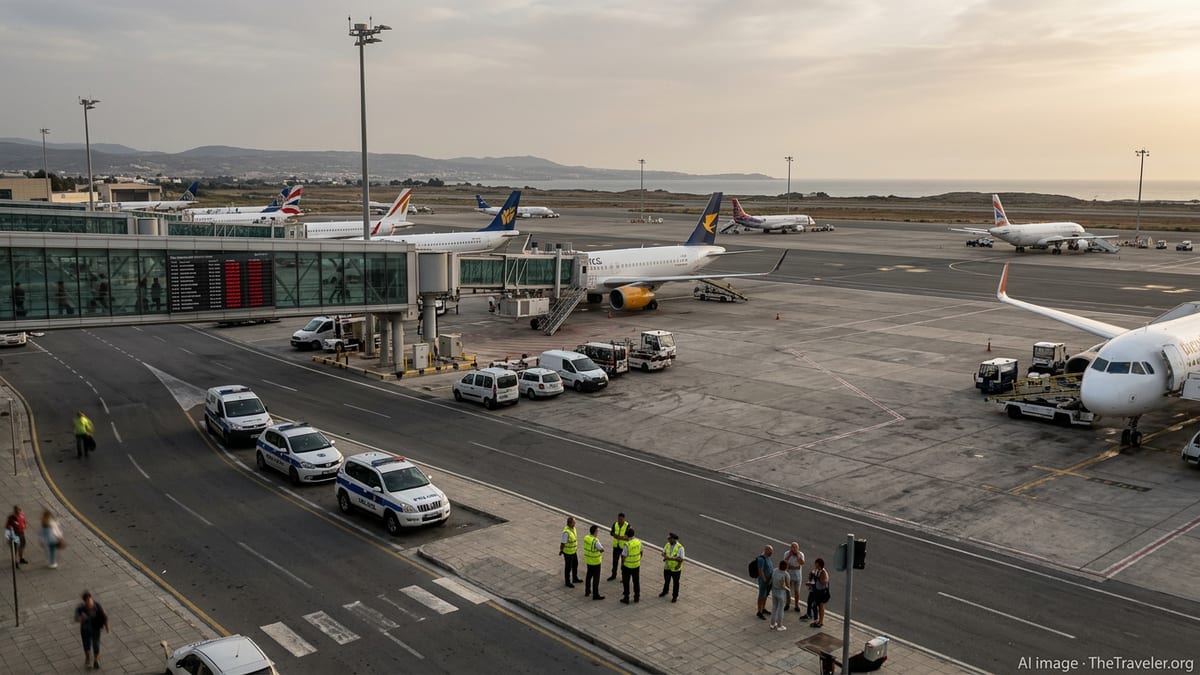
The immediate fallout for travelers has been disruption at Cyprus’s two main gateways, Larnaca International Airport and Paphos International Airport. In the days following the Akrotiri drone strike and the closure of parts of Middle Eastern airspace, dozens of flights were cancelled or rerouted as airlines reassessed risk and navigational options.
According to airport and aviation data, Larnaca alone saw nearly 40 flights grounded on one of the worst-affected days, with a roughly equal split between arrivals and departures. Services to and from regional hubs such as Tel Aviv, Beirut, Dubai, Doha and Amman have been hit hardest, creating knock-on delays for long-haul passengers connecting via the Gulf and Levant.
European links have also wobbled. Several carriers briefly suspended or reduced frequencies on UK–Cyprus routes and other European services as a precaution while military activity and airspace closures were assessed. Budget airline easyJet temporarily halted some flights to Larnaca and Paphos before resuming operations on a reduced schedule, while Lufthansa Group airlines and Emirates have only just restarted key routes after short suspensions.
The result for passengers is a climate of uncertainty in which flight schedules can change within hours. Travel agents and airport operators are urging visitors to check departure information repeatedly in the days before travel and to allow extra time for security checks and potential re-screening of luggage.
Cancellations Mount as Travelers React to Security Warnings
Beyond the immediate flight chaos, the conflict is starting to show up in booking patterns for spring and early summer holidays. Cyprus’s deputy tourism minister has acknowledged a noticeable slowdown in new reservations since the US-Israel strikes on Iran and the Akrotiri incident, describing a dip in momentum at the very moment when the island usually enters its peak booking window.
Local accommodation providers report an abrupt spike in cancellations, particularly from European travelers who had been planning short breaks in March and April. One short-term rental operator with properties across Limassol, Larnaca and mountain villages said that more than 50 nights were cancelled in a matter of days by guests who could have waited longer and still qualified for refunds, suggesting decisions driven by emotion and fast-moving headlines rather than on-the-ground conditions.
The shock has been amplified by new travel advisories. On 3 March, the United States Department of State raised its warning for Cyprus to Level 3, urging citizens to reconsider travel due to the threat of armed conflict. While no European Union country has imposed formal restrictions on visiting Cyprus, some foreign ministries have updated guidance to highlight the proximity of military operations and advise extra vigilance.
Tourism officials worry that even a short period at the center of global security alerts could dent consumer confidence heading into the vital May to October season. Cyprus welcomed a record 4.5 million visitors in 2025, and any sustained downturn would be acutely felt in a country where tourism accounts for around 14 percent of gross domestic product.
Industry Braces for Economic Pain but Hopes for Summer Rebound
Hoteliers, restaurateurs and tour operators across the island are now revising their forecasts for 2026. Industry associations say it is too early to quantify the full extent of the damage, but they warn that if the Iran conflict drags on and media coverage continues to show missiles and drones over the Eastern Mediterranean, Cyprus could lose a critical share of early-season visitors.
Analysts at Tourism Economics estimate that the war could reduce tourist arrivals across the broader Middle East region by 11 to 27 percent this year, with potential revenue losses of up to tens of billions of dollars. Cyprus is not counted among the active conflict states, but as the nearest European Union member to the fighting and a key air bridge between Europe and the Levant, it is particularly exposed to shifts in traveler sentiment and airline capacity.
At the same time, there are cautious signs that the initial shock may not turn into a full-scale collapse. By Monday, air links between Cyprus and major European markets were largely restored, with more than 130 flights scheduled across Larnaca and Paphos as airlines reinstated previously suspended services. Airport operator Hermes reported the return of Lufthansa, Austrian Airlines, Edelweiss Air, Eurowings and Emirates, helping to stabilize connectivity.
Tourism leaders are betting that if no further attacks occur on Cypriot soil and if regional airspace restrictions ease, many holidaymakers will ultimately decide to travel as planned, particularly those from Northern Europe seeking guaranteed sunshine and relatively affordable packages.
Heightened Security and Communication Drive to Reassure Visitors
In response to the unsettled mood, Cypriot authorities have moved to visibly strengthen security while also stressing that everyday life on the island remains peaceful. Additional patrols have been deployed around airports, ports and tourist hotspots, while coordination has been stepped up between civilian aviation authorities, the military and international partners monitoring regional skies.
Officials are also overhauling communication efforts to address a flood of queries from tour operators, conference organizers and individual travelers. The tourism ministry and airport operator are issuing more frequent bulletins on flight status and safety measures, and local travel agents have been briefing clients that the drone strike was directed at a military installation rather than civilian areas or resort towns.
Travel professionals say clear and consistent messaging will be crucial in the coming weeks. Many visitors are less concerned with abstract geopolitical risks than with practical questions such as whether their flights will operate, whether beaches and historic sites are open and whether insurance covers disruption linked to the conflict. The more reliably those questions are answered, the more likely it is that nervous would-be tourists will stay the course.
For now, Cyprus finds itself walking a tightrope between its role as a strategic outpost in a new Middle East conflict and its identity as a carefree island escape. How quickly airlines, governments and travelers regain confidence will determine whether the current shock becomes a brief interruption or a deeper setback for one of the Mediterranean’s most tourism-dependent economies.