

More news on this day
CzechTourism is sharpening its focus on India with a series of trade roadshows, workshops and B2B engagements designed to strengthen Indo-Czech ties and position Czechia as a multi-city European destination for Indian travellers.
Get the latest news straight to your inbox!
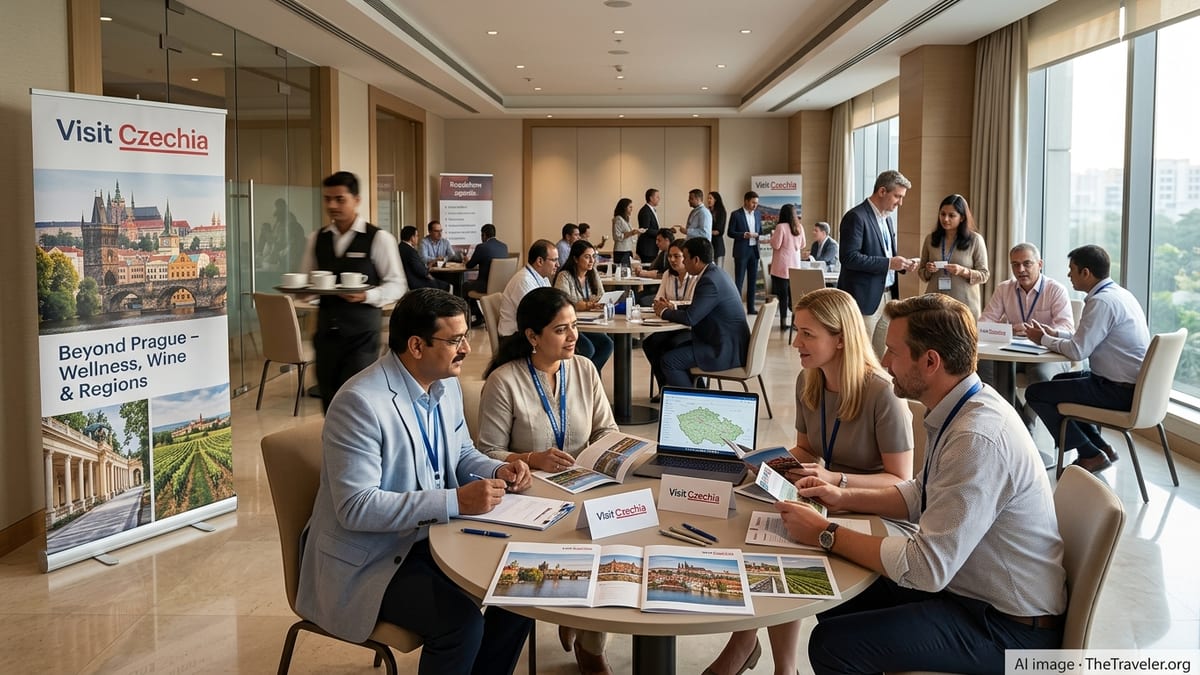
Roadshows and Workshops Target India’s High-Growth Outbound Market
Recent coverage of CzechTourism activity indicates that the national tourism board has adopted a sustained, trade-led approach in India, combining multi-city roadshows with themed workshops and destination briefings. A three-city roadshow across New Delhi, Mumbai and Bengaluru highlighted Czechia’s cultural depth, wellness offerings and regional experiences, while giving Indian agents direct access to hotels, destination management companies and regional tourism bodies.
Trade reports show that these initiatives are framed around India’s rapid outbound growth and rising preference for experiential European travel. Industry data referenced by Czech authorities projects India’s outbound spending to more than double over the coming decade, prompting destination boards to compete for early brand recognition and stronger distribution through local partners.
CzechTourism’s India-facing efforts are also structured to move beyond a one-off calendar of events. Fact sheets on the organisation’s global marketing activity note that B2B roadshows across Asia, including India, have been integrated into its annual trade strategy, combining in-person events with year-round training and cooperative marketing with key tour operators.
Observers in the trade interpret this as a pivot from purely consumer advertising to deeper channel development, with India treated as a long-term strategic market rather than a niche source of seasonal arrivals.
B2B Networking at the Core of Indo-Czech Tourism Push
At the heart of the recent outreach is structured B2B networking, where Indian travel agents, tour operators and MICE planners meet Czech suppliers in pre-scheduled sessions. Reports from New Delhi and Bengaluru describe formats that mix destination presentations with one-on-one meetings, giving Indian buyers an opportunity to compare products, negotiate group series and discuss tailored itineraries for higher-spend clients.
Coverage of a “Visit Czechia” roadshow in New Delhi noted that wellness tourism, visa facilitation and diversification beyond Prague were key talking points, with Czech regions positioning themselves for spa, nature and soft-adventure itineraries. For Indian agents, these sessions offer product differentiation in an increasingly crowded European portfolio, especially for repeat travellers who have already experienced the continent’s traditional circuits.
Trade-focused documents outlining VFS Global’s work for CzechTourism in Asia also underline the importance of B2B and B2C integration. Multi-city roadshows in India are paired with targeted consumer campaigns and joint promotions with select agents, aiming to convert trade training into actual bookings while keeping the sales narrative consistent across channels.
Destination observers note that such B2B networking is particularly relevant for India’s fragmented distribution landscape, where thousands of mid-sized agencies still rely on in-person relationship-building and direct contracting to shape their outbound offerings.
Agent Engagement Aims to Push Beyond Prague
While Prague continues to be the primary draw for Indian visitors, CzechTourism’s India outreach is repeatedly described as an effort to “go beyond the capital.” Recent travel industry reports highlight growing Indian interest in regional destinations such as South Moravia, Brno and Český Krumlov, particularly among repeat travellers and niche segments like wine tourism, film-inspired travel and heritage circuits.
Destination presentations during the India roadshows have reportedly focused on storytelling around local gastronomy, spa traditions, castles and wine routes, rather than on generic city-break messaging. By equipping agents with detailed information on regional attractions, rail connectivity and multi-country combinations in Central Europe, CzechTourism seeks to encourage longer stays and higher per-trip spending.
Supporting data from the tourism board’s South Asia office points to a double-digit rise in Indian hotel overnights in 2025, with repeat visitors increasingly selecting second or third destinations within Czechia. This shift aligns with broader efforts within the country to disperse visitor flows, reduce pressure on heavily visited urban centres and promote lesser-known towns and countryside regions.
Indian agents, in turn, gain the ability to curate itineraries that stand out from standard Europe tours, whether by adding winery visits in South Moravia for incentive groups or combining Prague with medieval towns for family and small-group travel.
Visa Access and Connectivity Framed as Enablers
A key backdrop to the tourism outreach in India is the gradual easing of access and connectivity between the two countries. Trade coverage in early 2026 highlighted official hotel data showing more than 100,000 Indian hotel guests in Czechia in 2025, with arrivals up by over 12 percent year-on-year. The same reports pointed to improved visa processing as an important factor in sustaining that growth.
One of the recurring announcements tied to recent roadshows has been the reopening of the Czech consular presence in Mumbai. Public information indicates that a full-service consulate and visa section is being reinstated to relieve pressure on the New Delhi mission, shorten processing times and make applications more convenient for travellers and agents based in western and southern India.
Earlier coverage of a three-city India roadshow also mentioned ongoing efforts to secure direct air links between India and Czechia. While connections today generally route via major European hubs, stakeholders on both sides continue to highlight the benefits that a non-stop service would bring to tourism, student mobility and business travel.
For Indian intermediaries, clearer visa pathways and the prospect of better connectivity reduce perceived risk when pitching Czechia to first-time Europe travellers, making it easier to package the destination for families, corporate groups and weddings.
Tourism Outreach as a Pillar of Indo-Czech Relations
The current tourism push builds on a longer history of Indo-Czech engagement that spans political, economic and cultural cooperation. Bilateral briefs from both governments describe tourism and people-to-people contact as an important dimension of the relationship, alongside trade, defence and technology ties.
India already features among the notable non-European source markets for Czechia, while India’s own tourism statistics list the Czech Republic as an increasingly popular European choice for outbound Indian travellers. Both sides also benefit from reciprocal flows, with Czech visitors making use of India’s e-visa regime for leisure and business travel.
By foregrounding tourism in its India strategy, CzechTourism effectively acts as a soft-power bridge between the two countries. Joint cultural events, film shoots on location, participation in Indian travel fairs and collaborative campaigns with airlines all contribute to a higher profile for Czechia among Indian consumers.
Industry analysts note that sustained B2B networking and agent engagement of the type now visible in India can translate into tangible gains for Indo-Czech relations, from increased student exchanges and bilateral business visits to new partnerships in hospitality and aviation. As Indian outbound travel accelerates, Czechia’s early, trade-centric positioning in the market is likely to play a significant role in shaping the next phase of ties between the two nations.