

More news on this day
From historic spa colonnades to forested mountain trails, Czechia is rapidly repositioning itself as a year-round escape for Gulf travellers seeking cooler climates, medical-grade wellness and crowd-free European culture.
Gulf Travel Demand Pushes Czechia Into the Spotlight
Czechia is drawing growing interest from travellers across the Gulf as tourism boards, airlines and regional partners eye demand for short to medium-haul escapes that combine wellness, nature and heritage. With Schengen access, competitive prices and moderate summer temperatures compared with southern Europe, the country is emerging as an attractive alternative for GCC residents used to defaulting to the Alps or traditional Western European hubs.
Industry observers say the appeal rests on a mix of practical and emotional factors. For many Gulf travellers, Czechia offers a perception of safety, compact distances between cities, and the reassurance of established medical and spa infrastructure dating back more than a century. At the same time, its relatively under-the-radar profile means visitors can still find uncrowded town squares, quiet hiking paths and spa promenades that feel distinctly European yet not overdeveloped.
Tourism officials have been steadily intensifying their outreach in Gulf markets, presenting Czechia’s historic spa triangle, mountain regions and city breaks as a cohesive portfolio rather than isolated destinations. Wellness, summer cooling breaks and multi-generational family travel are central themes of these campaigns, reflecting the shifting priorities of GCC travellers in search of healthier, slower-paced holidays.
UNESCO Spa Towns Turn Wellness Into a Year-Round Anchor
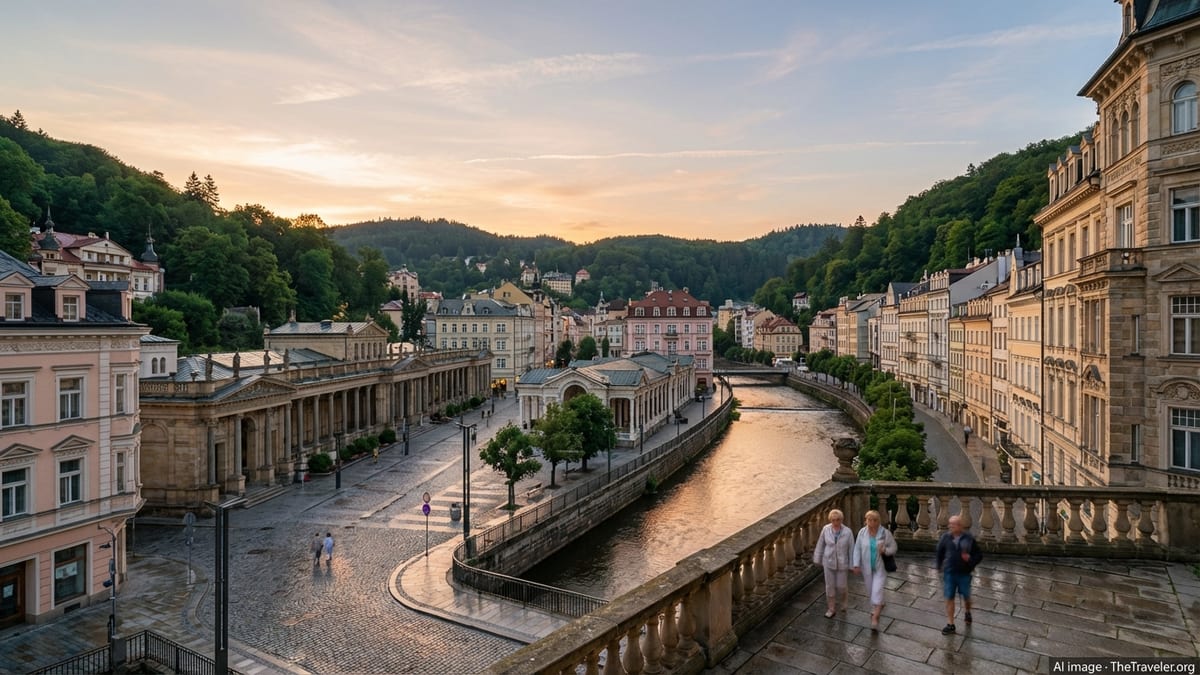
At the heart of Czechia’s pitch to the Gulf is its West Bohemian spa triangle, where Karlovy Vary, Mariánské Lázně and Františkovy Lázně form a cluster of ornate 19th-century resorts built around mineral-rich springs. The trio, together with other European spa centres, was added to the UNESCO World Heritage List in 2021 as part of the Great Spa Towns of Europe, underscoring their historical and architectural significance and giving the region a powerful new marketing asset.
For GCC travellers, these spa towns offer a style of wellness that differs sharply from beach resorts and mall-centric city breaks. Grand colonnades, pastel-hued villas and manicured parks set the stage for tailored programmes that range from classic balneology and weight management to musculoskeletal rehabilitation and respiratory therapies. Many properties operate year-round, allowing visitors to experience steaming outdoor pools in winter, fresh green parks in spring and golden forests in autumn.
Karlovy Vary, the largest and best known of the trio, combines traditional spa culture with a cosmopolitan feel, while Mariánské Lázně is surrounded by forested hills and landscaped gardens that appeal to walkers and trail runners. Smaller Františkovy Lázně, with its preserved historic core and intimate scale, targets guests looking for quiet, medically supervised stays. The three together provide a spectrum of experiences that Gulf agents can package for clients seeking everything from post-surgery recuperation to preventative health retreats.
Prague and Beyond: Culture, History and Cooler Summers
While Prague remains Czechia’s main gateway and most recognisable city for travellers from the Gulf, regional authorities are working to ensure it is seen as a starting point rather than the entire story. The capital’s Gothic spires, bridges and Baroque façades continue to attract first-time visitors, but newer itineraries layer in day trips to castles, medieval towns and wine regions to extend average length of stay.
Summer heatwaves across parts of southern Europe are also nudging GCC travellers toward cooler alternatives in Central Europe. Prague’s summer temperatures are typically more moderate than those in Mediterranean destinations, and its compact centre encourages walking tours, river cruises and open-air cultural events that remain comfortable well into the evening. For families travelling with children or older relatives, the combination of public parks, river islands and easy public transport adds everyday convenience.
Beyond the capital, regional hubs such as Brno in Moravia are promoting their own cultural calendars, café quarters and nearby wine country to Gulf visitors willing to venture off the main trail. Historic towns like Český Krumlov, with its castle complex and riverside setting, are appearing with greater frequency on GCC-focused itineraries as travellers become more confident in driving or joining organised circuits through the countryside.
Mountain Air and Soft Adventure for the GCC Outdoors Market
Czechia’s pitch to the Gulf is not limited to spa treatments and city breaks. Mountain regions such as the Krkonoše range on the Polish border, the Jeseníky mountains in the northeast and the Šumava National Park along the Bavarian frontier are being positioned as accessible soft-adventure playgrounds for families and younger travellers. Here, the focus is on hiking, cycling, easy summit walks and nature stays in traditional mountain chalets.
Tourism authorities emphasise that these activities are designed to be approachable rather than extreme, aligning with growing GCC interest in wellness-oriented outdoor experiences over high-risk sports. Signposted trails, family-friendly cable cars and guided excursions help first-time visitors ease into alpine landscapes without technical skills. In winter, smaller ski resorts and snow parks offer an alternative to the busier slopes of Austria and Switzerland, often at lower price points.
For Gulf travellers who have already experienced European cities and beaches, this combination of clean mountain air, moderate physical activity and proximity to spa facilities is particularly appealing. A number of operators now promote split stays that pair a few days in Prague with extended time in a spa town or mountain village, allowing visitors to experience both cultural immersion and active recovery within a single trip.
Medical Tourism and Halal-Friendly Services Gain Traction
Medical and wellness tourism from the Gulf has a long history, and Czechia is increasingly entering consideration alongside traditional destinations in Western Europe and Asia. Its spa heritage provides a foundation for medical rehabilitation, particularly in areas such as orthopaedics, cardiology and post-operative recovery, while private clinics in Prague and other cities offer cosmetic and elective procedures that can be combined with longer recuperative stays.
To better serve GCC guests, hotels and clinics are gradually expanding halal-friendly and family-oriented services. This includes arranging halal or no-pork menus, providing private or gender-segregated wellness slots in some facilities, and offering Arabic-speaking staff or translation services where possible. In spa towns, treatment plans can often be adapted to accommodate religious practices and privacy expectations, especially for female travellers.
Travel consultants in the Gulf note that multi-generational trips, where older relatives undergo treatment while younger family members explore the surrounding area, are an increasingly common pattern. Here, Czechia’s compact geography is an asset: within a short drive of a spa town, families can access castles, wildlife parks, museums and shopping areas, allowing medical stays to double as broader family holidays.
Improved Connectivity Strengthens Ties With the Gulf
Air connectivity remains central to Czechia’s campaign to attract more visitors from the Gulf. Prague’s role within the European network of major carriers allows GCC travellers to reach Czechia via established hubs such as Doha, Dubai and other regional gateways. Airlines in the Gulf continue to expand their networks across Europe, increasing frequencies to major cities and enabling smoother one-stop links for passengers connecting onward to Prague and regional Czech airports.
Regional airline expansions in Saudi Arabia and broader capacity growth at Gulf hubs are expected to further ease travel to Central Europe in the coming years. As more cities in the Kingdom and neighbouring states gain direct links to large transfer hubs, itineraries that once required complex connections are gradually being simplified, benefiting destinations like Czechia that rely on efficient long-haul feed.
Travel industry executives say that schedule reliability, through-checked baggage and coordinated arrival times into Prague are increasingly important to GCC families travelling with children or elderly relatives. Partnerships between Gulf carriers and European airlines, along with growing awareness of Czechia among regional travel agents, are helping to translate improved connectivity into concrete bookings.
Seasonal Experiences: From Snow-Covered Colonnades to Autumn Forests
One of Czechia’s main selling points to GCC travellers is its genuine four-season appeal. In winter, spa towns and historic city centres take on a different character as colonnades and church spires are dusted with snow and outdoor pools steam against frosty air. This period lends itself to cosy, restorative stays focused on thermal baths, treatments and short walks, with some visitors combining visits with nearby ski slopes and winter markets.
Spring and autumn, meanwhile, are increasingly promoted as ideal shoulder seasons for Gulf visitors who prefer mild weather and quieter streets. Blossoming parks, riverside promenades and forest trails lend themselves to photography and leisurely exploration, while autumn in particular offers colourful foliage in the country’s numerous protected landscapes. Tour operators highlight these periods as opportunities to secure attractive hotel rates and more personalised service.
Summer remains a key period for GCC travel, especially among families escaping intense regional heat. Czechia’s lakes, outdoor pools and forest parks, combined with evening cultural programmes and food festivals, are positioned as a cooler alternative to more crowded Mediterranean coasts. For repeat visitors, cycling routes, river rafting and countryside guesthouses add variety beyond the main city and spa circuits.
Strategic Positioning Targets Long-Term Gulf Growth
As regional competition for GCC tourists intensifies, Czechia’s tourism authorities are looking beyond one-off campaigns to long-term positioning. Industry analysts point to the country’s blend of medical-grade spa heritage, compact cities and accessible nature as a differentiator that is difficult for newer resort destinations to replicate. Investments in preserving historic townscapes and upgrading spa infrastructure are intended to ensure that growth in visitor numbers does not come at the expense of authenticity.
Collaboration with Gulf-based travel agents and tour operators remains a key part of this strategy. Tailor-made itineraries that address the specific needs of GCC families, solo travellers and wellness seekers are becoming more common, often combining Prague with at least one spa or mountain stay. As word-of-mouth builds within the region, Czechia’s under-the-radar image is gradually giving way to a reputation as a reliable, repeatable year-round choice.
With visa facilitation, airline connectivity and on-the-ground services all evolving, tourism officials expect the Gulf to account for a growing share of international arrivals in the medium term. For GCC residents weighing their next European break, Czechia is increasingly positioning itself not as a one-time curiosity, but as a destination to return to in different seasons and life stages, from first city break to family spa retreat.