

More news on this day
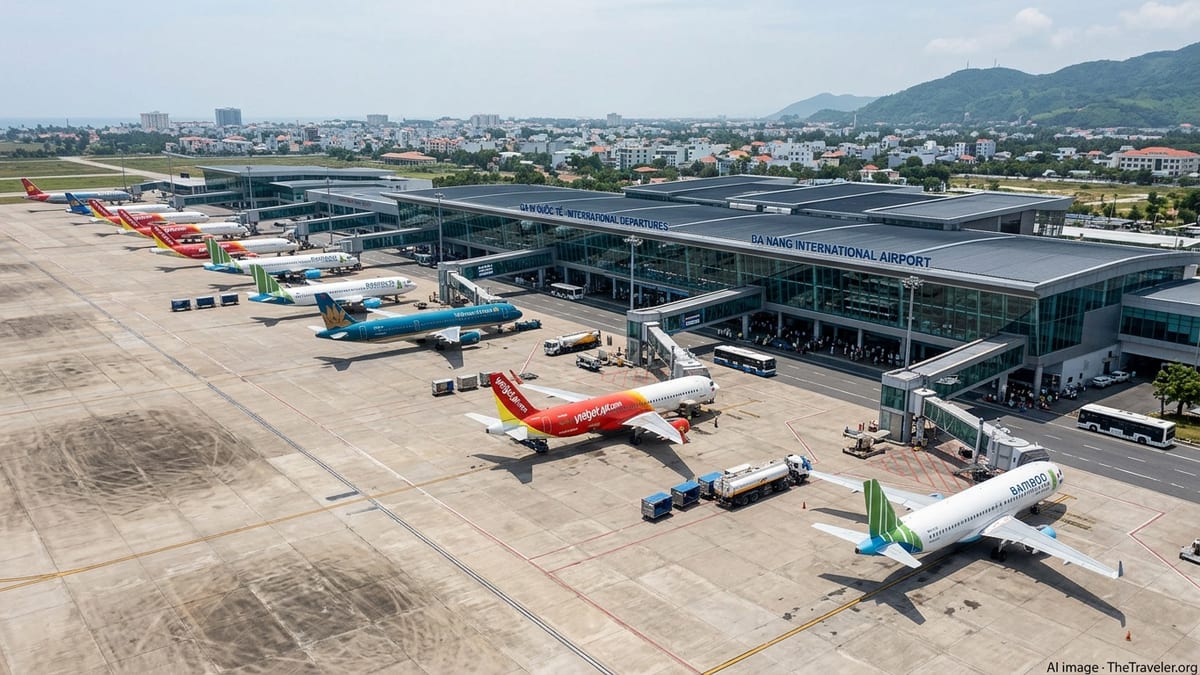
Da Nang International Airport, gateway to Vietnam’s central coast, is straining under a fast-rising wave of passengers, forcing planners to accelerate expansion plans even as aircraft and travelers jostle for space at one of the country’s most important tourism hubs.
Get the latest news straight to your inbox!
Tourism Boom Pushes Da Nang Beyond Its Design Limits
Da Nang has transformed from a laid-back coastal city into one of Vietnam’s busiest tourism and investment magnets, and its airport is feeling the strain. The facility was originally planned to handle around 11 to 12 million passengers a year, but recent travel demand, particularly on domestic leisure routes and inbound international tourism, has pushed operations close to that threshold in peak seasons.
Published coverage on Vietnam’s aviation sector shows that in 2025, more than 48,000 domestic and international flights operated through Da Nang International Airport and nearby Chu Lai, with passenger numbers climbing in tandem. International arrivals at Da Nang’s dedicated terminal surpassed 3.3 million, while domestic passengers exceeded 4.5 million, underscoring the central region’s growing pull for both regional and long-haul travelers.
This rapid growth is compounded by Da Nang’s recent administrative merger, which expanded its geographic footprint and economic ambitions. Master plans now frame the city as an anchor for the central coastal corridor and the East–West Economic Corridor, roles that depend heavily on efficient air connectivity. As a result, congestion at the airport has become a symbol of both the city’s success and its growing pains.
Travelers report that while Da Nang still feels smaller and more manageable than the country’s largest hubs, crowding is increasingly visible in check-in halls, security lanes, and aircraft parking areas during national holidays and peak tourism months. Airport operators are being pushed to find short term fixes even as they lay out longer term structural upgrades.
Master Plan Targets 20 Million Passengers by 2030
To tackle the looming capacity crunch, Vietnam’s Ministry of Construction recently approved a new master plan for Da Nang International Airport running through 2030 with a vision to 2050. Publicly available information indicates that the plan aims to double the airport’s overall capacity to about 20 million passengers per year, up from a current design capacity in the low teens.
Under this roadmap, the domestic Terminal T1 will be expanded to accommodate roughly 14 million passengers annually, reflecting the strong role of Da Nang as a holiday and business destination for travelers from Hanoi, Ho Chi Minh City, and secondary cities. The international Terminal T2 is slated to be upgraded to a capacity of about 6 million passengers per year, creating room for more direct links from North Asia, Southeast Asia, and potentially further afield.
The master plan also calls for expanding aircraft parking areas to around 52 stands, a critical step to reduce bottlenecks at peak times when multiple narrowbody jets arrive and depart in tight waves. This will allow more flexibility in scheduling and reduce on-ground delays that can ripple through Vietnam’s domestic network.
By setting targets to 2050, planners are signaling that Da Nang is expected to remain a strategic gateway for central Vietnam’s tourism, logistics, and tech industries. However, the timeline also highlights a tension between long term vision and the immediate pressure travelers are experiencing today.
Runway Rehab and Terminal Projects Race Against Demand
Infrastructure reports indicate that Da Nang International Airport is not only adding capacity but also facing essential maintenance challenges. One of the two main runways, designated 35L/17R, has been flagged as structurally degraded, prompting a proposal for total reconstruction alongside terminal expansion and system upgrades.
At the same time, separate projects are moving forward to enlarge both passenger terminals. An earlier plan set out the expansion of the domestic T1 terminal, raising its capacity to approximately 10 million passengers per year and bringing the combined capacity of T1 and T2 to around 14 million. Newer planning documents build on that concept with the more ambitious 20 million passenger target, suggesting that initial upgrades may quickly be outpaced by real-world demand.
The international T2 terminal, which opened less than a decade and a half ago, is already slated for expansion of its own. A local terminal operator has proposed a project that would raise T2’s capacity from about 4 million passengers to 6 million annually, with construction projected to start in 2025 and wrap up by late 2026. That work is expected to run in parallel with broader airport-wide improvements outlined in the national planning framework.
The overlap of essential runway rehabilitation, terminal enlargement, and apron expansion creates a complex construction environment. Planners must sequence works to keep Da Nang operating as a fully functional gateway while minimizing disruption, a balancing act that has challenged other Vietnamese airports undergoing upgrades in recent years.
Overcrowding Highlights Wider Strain on Vietnam’s Airport Network
The pressures now visible in Da Nang are part of a wider pattern confronting Vietnam’s airport network. Major hubs such as Ho Chi Minh City’s Tan Son Nhat and Hanoi’s Noi Bai have also struggled with crowding as tourism and domestic air travel surged after pandemic restrictions were lifted. Government documents and analyst reports point to ongoing terminal expansions and new airport projects designed to spread traffic more evenly across the country.
Airports Corporation of Vietnam, the state-linked operator managing most civilian airports, is simultaneously investing in mega projects such as Long Thanh International Airport near Ho Chi Minh City and the new T3 terminal at Tan Son Nhat, as well as runway and terminal works at provincial airports. This concentration of capital spending underscores both the urgency and the scale of Vietnam’s aviation upgrade cycle.
For Da Nang, these national dynamics cut both ways. On one hand, the city stands to benefit from experience gained on projects elsewhere in Vietnam, potentially speeding up approval, design, and construction processes. On the other, Da Nang is competing for funding, contractors, and regulatory attention in a crowded pipeline of aviation infrastructure works.
Observers of Vietnam’s transport planning note that if Da Nang’s expansion schedule slips, the airport could face years of operating above comfortable capacity, particularly during holidays such as Lunar New Year when thousands of additional flights are scheduled. That scenario would test traveler patience and could limit the city’s ability to capture higher-value tourism and business events.
Balancing Growth, Passenger Experience, and City Ambitions
For travelers, the stakes are immediate: longer queues, tighter gate space, and busier arrival halls that can undercut the region’s reputation as a relaxed beach destination. For city leaders, the airport’s constraints are intertwined with broader ambitions to attract foreign investment, host regional conferences, and position Da Nang as a high-tech and logistics hub for central Vietnam.
Local planning documents and investment promotion materials describe Da Nang’s intention to leverage the airport as a linchpin for logistics centers, cargo terminals, and tourism corridors stretching into neighboring provinces and across the border into Laos and Thailand. A new cargo terminal project already under way at the airport is intended to support that role and reduce reliance on facilities in the country’s largest cities.
Yet as millions more passengers pass through Da Nang, expectations around service quality, punctuality, and comfort are rising. Vietnam’s expansion plans will need to keep pace not only with raw numbers but also with the evolving standards of international travelers and airlines choosing where to deploy capacity.
Whether Da Nang can avoid the gridlock that has plagued some of the country’s older airports will depend on how quickly today’s blueprints translate into working gates, refurbished runways, and smoother journeys for the tourists and residents who increasingly see the city as their preferred entry point to Vietnam’s central coast.