

More news on this day
Qatar Airways is maintaining a crucial daily air bridge between Tehran and Doha even as wider operations to Iran remain constrained, preserving a key one-stop global travel corridor for business and leisure passengers across Europe, Asia, Africa and the Americas.
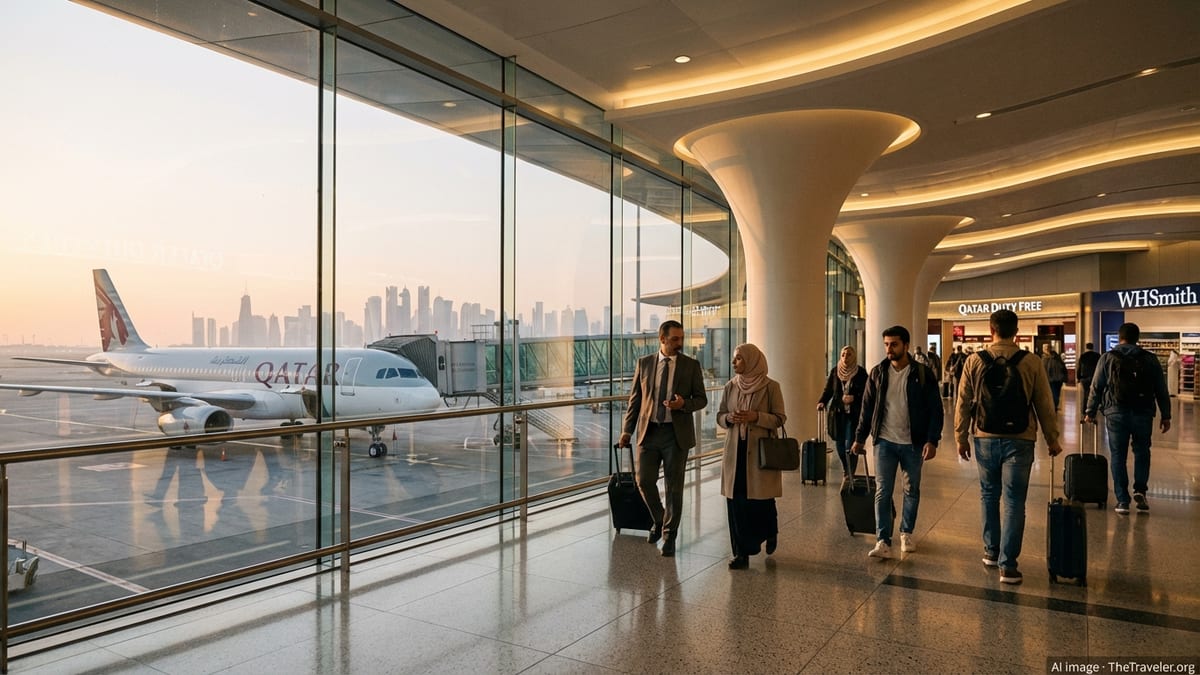
Reduced Iran Schedule, But Daily Tehran Link Holds
Qatar Airways has extended temporary cancellations on most of its Iran routes until mid-2026, but a restricted daily service between Tehran’s Imam Khomeini International Airport and Doha is continuing to operate. According to a recent trade advisory, one flight in each direction is scheduled every day through at least June 30, 2026, effectively keeping the corridor open while wider regional conditions remain under review.
The decision underscores the route’s importance for travelers who depend on Qatar’s hub for onward long-haul connectivity, even as overall capacity into Iran is significantly lower than it was before the latest round of security-related disruptions. Travel agents report that seats on the Tehran–Doha sectors are booking up quickly around key business dates, religious holidays and summer peak periods, reflecting strong underlying demand despite a leaner schedule.
Industry observers note that the airline has historically treated Tehran as a strategic gateway in its wider Middle East network. Data from flight-tracking services indicates that, while frequencies and aircraft types have fluctuated over the past two years, non-stop services between the two capitals have resumed a stable pattern, with timings designed around Doha’s main connection banks.
For Iranian passengers, the continuation of this single daily service represents a critical alternative to longer multi-stop itineraries through regional competitors, particularly for journeys to secondary cities in Europe and emerging markets in Africa and Southeast Asia.
Hamad International Airport Strengthens Its Super-Connector Role
The resilience of the Tehran–Doha corridor is closely tied to the rising profile of Hamad International Airport as one of the world’s leading transfer hubs. Recent industry analysis shows that around three-quarters of passengers using Doha are connecting onwards, giving Qatar’s capital one of the highest shares of transfer traffic globally among so-called super-connector airports.
Qatar Airways supplies the vast majority of capacity at Hamad International, allowing tight coordination of schedules and sharply optimized connection windows. The Tehran arrival and departure times are planned to plug directly into several of Doha’s key long-haul banks, minimizing layovers while still meeting operational and security constraints on flights to and from Iran.
Airport infrastructure development has further reinforced Doha’s role. A multi-phase expansion, including new concourse capacity and upgraded transfer facilities, has been opened in recent years to smooth passenger flows and reduce minimum connection times. For travelers originating in Tehran, that translates into relatively short and predictable transits even during peak hours.
With additional partner airlines joining Qatar Airways at Hamad International and more interline and codeshare agreements coming online, passengers on the Tehran–Doha leg can now tap into a broader list of onward options. This is particularly evident on routes to China, Southeast Asia and the Indian subcontinent, where joint schedules with partner carriers have created denser, more flexible connection patterns.
Business Travelers Prioritize Reliability and Network Reach
For corporate passengers in Tehran, the daily Doha service is functioning as a lifeline into global markets. Banking and energy executives, technology consultants and traders interviewed by regional media describe Qatar Airways as one of the few carriers still able to offer predictable one-stop journeys to key financial centers such as London, Frankfurt, Singapore and New York.
While the limited number of frequencies has reduced same-day return options on some city pairs, business travelers say the trade-off is acceptable in exchange for access to a large and reliable global network. Many are adjusting meeting schedules to align with the remaining overnight and early-morning departures from Tehran, taking advantage of early arrivals in Europe and evening connections to Asia.
Travel management companies report that interest is particularly strong among small and medium-sized enterprises that depend on frequent regional trips but lack the resources to charter or reroute via more complex multi-stop itineraries. The daily Tehran–Doha flights also remain popular among professionals commuting on rotational contracts in the Gulf energy sector, who rely on consistent weekend and crew-change patterns.
Qatar Airways’ reputation for stable operations, coupled with Hamad International’s relatively efficient transfer processes, has also become a selling point in corporate travel policies. In markets where risk assessments now heavily factor airspace restrictions and operational volatility, the continuity of the Tehran–Doha corridor is being viewed as a relative advantage.
Leisure Demand Returns as One-Stop Holidays Remain Viable
Alongside business traffic, leisure and visiting-friends-and-relatives travelers are increasingly returning to the Tehran–Doha route. Agents in Tehran note a steady pickup in bookings for one-stop holidays to destinations such as Istanbul, Phuket, Bali, Zanzibar and coastal East Africa, all of which are served within a single connection via Doha.
Families and younger independent travelers are using Doha as a staging point for multi-destination trips, combining short Gulf stopovers with onward itineraries to Europe or Southeast Asia. Hamad International’s retail, dining and lounge offerings, expanded during the lead-up to the 2022 FIFA World Cup and continually upgraded since, are being marketed as part of the journey, particularly to passengers facing slightly longer layovers.
Pilgrimage and religious tourism also play a role in sustaining the corridor. Seasonal peaks tied to major Islamic observances create surges in demand toward destinations in Saudi Arabia and Iraq, with Doha serving as a critical redistribution hub for traffic originating in Iran’s capital.
Although fare levels on the Tehran–Doha leg have risen compared to pre-disruption norms, tour operators say that packaged deals leveraging competitive long-haul pricing from Doha still offer acceptable value for many households. Flexible rebooking policies introduced in recent years by Qatar Airways are also encouraging leisure travelers to commit earlier to complex itineraries.
Strategic Outlook: A Narrow but Vital Corridor
Aviation analysts view Qatar Airways’ decision to keep at least one daily Tehran–Doha rotation in place as a calculated strategic move. Even at reduced capacity, the service preserves market presence in Iran while ensuring that high-yield connecting flows can still be funneled into the carrier’s global network.
From a competitive standpoint, maintaining the corridor helps Qatar Airways defend its position against other regional hubs looking to attract Iranian travelers. It also preserves flexibility for a future ramp-up in frequencies should operational conditions improve or demand rise further.
For passengers, the daily service remains both a practical travel option and a barometer of broader regional connectivity. As long as the Tehran–Doha air bridge continues to function, business and leisure flyers in Iran’s capital retain access to a dense web of destinations across multiple continents with a single plane change.
While the broader picture for Iran’s international aviation links remains fluid, the continued operation of this narrow but vital corridor suggests that Tehran will remain part of Qatar Airways’ long-term vision for its interconnected, hub-and-spoke global network.