

More news on this day
A new wave of flight cancellations centered on Dallas-Fort Worth International Airport is disrupting travel across the United States and key long-haul routes, as severe weather, staffing strains and an already stretched aviation system converge at one of the country’s busiest hubs.
Get the latest news straight to your inbox!
Storm Systems and Shutdown Pressures Converge on a Major Hub
Recent storm systems sweeping across the Midwest and East Coast in mid-March 2026 have compounded pressure on an airline network still adjusting to a partial U.S. government shutdown. Publicly available tracking data for March 16 and March 17 indicate thousands of cancellations and delays nationwide, with Dallas-Fort Worth (DFW) repeatedly appearing among the top U.S. airports for disrupted operations.
DFW’s vulnerability is magnified by its role as a primary hub for American Airlines and a key connector for domestic and international itineraries. When snow, ice or severe thunderstorms slow operations at other major airports, aircraft and crews arriving into DFW often run late or fail to arrive at all. Reports indicate that this has triggered rolling cancellations on routes that depend on tight aircraft and crew rotations through North Texas.
The timing is especially difficult, as the March travel period overlaps with spring break and large sports events, including college basketball tournaments, which have filled flights and left fewer empty seats for stranded passengers seeking rebooked itineraries.
Conditions at security checkpoints have also been strained. Coverage from national outlets highlights how reduced screening capacity during the partial government shutdown has lengthened lines at some airports. At a hub as busy as DFW, even modest slowdowns at checkpoints can ripple into late departures and missed connections throughout the day.
From Domestic Gridlock to Global Disruptions
The cancellations at DFW extend well beyond Texas-bound travelers. As a central connecting point in American Airlines’ global network, the airport handles high volumes of traffic linking smaller U.S. cities to major coastal gateways and overseas destinations. When operations seize up in Dallas-Fort Worth, those connections can unravel quickly.
In recent weeks, travelers using public forums and social platforms have described repeated cancellations on long-haul services from DFW, including trans-Pacific and trans-Atlantic routes. Accounts of multiple consecutive days of cancellations on select international flights out of Dallas-Fort Worth underscore how sustained disruptions at a single hub can strand passengers far from their intended destinations and limit options for rerouting.
Domestic connections have been equally fragile. Reports from flight-tracking services and traveler accounts describe chains of cancellations affecting regional links from DFW to Midwest and Mountain West airports, where adverse weather has also been in play. When inbound aircraft to Dallas-Fort Worth are unable to depart from snow- or storm-affected cities, the resulting equipment and crew shortages cascade across the network.
The result is a system in which a disruption in one region can rapidly evolve into a nationwide gridlock. For many travelers who booked through Dallas-Fort Worth, this has meant extended airport stays, last-minute hotel searches, and in some cases abandoning their original airline to secure passage on a competitor with available seats.
Winter’s Legacy: A Fragile Operational Backdrop
The latest cancellations are unfolding against the backdrop of an already punishing winter for U.S. air travel. A series of major storms in January and February 2026 generated historic volumes of flight cancellations across the country, with Texas, the Gulf Coast and the Northeast all experiencing severe weather at different points in the season.
Documents from recent DFW Airport board discussions note that January’s winter storm alone led to several thousand cancellations at the Dallas-Fort Worth hub, along with heavy use of de-icing equipment and prolonged runway clearing operations. That period was followed by a February blizzard in the Northeast and a January cold-season storm that aviation analysts have described as one of the most disruptive weather events for airlines since the early years of the pandemic.
Industry reports indicate that airlines, including those operating large hubs at DFW, have been working to restore regular schedules after these winter shocks. However, the combination of crew duty-time limits, aircraft maintenance backlogs and ongoing staffing gaps in some operational areas has left limited slack in the system. When new storms develop, the infrastructure needed to absorb sudden disruptions is often not fully recovered.
These constraints have made hubs such as DFW particularly sensitive to fresh disturbances. Even when local weather in North Texas is relatively calm, disruptions elsewhere can still create bottlenecks if aircraft or crews scheduled to pass through Dallas-Fort Worth are delayed or diverted.
Travelers Face Tough Choices and Limited Workarounds
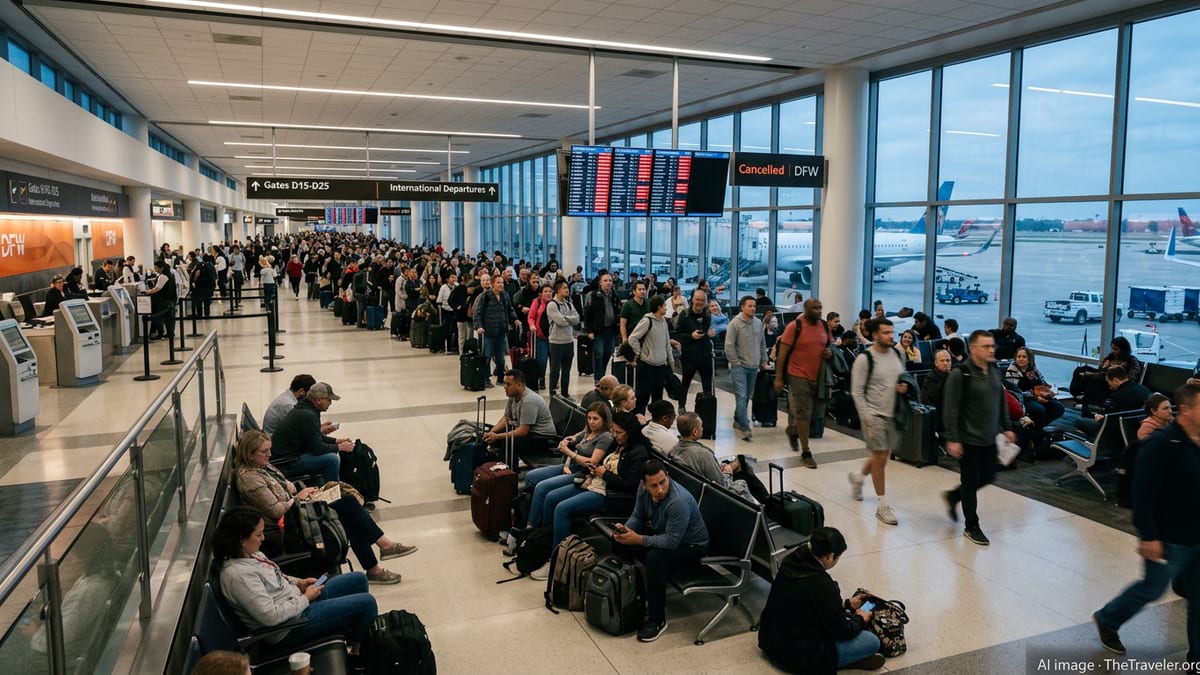
For passengers, the Dallas-Fort Worth travel crisis has translated into difficult decisions and complex rerouting efforts. Publicly shared experiences from recent weeks describe travelers spending many hours in terminal queues, waiting for rebooking options that often involve circuitous itineraries or departures several days later than planned.
Some travelers have reported shifting from DFW-centered itineraries to routings through other hubs, where possible, in an attempt to reduce exposure to further cancellations. Others have turned to nearby airports in Texas or neighboring states when seats from Dallas-Fort Worth could not be secured. In cases where ground transportation was feasible, passengers have opted for long drives to alternate airports to access flights that were still operating.
Airlines have issued a series of weather-related travel waivers during major storm periods, allowing itinerary changes without standard fees on affected dates and routes. While such waivers can provide flexibility, they also tend to fill remaining seats quickly on less-disrupted flights, leaving late-arriving travelers with fewer alternatives.
Industry guidance and consumer advocates frequently stress the importance of monitoring flight status closely, building extra time into connections, and considering direct flights when possible to reduce risk. Given DFW’s current instability, some travel advisers are recommending longer connection buffers through Dallas-Fort Worth or, where feasible, choosing routes that bypass the hub entirely during peak storm windows.
Outlook for Dallas-Fort Worth and the Wider Network
Short-term prospects for travelers remain uncertain, dependent on how quickly airlines can rebalance aircraft and crew and how the evolving March weather pattern develops. Forecasts point to additional storm activity across parts of the country in the days ahead, raising the possibility of further knock-on effects for flights routed through DFW.
Airports and airlines are continuing efforts to harden operations against severe weather and staffing challenges, from investments in de-icing capacity to schedule adjustments that reduce ultra-tight connections. Yet, as recent events have shown, such measures have limits when multiple stressors converge on a complex hub in a high-demand travel period.
For Dallas-Fort Worth specifically, the recent surge in cancellations highlights both its indispensability and its fragility within the U.S. air travel system. As long as a significant share of domestic and international routes depend on smooth operations at this single hub, disruptions there are likely to reverberate widely whenever storms, staffing pressures or policy shocks collide.
Travelers planning itineraries through DFW in the coming weeks may continue to face elevated risk of schedule changes. Many are closely watching airline advisories, weather forecasts and publicly available performance data in hopes of avoiding the next wave of cancellations radiating outward from North Texas to the rest of the country and beyond.