

More news on this day
An American Airlines flight from Dallas to Las Vegas has become the latest flashpoint in a string of high-profile aviation disruptions after a passenger’s erratic mid-boarding behavior, captured on video and widely shared online, turned a routine departure into an international talking point from the United States to the United Arab Emirates.
A Routine Boarding Turns Into a Disturbance
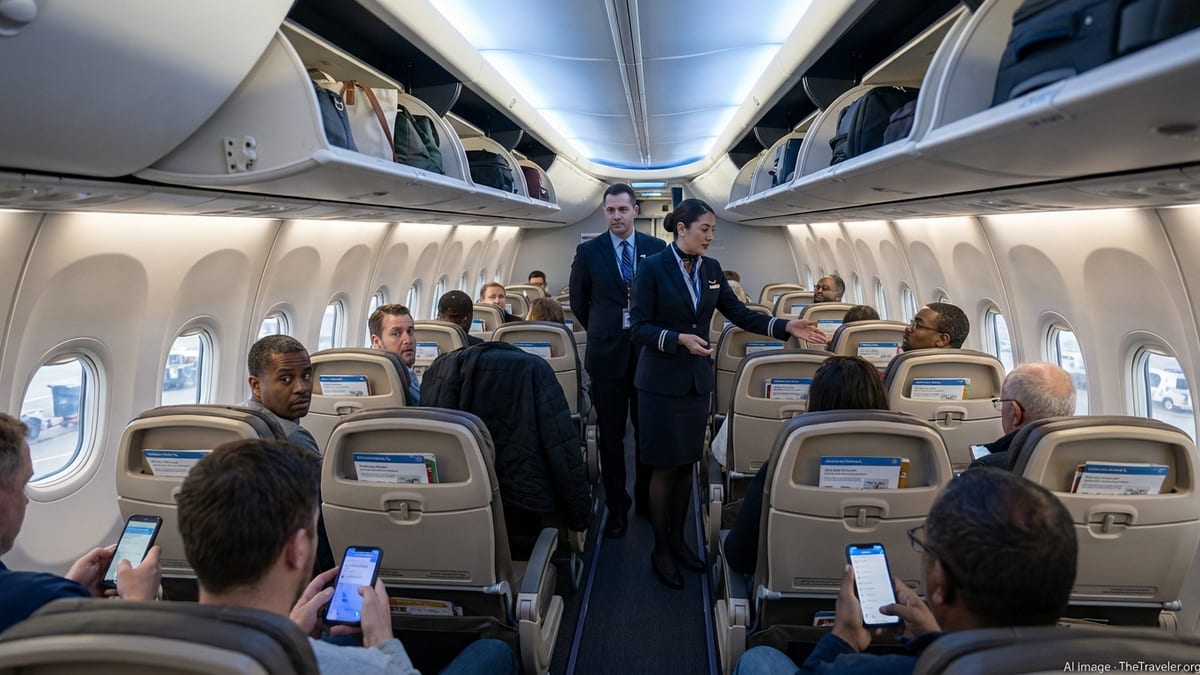
The incident unfolded on an American Airlines service from Dallas Fort Worth International Airport to Las Vegas, when a male passenger began behaving erratically during boarding, according to accounts shared by travelers. What began as a relatively normal embarkation quickly deteriorated as the man moved down the aisle, shouting disjointed remarks that alarmed fellow passengers and startled crew members.
Video clips that later surfaced show the passenger crawling in the aisle and making a series of confused claims, referencing rockets, aircraft doors and his refusal to sit near a seatmate. Witnesses said the tone inside the cabin shifted from impatience over a delayed departure to visible unease as the man’s behavior escalated in the confined space of the aircraft.
Flight attendants can be seen attempting to calm the situation, repeatedly asking the man to take his seat and comply with instructions so that the plane could depart. Instead, he continued speaking loudly and moving awkwardly through the cabin, forcing crew to halt the boarding process while they assessed whether it was safe to continue.
According to passengers, the disturbance caused a further delay to a flight that was already running behind schedule amid a period of wider disruption for American Airlines operations out of Dallas, with recent days marked by weather impacts and knock-on delays across the network.
Viral Video Propels a Domestic Flight into Global Spotlight
Within hours of landing, footage recorded by travelers on board had appeared on major social platforms, where it was stitched, subtitled and re-shared for audiences far beyond Dallas and Las Vegas. One clip, originally posted on TikTok, quickly drew hundreds of thousands of views, before being picked up by digital outlets that specialize in viral aviation and travel stories.
The speed at which the video spread underscores how airline incidents that once might have remained local are now amplified globally in real time. Comment threads filled with viewers trading jokes, criticism and concern, with some focusing on the passenger’s condition and others on the response of the crew and airline.
In the United States, the episode became part of a broader conversation about passenger behavior and stress in crowded domestic air travel markets. In the United Arab Emirates, where many residents are frequent long-haul travelers and closely follow aviation developments, local forums and social channels highlighted the clip as another example of what can happen on busy US routes, contrasting it with the often stricter enforcement seen on Gulf carriers.
Social media users in the UAE drew parallels with earlier high-profile inflight meltdowns that reshaped expectations around cabin security and customer conduct, noting that a single smartphone video can now influence perceptions of an airline’s brand among potential travelers halfway around the world.
Airline Response and Safety Protocols Under Scrutiny
While American Airlines has not released a detailed public account of the Dallas to Las Vegas disturbance, the footage makes clear that cabin crew moved quickly to stabilize the situation. At least one attendant is seen standing between the passenger and seated travelers, repeatedly instructing him to sit and attempting to de-escalate the confrontation without physical restraint.
Under Federal Aviation Administration regulations, US airlines are required to remove any passenger whose behavior could pose a safety risk or interfere with crew duties. Aviation safety specialists note that the most challenging moments often occur during boarding, when the aircraft door is open, passengers are moving freely, and tensions over delays, seating and luggage can easily boil over.
The Dallas incident appears to fit a pattern of disruptive behavior that stops short of a full security emergency but still forces a difficult judgment call by the captain and crew. In other recent cases involving American Airlines, passengers who tried to open doors in flight or attacked crew were restrained and the flights diverted, with images of duct-taped passengers and emergency landings widely shared online.
In contrast, here the disturbance was contained on board before departure, and the aircraft later continued its journey. For airline managers and regulators, such episodes raise questions about how to support front-line staff with clearer protocols, better mental health training and more consistent post-event communication to reassure the public.
Disruption Amid Wider Operational Strain at Dallas Fort Worth
The mid-boarding chaos comes at a time when American Airlines’ Dallas Fort Worth hub has been dealing with substantial operational pressure. In recent days, the carrier has coped with hundreds of delays and cancellations tied to heavy rain and congested airspace, forcing crews and aircraft out of position and stretching schedules thin.
Travelers passing through Dallas have reported long lines, rolling gate changes and last-minute rebookings as American works to stabilize its timetable. Aviation data from recent weekends shows the airline operating with significant departure delays on multiple Dallas to Las Vegas services, indicating that the route has not been immune to the broader disruption.
For passengers on the affected flight, that context helped to frame the boarding disturbance as part of a wider sense of strain. Some described arriving at the gate after navigating weather-related queues and security backlogs, only to face yet another delay when the situation in the cabin escalated.
Industry analysts say that when operations are fragile, even a single unpredictable event on board can cascade through the system, triggering missed connections, crew timing issues and further delays. The Dallas incident may ultimately be remembered as much for what it reveals about US hub congestion as for the individual at the center of the video.
Transatlantic Reactions: Comparing US and UAE Aviation Cultures
The viral spread of the Dallas to Las Vegas footage has drawn particular interest in the United Arab Emirates, a country where aviation is both a critical economic pillar and a source of national pride. Commentators in Dubai and Abu Dhabi, home to two of the world’s largest long-haul carriers, have contrasted the atmosphere on US domestic flights with the more strictly controlled environments on many Gulf-based airlines.
Travel professionals in the UAE note that while disruptive passengers are not unique to any one region, the US market’s high frequency of short-haul journeys, crowded hubs and complex weather systems can create more opportunities for tension. Some Emirati and expatriate travelers on local forums remarked that they felt more comfortable on routes where rigorous pre-boarding screening and assertive cabin policies make outbursts less likely to play out unchecked.
At the same time, there was empathy for American Airlines crew among aviation workers in the Gulf. Flight attendants, pilots and ground staff posting anonymously online described the Dallas incident as a familiar scenario: a passenger in distress or under the influence, a full cabin, and a ticking clock as the airline tries to minimize delay while prioritizing safety.
In both the United States and the UAE, the episode has reignited a discussion about whether airlines should more systematically share information on disruptive travelers and collaborate across borders on no-fly lists, while balancing privacy concerns and legal differences between jurisdictions.
Rising Reports of Unruly Passengers and a Stressed Travel Public
Although the Dallas to Las Vegas incident did not involve physical violence or damage to the aircraft, it fits into a worrying trend documented by regulators and industry bodies. Since the pandemic, US airlines have reported elevated levels of disruptive behavior, ranging from refusals to follow mask rules during earlier phases to arguments over seat assignments, carry-on bags and alcohol service.
Regulators in Washington have responded with a zero-tolerance policy toward serious inflight misconduct and higher civil penalties for interfering with crew, moves that have been largely welcomed by airline unions. Still, frontline workers say that the burden of managing tense situations often falls on cabin crew who must make split-second decisions with limited information about a passenger’s state of mind.
Experts in passenger behavior point to a combination of factors driving the trend: crowded flights, lingering anxiety about travel disruptions, social media’s tendency to reward dramatic content, and a broader fraying of civility in public spaces. The Dallas disturbance, they argue, illustrates how quickly a situation can escalate once someone in a confined cabin feels cornered, agitated or misunderstood.
For travelers, the practical takeaway is that compliance with crew instructions is not only a legal requirement but also a buffer against chaos that can derail entire flights. For airlines, episodes like this one intensify pressure to review alcohol policies, boarding procedures and support for staff who regularly interact with stressed customers.
Implications for American Airlines’ Brand and Passenger Confidence
American Airlines, one of the world’s largest carriers, is no stranger to viral moments. Over the past several years, videos of inflight disputes, emergency diversions and confrontations at gates have periodically thrust the brand into the spotlight, sometimes overshadowing the sheer volume of routine flights that operate without incident each day.
Marketing specialists say the Dallas to Las Vegas disruption is another reminder that in the smartphone era, every boarding announcement and every disagreement in a jet bridge can become global content. Even when crew follow procedure and no one is harmed, the optics of a chaotic cabin can shape perceptions among millions of viewers who have never flown the route in question.
For American, the challenge is to demonstrate that such incidents are exceptions in a system that overwhelmingly functions smoothly, while also acknowledging the frustration and anxiety they cause customers. Transparent communication, swift follow-up with passengers on affected flights and visible support for crew are key elements in defending trust, especially in competitive leisure markets such as Las Vegas.
Travel advisors in both the United States and the UAE report that high-profile disruptions rarely lead clients to avoid a specific airline altogether, but they do contribute to a general sense of unease about air travel. Clear information about safety protocols and the rarity of serious inflight events can help counterbalance the dramatic images that dominate social feeds.
What the Dallas–Las Vegas Episode Reveals About Modern Air Travel
The eruption of a single boarding sequence into a global talking point encapsulates many of the tensions underlying modern aviation. Airlines juggle tight schedules, packed aircraft and volatile weather, while passengers bring their own stresses and expectations on board, smartphones in hand and social feeds waiting for content.
The Dallas to Las Vegas disturbance is not the most severe airline incident in recent memory, nor is it likely to change regulations on its own. Yet by ricocheting across timelines from North America to the Gulf, it highlights how interconnected the global travel conversation has become, and how quickly reputations can be tested by behavior inside a single cabin.
For the millions planning trips between the United States and the United Arab Emirates this year, the episode may serve less as a deterrent than as a reminder of the shared responsibility involved in flying. Airlines must maintain robust safety and training standards, regulators must enforce clear rules, and passengers must recognize that cooperation and calm are now as essential to a successful journey as a valid ticket and a passport.
As American Airlines continues to navigate weather disruptions, operational challenges and the glare of viral scrutiny, the Dallas–Las Vegas flight stands as a snapshot of an era in which every takeoff and every boarding call unfolds under a global lens.