

More news on this day
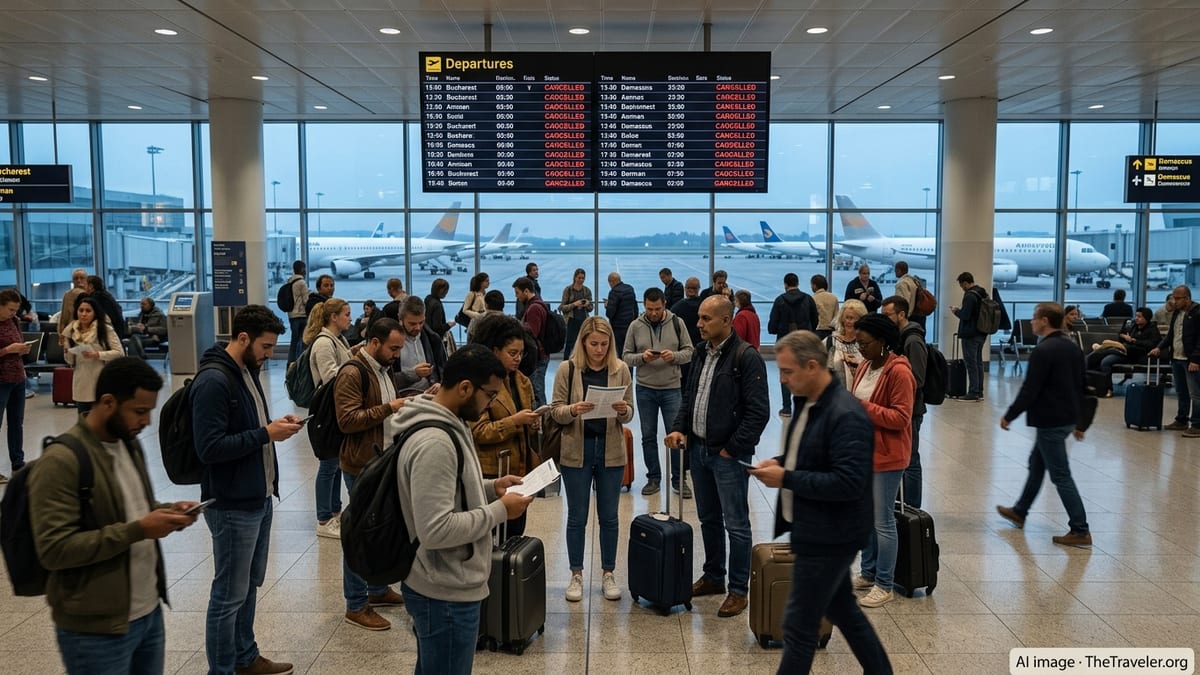
Fresh cancellations at Damascus International Airport are rippling across regional air networks, affecting passengers booked on services with Dan Air, Royal Jordanian and other carriers linking Syria with Bucharest, Amman and onward global destinations.
Get the latest news straight to your inbox!
Damascus Airspace Closures Trigger New Wave of Disruptions
Recent airspace restrictions around Damascus have again forced airlines to cancel services into Syria’s main international gateway, with three additional flight cancellations reported in the latest operational update. Publicly available notices from aviation authorities and airline schedules indicate that Damascus International Airport remains subject to intermittent closures, leaving carriers with limited options to maintain connectivity.
These cancellations add to a pattern of on-off operations at the Syrian capital’s airport since the escalation of regional tensions earlier in March 2026. Industry reporting shows that authorities have periodically halted traffic in and out of Damascus, citing security considerations, while allowing some northern corridors to reopen for airports such as Aleppo. As a result, airlines serving Syria have been forced into rapid schedule changes and emergency rerouting.
The latest three cancelled rotations at Damascus are relatively small in number, but they carry significant knock-on effects because alternatives inside Syria are scarce and capacity on neighboring hubs is already strained. Travelers using Damascus as a gateway for onward journeys through Bucharest, Amman, Istanbul and Gulf hubs are encountering missed connections, extended layovers and, in some cases, the need to rebook entire itineraries.
Airport operations data and corporate travel bulletins suggest that these disruptions are likely to continue so long as airspace restrictions remain fluid. Airlines are updating schedules in short cycles, often only a few days in advance, which complicates planning for both leisure travelers and members of the Syrian diaspora relying on scarce seats out of the region.
Dan Air Shifts Bucharest Route from Damascus to Aleppo
Romanian carrier Dan Air has been among the most visibly affected operators, given its role as the first European Union airline to resume scheduled commercial flights to Syria on the Bucharest–Damascus route in 2025. As closures at Damascus intensified this month, Dan Air announced that it would temporarily move operations from Damascus International Airport to Aleppo International Airport.
According to multiple aviation news outlets, all flights scheduled to operate between Bucharest and Damascus over a roughly ten-day window in mid to late March have been reassigned to Aleppo. The airline is maintaining its established frequency pattern, but now using Aleppo as the Syrian endpoint while Damascus remains offline for civilian traffic. Timetables show that departure and arrival times have been kept largely unchanged in order to minimize disruption.
Dan Air has stated in public communications that passengers holding tickets to or from Damascus during the affected period are being accommodated on the Aleppo services. Travel industry reports indicate that the carrier’s safety and risk committees carried out an assessment before shifting the route, with the move coordinated through the Syrian civil aviation authorities. The airline has emphasized continued adherence to European aviation safety standards and ongoing monitoring of conditions on the ground.
The temporary relocation highlights both the fragility and importance of Dan Air’s connection for passengers traveling between Romania, wider Europe and Syria. For many Syrians living in the European Union, the Bucharest link is one of the few relatively direct options available. While Aleppo offers a short-term workaround, the latest cancellations at Damascus underline the uncertainty facing travelers who depend on this corridor.
Royal Jordanian and Regional Carriers Grapple with Jordan–Syria Volatility
While Dan Air reshapes its Romania–Syria network, Royal Jordanian and other regional carriers are dealing with their own operational challenges tied to shifting security conditions. Queen Alia International Airport in Amman functions as a major transfer point for passengers heading to and from Syria, and broader Middle East disruptions have periodically affected Royal Jordanian’s schedules.
Travel forums and airline advisories point to rolling cancellations and rebookings on some Amman routes in March, as regional tensions prompted temporary airspace closures and capacity reductions by several airlines. Although Royal Jordanian continues to position itself as a stable option for travel into and out of Jordan, passengers connecting via Amman to reach Syria are facing longer transit times and, in some cases, last-minute changes to routings.
Jordan’s civil aviation announcements earlier this month described short-lived but impactful restrictions on the country’s airspace, which contributed to wider schedule volatility. While these limitations have since eased, residual disruptions are still evident in the form of rearranged departure banks and selective route adjustments. For travelers who had relied on Amman as a predictable bridge between Europe, the Gulf and Syria, the latest cancellations at Damascus intensify uncertainty about onward connections.
Regional carriers beyond Royal Jordanian, including operators based in the Gulf and Turkey, are also recalibrating their approach to Syria-linked traffic. Some have suspended direct operations into the country altogether, instead funnelling passengers through nearby hubs from which they can continue overland. The cumulative effect of these decisions is a more fragmented and less resilient travel network for anyone whose plans involve Damascus.
Passengers Confront Rebookings, Overland Detours and Limited Protection
For individual travelers, the practical impact of the three new cancellations at Damascus extends well beyond a single missed flight. With capacity constrained and alternative airports inside Syria limited, many passengers are being steered toward complex rebookings that involve multiple airlines, mixed modes of transport and extended journeys.
Reports from travel agencies and corporate travel managers indicate that some passengers originally booked through Damascus are now being rerouted via Aleppo, Amman, Istanbul or Gulf hubs, then continuing by road where feasible. In cases where airlines cannot offer workable alternatives, travelers are requesting refunds or vouchers, but the outcomes vary widely depending on the carrier’s policy and whether the ticket was issued directly or via an intermediary.
Risk advisories issued this month highlight an additional challenge: standard travel insurance policies often treat airspace closures and missile-related security events as excluded risks. This leaves some passengers absorbing extra costs for new tickets, hotels and ground transport when flights are canceled at short notice. Travel management companies are urging clients to review policy language carefully and to document all disruption-related expenses.
In the absence of uniform consumer protections across jurisdictions, passenger experiences differ markedly between airlines and booking channels. Some carriers are offering generous waivers and free rebooking windows, while others are limiting assistance to minimal refunds. The latest cancellations at Damascus are therefore reinforcing a broader lesson for travelers: when planning itineraries involving high-risk airspace, flexibility and robust contingency planning are becoming essential.
Outlook for Connectivity Between Syria, Romania and Jordan
Industry analysts following Middle East aviation trends suggest that the near-term outlook for flights touching Damascus remains uncertain. So long as airspace restrictions can be tightened or loosened on short notice, airlines are likely to maintain a cautious posture, with temporary suspensions and rapid route shifts an ongoing reality.
For Romania, Dan Air’s adaptation via Aleppo keeps a partial bridge open between Bucharest and Syria, but the durability of this solution will depend on the security assessment for northern Syrian airspace. If conditions deteriorate or regulatory guidance changes, even this contingency route could come under review, potentially severing one of the few direct aerial links between Syria and the European Union.
In Jordan, Amman’s role as a regional hub is expected to endure, yet future ripple effects from Syrian airspace closures cannot be ruled out. Any renewed restrictions affecting Jordanian airspace or neighboring corridors would likely lead to more cancellations or schedule thinning by Royal Jordanian and its partners, with consequences for passengers connecting between Europe, the Levant and the Gulf.
For now, travelers planning to move between Syria, Romania and Jordan are being advised by travel professionals to monitor airline communications closely, remain flexible with dates and routings, and be prepared for further last-minute changes. The latest cancellations at Damascus International Airport underscore how quickly geopolitical developments can reshape flight networks across Bucharest, Amman and beyond.