

More news on this day
Dane County Regional Airport in Madison is flying higher than ever in 2025, shattering all-time passenger records and cementing its role as one of the Midwest’s fastest-rising regional hubs.
After edging past its pre-pandemic peak set in 2019, the airport closed 2025 with nearly 2.5 million passengers, capping a year marked by record-breaking summer traffic, expanded nonstop service and an aggressive push toward international status.
More News
- Caribbean Travel to U.S. Upended by New Visa Freezes and Expanded Bans
- Mexico Restores E-Visas for Brazilians, Paving the Way for Borderless Tourism
- Philippine Airlines Joins Regional Carriers Powering Southeast Asia’s Tourism Boom
Record Year: 2025 Passenger Numbers Take Off
Airport and county officials confirmed this week that Dane County Regional Airport handled nearly 2.5 million passengers in 2025, the highest total in its 85-year history and roughly 6 percent more than in 2024. The result lifts the airport decisively beyond its pre-pandemic benchmark, set in 2019, when it logged what was then an all-time high.
The new record follows a steady climb out of the pandemic downturn. In 2023 the airport reported what was then its third-busiest year, followed by 2.35 million passengers in 2024, the second-busiest on record. By late 2024, officials were already noting that monthly volumes were outpacing 2019, and early 2025 data signaled that a new high was within reach.
Those expectations have now been surpassed. Airport leaders say the 2025 totals validate a multi-year strategy focused on adding destinations, recruiting new carriers and using a recently expanded terminal to accommodate larger aircraft and higher passenger volumes. They also point to robust business travel, a thriving regional economy and sustained demand for leisure trips as critical contributors.
“This record-breaking year is a powerful indicator of how strongly our community continues to embrace Dane County Regional Airport,” Executive Director Mark Papko said in a statement, noting that more travelers are choosing to “Fly Local” for both convenience and expanding nonstop options.
Busiest Summer Ever Cements Momentum
The all-time annual record was built on an unprecedented summer. From May through August 2025, Dane County Regional Airport recorded 854,330 passengers, its busiest summer travel season on record and a clear jump from the 814,545 passengers handled over the same months in 2024.
June and July each saw more than 200,000 passengers move through the terminal, ranking among the busiest individual months in the airport’s history. A single week in mid-August set records for passenger traffic, security screenings and baggage handling, as the airport absorbed a surge driven by conference visitors, military travelers and vacationers.
Airport officials say those months demonstrated both the depth of demand in the Madison market and the airport’s operational resilience under pressure. Load factors on some routes reached as high as 99 percent during the August peak, even as checkpoint queues and baggage operations remained largely smooth, according to the airport.
For Dane County leaders, the summer performance offered tangible evidence that investments in capacity and amenities are paying off. “These numbers reflect a thriving regional economy and a community that values accessible, high-quality air service,” County Executive Melissa Agard said, describing the airport as a powerful engine for tourism and business development.
New Routes, New Airline and a Bigger Network
Underpinning the surge in passenger traffic is an evolving route map that gives Madison-area travelers more options without the need to connect through Chicago or Milwaukee. In 2025, the airport benefited from a mix of new services and returning seasonal flights that broadened its reach to key leisure and business markets.
Seasonal nonstop flights to Phoenix, Fort Myers and Los Angeles returned to the schedule, tapping into strong demand from Wisconsin travelers seeking warm-weather destinations. Those routes joined an existing network of nonstop service to major hubs such as Chicago O’Hare, Denver, Dallas-Fort Worth, Minneapolis–St. Paul, Atlanta, Charlotte and Detroit, which collectively feed hundreds of onward connections.
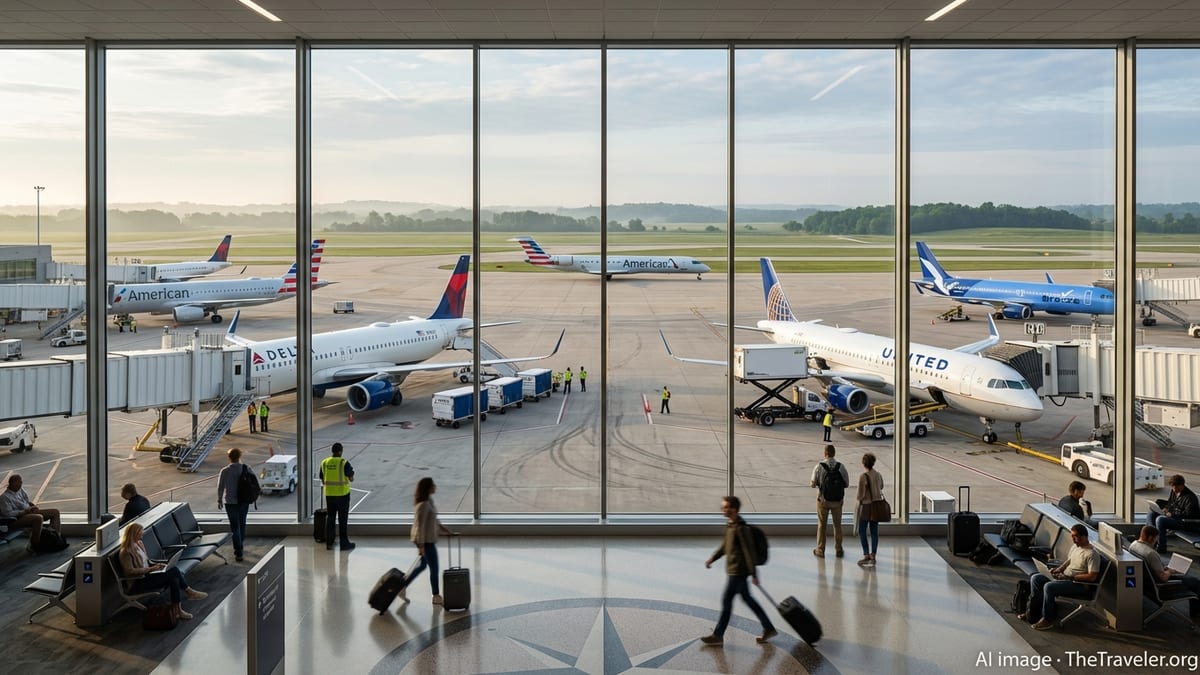
The arrival of Breeze Airways added another competitive wrinkle to the market. The low-cost carrier joined incumbent airlines including American, Delta, United and others, increasing seat capacity and providing additional choices on select routes. Airport officials credit the mix of legacy and newer carriers with helping keep fares competitive while supporting the airport’s growth strategy.
As passenger numbers rose, the airport also announced new nonstop flights from Madison to Boston on both American Airlines and Delta Air Lines. The twin launches signal strong corporate and academic ties between Madison, a prominent research and technology hub, and the Boston region, and illustrate how airlines are responding to the market’s maturing demand profile.
Terminal Expansion and Customer Experience Investments
Dane County Regional Airport’s ability to absorb record traffic in 2025 was built on infrastructure work completed in the years leading up to the surge. A 90,000-square-foot expansion of the south terminal, fully completed in 2024, added gate capacity, new concessions and more space for passengers to move through the facility.
The expanded area features additional jet bridges, larger gate hold rooms and new food and beverage concepts, including the Launch Deck Bar, designed to give travelers more options to relax or work before boarding. A signature compass-rose terrazzo floor marks the transition between old and new gate areas, symbolizing the airport’s aspirations to serve as a broader gateway for the region.
At the same time, the airport has invested in passenger amenities that reflect changing traveler expectations. Recent additions include a nursing mother’s lounge, a children’s play area, upgraded free Wi-Fi, meeting rooms and an indoor pet relief area. The goal, officials say, is to pair regional-airport convenience with features more commonly associated with larger hubs.
These improvements have been critical as passenger counts climbed back toward and then beyond 2019 levels. With peak-day volumes now hitting new highs, the expanded concourses and enhanced public spaces have helped maintain a relatively low-stress experience, which local officials see as central to convincing residents to start their trips in Madison rather than driving to larger airports.
Economic Ripple Effects Across the Madison Region
The record-breaking passenger numbers carry implications well beyond the terminal walls. Local officials argue that Dane County Regional Airport’s growth is both a reflection and a driver of the Madison area’s expanding economy, which is anchored by the University of Wisconsin–Madison, a growing technology and life sciences sector, and major employers such as health care systems and software firms.
Higher passenger volumes translate into more visitors spending money in hotels, restaurants and entertainment venues, while improving air service makes the region more attractive for conferences, sporting events and academic gatherings. The airport’s busiest week on record, which coincided with a major Epic Systems conference and strong military traffic tied to Fort McCoy, highlighted those synergies in real time.
Business leaders also point to air connectivity as a key factor in corporate site selection and expansion decisions. Direct flights to major hubs and coastal cities can influence where companies choose to invest or expand offices, particularly in sectors such as technology, biotech and finance that rely on frequent travel.
County officials say the airport’s ascendance supports their broader vision of Madison as a globally connected midsize metro, capable of competing with larger cities for talent, investment and tourism. Each new route and record month, they argue, strengthens the case for further air service development and infrastructure upgrades.
International Ambitions and the Next Phase of Growth
Riding the momentum of record traffic, Dane County leaders are now looking to broaden the airport’s horizons even further. In early 2025, County Executive Melissa Agard formally announced an effort to secure an international designation for the airport, a step that would allow it to handle direct international arrivals equipped with federal customs and border protection facilities.
Officials believe the airport’s growth trajectory, along with the Madison area’s rising population and global business links, justify the push. Currently, international travelers in southwest Wisconsin typically connect through hubs such as Chicago or Minneapolis. An international designation could eventually open the door to cross-border flights, particularly to destinations in Canada or Mexico, as well as seasonal long-haul charters.
The process will require a federal review of demand, space and security requirements, along with investments in dedicated customs facilities and staffing. While the timeline is uncertain, local leaders describe the bid as a logical next step following the airport’s record-setting performance in 2025 and the completion of its terminal expansion.
Airport executives say they will continue focusing on incremental route growth and service enhancements while the international effort advances. The near-term priority, they note, is sustaining the gains achieved in 2025 and proving to airline partners that Madison can consistently fill the larger aircraft and increased schedules now operating at the field.
How Dane County Regional Compares to Other Midwest Airports
While Dane County Regional Airport is modest in size compared with large Midwest hubs such as Chicago O’Hare or Minneapolis–St. Paul, its growth trajectory has drawn attention among regional airports. With nearly 2.5 million passengers in 2025, the airport remains firmly in the small-hub category by national standards but is now operating close to or above pre-pandemic volumes, ahead of many peer facilities.
Industry observers note that Madison’s combination of a stable institutional base, diversified economy and relatively high-income catchment area gives it an advantage in supporting sustainable air service. The airport’s expanded terminal and strong on-time performance have also become selling points as it courts additional flights and frequencies.
At the same time, officials emphasize that Dane County Regional’s role is complementary rather than competitive with larger regional hubs. By offering more nonstop options and a smoother local experience, Madison’s airport can keep more trips originating in the region while still feeding passengers into the national and international networks of major carriers.
As airlines fine-tune their post-pandemic route maps, airports like Madison that demonstrate consistent demand, rising load factors and efficient operations are well positioned to secure incremental capacity. The 2025 record is therefore seen not as a ceiling, but as a new baseline from which to grow.
FAQ
Q1. How many passengers used Dane County Regional Airport in 2025?
The airport handled nearly 2.5 million passengers in 2025, its highest annual total on record and about 6 percent more than in 2024.
Q2. How does the 2025 record compare with pre-pandemic levels?
The 2025 total surpasses the previous all-time record set in 2019, marking the first time the airport has exceeded its pre-pandemic peak.
Q3. What were the main drivers of passenger growth in 2025?
Growth was fueled by a record summer travel season, returning and new seasonal nonstop routes, the addition of Breeze Airways, strong business and leisure demand, and the airport’s expanded terminal capacity.
Q4. Which months were the busiest in 2025?
June and July 2025 were among the busiest months in the airport’s history, each surpassing 200,000 passengers, and a week in mid-August set single-week records for traffic, security screenings and baggage handling.
Q5. What new routes or services were added recently?
Recent additions include seasonal nonstop flights to Phoenix, Fort Myers and Los Angeles, the introduction of Breeze Airways service, and newly announced nonstop flights to Boston on both American Airlines and Delta Air Lines.
Q6. How has the terminal expansion impacted the passenger experience?
The 90,000-square-foot south terminal expansion has added gates, larger gate areas, new restaurants and bars, and more space for passengers, helping the airport manage higher volumes while maintaining a low-stress experience.
Q7. Is Dane County Regional Airport pursuing international flights?
Yes. County leaders have begun pursuing an international designation for the airport, which would enable it to handle direct international arrivals once customs facilities and staffing are in place.
Q8. How does this growth benefit the Madison area economy?
More passengers mean increased visitor spending on hotels, dining and entertainment, better connectivity for local businesses and institutions, and greater appeal for conferences and events that bring additional economic activity to the region.
Q9. Which airlines currently serve Dane County Regional Airport?
The airport is served by major U.S. carriers such as American, Delta and United, as well as regional affiliates and newer entrants like Breeze Airways, providing a mix of hub connections and point-to-point service.
Q10. What amenities can travelers expect when flying from Madison?
Travelers will find upgraded dining and shopping, a nursing mother’s lounge, a children’s play area, free high-speed Wi-Fi, meeting rooms, an indoor pet relief area and other conveniences designed to offer a comfortable, easy travel experience.