

More news on this day
Travelers across the United States are facing days of disruption after a deadly collision between an Air Canada Express jet and an airport fire truck at New York’s LaGuardia Airport forced runway closures, triggering hundreds of delays and cancellations that rippled through airline networks nationwide.
Get the latest news straight to your inbox!
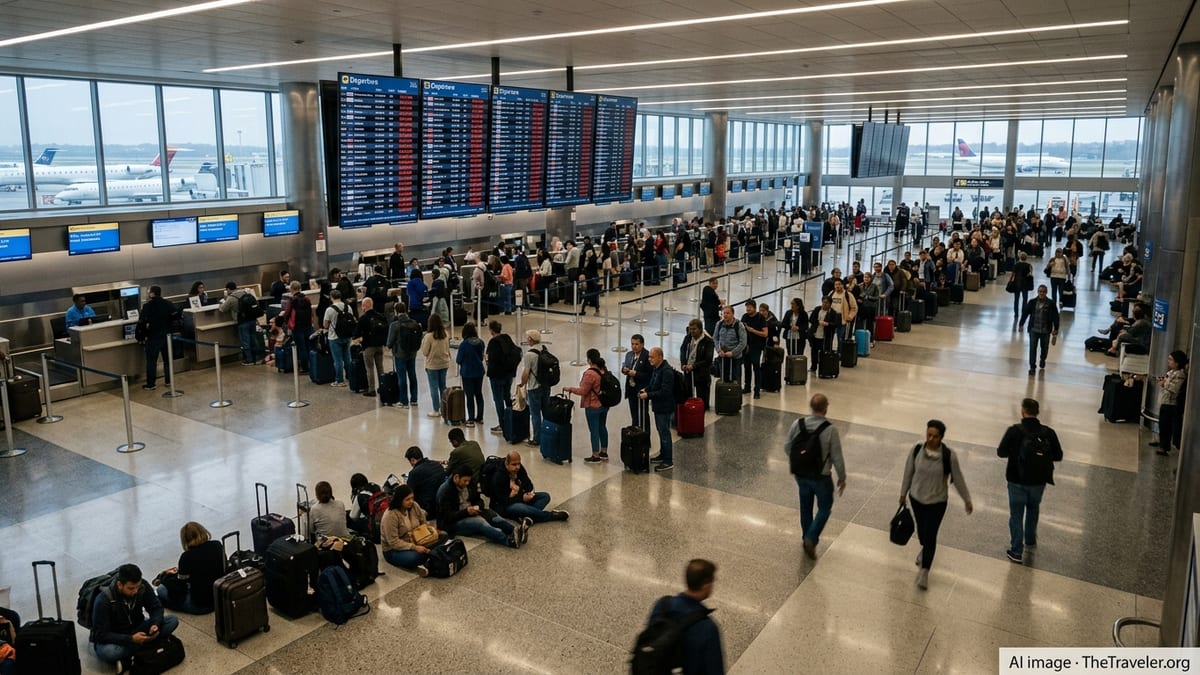
Deadly collision on LaGuardia runway halts operations
The crash occurred late on March 22 when an Air Canada Express Bombardier CRJ900 arriving from Montreal collided with an airport firefighting truck on a runway at LaGuardia. Publicly available information identifies the flight as Air Canada Express Flight 8646, operated by regional carrier Jazz Aviation, with more than 70 people on board.
Reports indicate the impact sheared off the forward section of the jet and left debris scattered across the tarmac, killing the two Canadian pilots and injuring dozens of passengers and crew. Images and video from the scene shared by news outlets show extensive damage to the aircraft’s nose and fuselage and a toppled fire truck lying on its side near the runway.
In the immediate aftermath, LaGuardia suspended operations on the affected runway and temporarily closed the airport to arriving traffic while emergency teams worked and federal investigators were dispatched. Limited service gradually resumed using a single runway, but capacity remained sharply reduced as specialists documented the wreckage and removed debris.
According to published coverage, the closure left one of the nation’s busiest urban airports operating at a fraction of normal throughput at the start of a busy spring travel period, setting the stage for widespread knock-on delays across the system.
Runway closure drives mass delays and cancellations
With only one of LaGuardia’s two runways available, airlines were forced to slash schedules and reroute aircraft, resulting in hundreds of disrupted flights. Flight-tracking data cited in multiple reports show that LaGuardia has led the country for cancellations in recent days, with more than 300 flights scrubbed within a 24-hour window as the airport struggled to clear the backlog.
Passengers reported hours-long waits, congested terminals and last-minute schedule changes as carriers tried to juggle limited takeoff and landing slots. Some flights were diverted to other New York area airports, while others were terminated at their origin or returned to gates after extended ground holds.
Because LaGuardia serves as a key domestic hub, especially for short-haul business routes along the East Coast and into the Midwest, the curtailed schedule had immediate effects on connections. Aircraft and crews that would normally cycle through New York failed to reach subsequent legs on time, forcing additional cancellations far from the original disruption.
Even as the damaged runway reopened on March 26 following repairs and inspections, travel advisories continued to warn of lingering delays and encouraged passengers to confirm flight status before heading to the airport. Airlines were still working through displaced aircraft, crew reassignments and a heavy backlog of rebooked travelers.
Nationwide ripple effects across airline networks
LaGuardia’s difficulties quickly radiated across the country as airlines contended with misaligned schedules and equipment imbalances. Carriers rely on tightly timed rotations, and when a key hub airport experiences a prolonged interruption, disruptions cascade through the network hours and even days later.
Publicly available data from flight-tracking services showed elevated delay and cancellation rates at airports feeding New York, including major hubs in the Midwest and Southeast. Some westbound flights departed late or were canceled altogether when inbound aircraft failed to arrive from LaGuardia on time, while early-morning departures were affected by aircraft stranded overnight on the East Coast.
Travel forums and social media posts from passengers in cities as far apart as Atlanta, Chicago and Dallas described receiving notifications that their flights were disrupted due to “air traffic” or “operational impacts” related to New York. In many cases, travelers who were not originally scheduled to pass through LaGuardia found themselves rebooked onto alternative routings or facing overnight stays.
Industry analysts cited in news coverage noted that New York’s constrained airspace and chronic congestion magnify the impact of any major incident. When a core facility such as LaGuardia loses capacity, the knock-on effects tend to spread quickly as airlines shuffle limited resources across their national networks.
Investigators focus on runway incursion and safety systems
The National Transportation Safety Board has opened a full investigation into the collision, focusing on how a firefighting vehicle came to be on an active runway as the CRJ900 was landing. Preliminary details from released summaries indicate that the truck had been cleared to respond to a separate emergency involving another aircraft before the crash.
According to published accounts of recorded tower communications, an air traffic controller attempted to halt the truck’s movement seconds before impact, but the warning came too late. Investigators are examining whether staffing levels, workload, communication procedures or technology shortfalls contributed to the breakdown in runway protection.
Specialists are also expected to review the status and performance of ground radar and alerting systems designed to prevent runway incursions, as well as the training protocols for both pilots and emergency response crews operating in complex airfield environments. LaGuardia’s dense layout, intersecting taxiways and heavy traffic volumes are likely to form part of the analysis.
While a preliminary report is expected in the coming weeks, a final determination of probable cause and safety recommendations typically takes many months. In the meantime, the crash has sharpened attention on surface-movement safety at busy airports and the safeguards in place when multiple emergencies unfold simultaneously.
Travelers face extended disruption and uncertainty
For passengers, the human impact of the crash has been felt not only in the tragedy of lives lost and injuries sustained, but also in the practical challenges of navigating a severely disrupted air transport system. Many travelers bound for New York have had to reroute via John F. Kennedy International Airport or Newark Liberty International Airport, both of which were already contending with separate staffing and congestion pressures.
Public advisories from airlines and airport operators have urged travelers to build in extra time, monitor mobile alerts and be prepared for gate changes and rolling departure estimates. Some carriers have issued temporary travel waivers for New York area flights, allowing passengers to change itineraries without typical penalties in an effort to relieve pressure on the system.
Industry observers note that while runway capacity at LaGuardia is returning, the disruption may continue for several days as airlines work through a tangled web of missed connections, out-of-position aircraft and crews approaching duty-time limits. Travelers with near-term plans involving the New York region are being encouraged, through publicly available guidance, to treat departure times as provisional and to keep backup options in mind.
The crash has underscored how a single catastrophic event at a major airport can ripple through a tightly scheduled aviation network, turning a local runway accident into a nationwide travel story that affects thousands of journeys far beyond New York City.