

More news on this day
A week after a deadly collision between an Air Canada Express jet and a fire truck at New York’s LaGuardia Airport, a clearer picture is emerging of what happened on the runway and how it disrupted one of the United States’ busiest air hubs.
Get the latest news straight to your inbox!
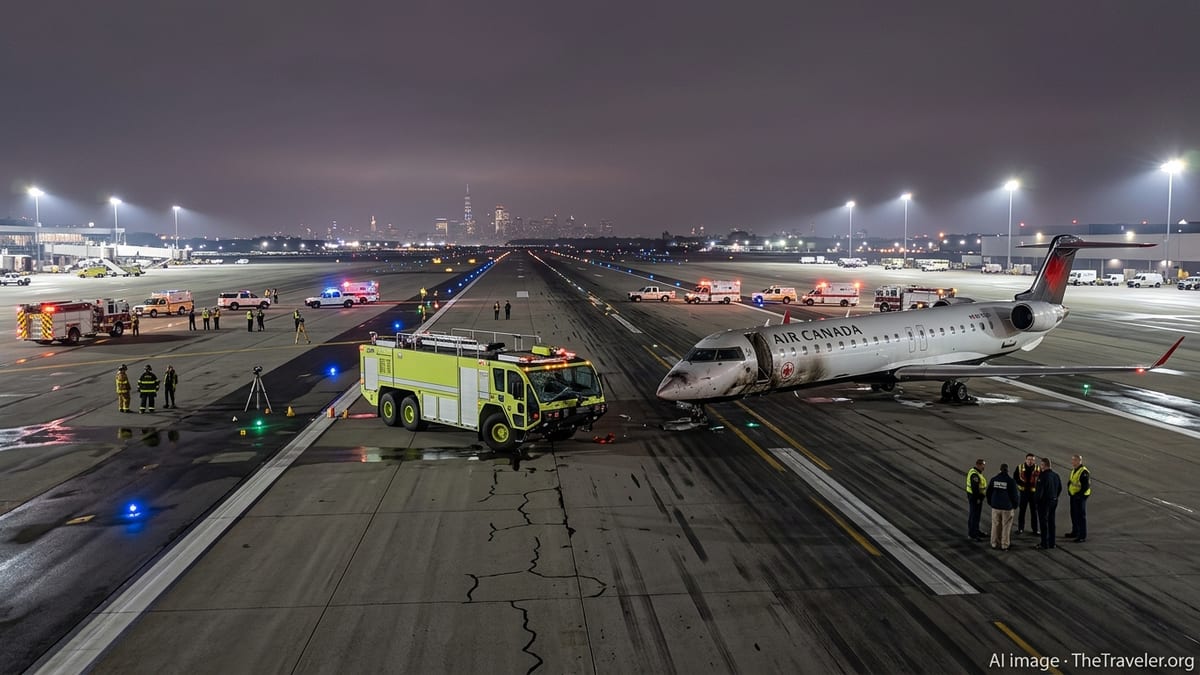
The Collision on the Runway
Publicly available information indicates that the crash occurred late on Sunday, March 22, 2026, when an Air Canada Express Bombardier CRJ900 arriving from Montreal struck a Port Authority fire truck on a LaGuardia runway during landing. The regional jet, operating as Flight 8646, was carrying more than 70 passengers and crew as it touched down in Queens.
Reports describe a high-speed impact that tore into the forward section of the aircraft and heavily damaged the fire truck. The pilots, both Canadian, were killed in the collision. Dozens of passengers and several members of the emergency vehicle’s crew sustained injuries ranging from minor to serious.
Initial accounts from published coverage note that the fire truck had entered the runway as part of a response to a separate incident elsewhere at the airport. Airport radio transcripts shared in media reports suggest that an air traffic controller attempted to halt the truck moments before impact, underscoring how rapidly the situation unfolded.
The crash marked the first fatal incident at LaGuardia in more than three decades, drawing immediate national attention to ground safety at congested U.S. airports.
Casualties, Injuries and Passenger Evacuation
Across multiple news outlets, the death toll has consistently been reported as two, both in the cockpit of the Air Canada Express aircraft. The pilots were pronounced dead after the collision, despite rapid response from on-site emergency crews already positioned on the airfield.
Dozens of other people were injured, including passengers, cabin crew and several members of the fire service. Various accounts put the total number of those treated at hospitals at around 40, with a smaller group remaining hospitalized in the days after the crash. Most of the injured have since been discharged, according to recent airline and hospital updates cited in news coverage.
Passengers described in published interviews how they escaped through emergency exits and down slides into a chaotic scene illuminated by runway lights and emergency vehicles. While some were able to walk away with minor cuts and bruises, others suffered fractures, head injuries and smoke inhalation as they navigated the damaged cabin.
The condition of the firefighters in the truck has been reported as serious but stable in several outlets, with expectations of recovery. The human toll on both aviation professionals and travelers has become a central focus of public reaction to the incident.
Airport Shutdown and Travel Disruption
The collision immediately shut down operations at LaGuardia overnight, with a ground stop that extended into Monday, March 23. Airport and airline statements cited in media reports show that all flights were halted for hours while emergency crews secured the scene and investigators documented the wreckage.
One of LaGuardia’s two main runways remained out of service for days, as the mangled CRJ900 and damaged fire truck blocked access. Work to remove the aircraft and clear debris only began in earnest once investigators had completed initial on-site examinations of the fuselage, engines and landing gear.
With capacity sharply reduced, flights were canceled or diverted across the region, affecting thousands of passengers on both domestic and international connections. Travelers reported extensive delays, missed connections and last-minute rebookings as airlines worked to reroute traffic to other New York area airports.
According to travel-industry coverage, the affected runway reopened later in the week, allowing LaGuardia to return gradually to more normal schedules. Even after physical operations resumed, however, residual delays and aircraft repositioning continued to ripple through airline networks.
What Investigators Are Examining
The National Transportation Safety Board and other aviation agencies have opened a full investigation into the collision. Public briefings and early reporting indicate that officials are focusing on how the fire truck came to be on the active runway at the same time the Air Canada Express jet was landing.
Key questions include whether there was any miscommunication between air traffic control, airport operations and emergency crews, and how warnings delivered over radio were handled in the seconds before the crash. Investigators are expected to analyze audio recordings, radar data, airport surface movement logs and written procedures for runway access during emergencies.
The cockpit voice recorder and flight data recorder from the CRJ900 have reportedly been recovered and will be central to reconstructing the sequence of events in the final minutes of the flight. Analysts will also look at environmental conditions, such as visibility and lighting, and any potential mechanical issues, although early coverage has not highlighted technical faults with the aircraft.
Safety experts quoted in news analyses have noted that LaGuardia is equipped with advanced ground surveillance systems designed to reduce the risk of runway incursions. Part of the inquiry will likely assess how those systems were operating that night, and whether staffing levels, workload or procedural gaps contributed to the tragedy.
Runway Safety Under Renewed Scrutiny
The LaGuardia crash comes after a series of less severe ground incidents at the same airport and at other major U.S. hubs, prompting growing concern about so-called runway incursions. In recent years, LaGuardia has seen low-speed collisions between taxiing jets, as well as minor contacts with ground vehicles, none of which resulted in fatalities.
Aviation analysts writing in major outlets have pointed to rising traffic volumes, tight schedules and staffing pressures in air traffic control as factors that can strain safety margins on the ground. The fatal collision at LaGuardia has intensified calls for renewed investment in technology, training and procedures aimed specifically at preventing conflicts between aircraft and vehicles on or near runways.
Airlines and airport operators are expected to study the findings of the investigation carefully, particularly any recommendations related to emergency-response protocols. Questions are already being raised about how firefighting and rescue vehicles are dispatched and cleared across active runways when responding to separate incidents.
For travelers, the crash serves as a stark reminder that some of aviation’s most serious risks can occur not in the air, but during the critical phases of landing, takeoff and ground movement. As New York’s key domestic airport resumes normal operations, attention is now turning to how lessons from this collision will be translated into practical changes designed to keep aircraft and ground crews safely separated in the years ahead.