

More news on this day
A deaf Georgia woman’s viral claim that she was removed from a Frontier Airlines flight for “not listening” has sparked a heated debate over disability discrimination in air travel, as the carrier counters that the removal stemmed from her bringing an open alcoholic drink on board.
Get the latest news straight to your inbox!
Conflicting Accounts From Passenger and Airline
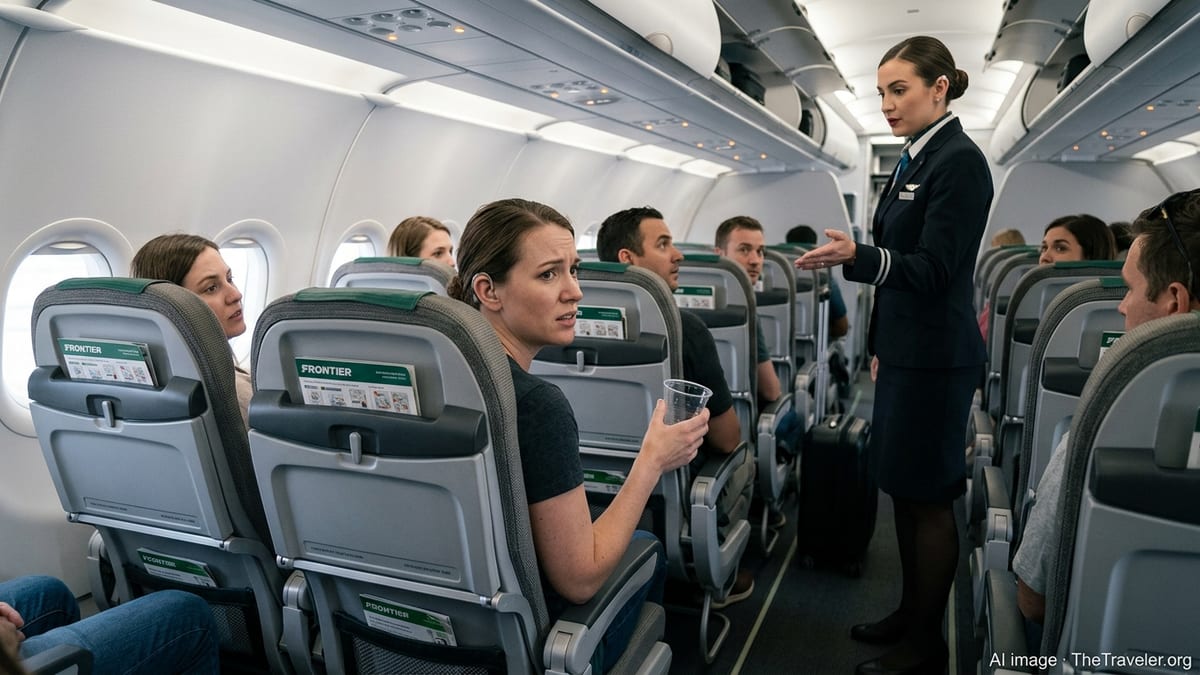
The incident occurred on a Frontier Airlines flight departing from Atlanta, after the woman, who identifies as deaf, shared videos on social media describing what she called a humiliating removal rooted in her disability. She said she was seated in an exit row when a flight attendant questioned her ability to hear verbal instructions, and that she was ultimately told to leave the aircraft because she did not respond in the way the crew expected.
In her posts, the passenger framed the episode as a clear case of disability discrimination, asserting that she repeatedly informed the crew about her hearing loss and attempted to explain how she communicates. She described feeling singled out, accusing Frontier of failing to accommodate a deaf traveler and alleging that the phrase “you’re not listening” was used as justification for taking her off the plane.
Frontier Airlines later issued a detailed public statement presenting a sharply different narrative. According to the company’s account, crew members reported that the passenger boarded with a cup containing alcohol purchased in the terminal and acknowledged that it was an alcoholic drink when questioned. The carrier maintains that the resulting policy violation, not her hearing status, led the crew to decide she could not remain on that particular flight.
The airline’s statement also noted that there was no disability notation connected to her reservation and that staff who interacted with her said she was able to converse with them during boarding and the pre-departure period. Disability advocates observing the case, however, have pointed out that many deaf and hard-of-hearing people communicate effectively by speaking and lip-reading, and that conversational ability does not negate the need for reasonable accommodations.
Alcohol Policy and Federal Rules in the Spotlight
Central to Frontier’s account is the allegation that the passenger violated rules governing alcohol on board. Publicly available information on airline and federal policy indicates that passengers are not allowed to consume their own alcohol during a commercial flight, whether purchased at an airport bar or brought from elsewhere, and open containers from the terminal generally cannot be carried onto the aircraft cabin.
Frontier’s statement describes a sequence in which the flight attendant noticed the drink, informed the passenger that carrying it onto the aircraft contravened both company policy and federal law, and then saw her quickly finish the remaining contents before handing over the cup. The airline argues that this behavior, combined with the original violation, prompted the crew to determine that she should be removed and rebooked on a later service.
These details have become a focal point in the public reaction. Some commenters on social platforms and in online forums have stressed that, if accurate, an open-alcohol violation gives the carrier a clear procedural basis for removal regardless of disability status. Others counter that even when a rule violation occurs, the way in which crew communicate with and manage a disabled passenger is still subject to federal nondiscrimination protections.
The dispute highlights how alcohol enforcement and disability rights can collide in the confined, high-stakes environment of an aircraft cabin. Flight attendants have broad discretion to address potential safety and compliance concerns, yet federal guidance also underscores that policy enforcement must not be influenced by bias about a traveler’s disability.
Disability Rights Framework for Air Travelers
The controversy around the Frontier incident is unfolding against a backdrop of increasing scrutiny of how airlines treat passengers with disabilities. Under the Air Carrier Access Act, U.S. and foreign airlines serving the United States are prohibited from discriminating against qualified individuals on the basis of disability, including those who are deaf or hard of hearing.
Recent guidance from the U.S. Department of Transportation emphasizes that carriers may not deny boarding or remove a passenger solely because of a disability, and that they must provide reasonable accommodations such as alternative communication methods when verbal instructions may not be accessible. For deaf travelers, that can include written notes, visual demonstrations of safety procedures, or ensuring that safety briefings are understandable without relying exclusively on spoken announcements.
Advocacy groups note that conflict often arises at the intersection of safety rules and communication gaps. For example, passengers seated in exit rows must be able to understand and perform safety instructions, and crew are responsible for confirming that each person in those seats can assist in an emergency. When hearing loss is involved, clear alternatives to oral briefings become especially important to avoid misinterpretation or the perception that a traveler is being penalized for a disability.
The current case also comes as disability-related complaints in air travel have been drawing more attention. Government data on recent years show that passengers regularly report issues ranging from communication barriers for deaf and hard-of-hearing travelers to problems with mobility devices, prompting regulators to update rules and enforcement priorities. The Frontier incident is now being cited by some observers as another example of the need for training that combines safety enforcement with disability awareness.
Social Media Reaction and Broader Airline Scrutiny
Once the woman shared her account online, video clips from the cabin and from the jet bridge spread quickly across social platforms. Viewers saw portions of the interaction between the passenger, cabin crew, and another staff member escorting her off the flight, though the clips did not capture the entire lead-up. The woman’s narration, presented over the footage, focused on her deafness and the phrase “not listening,” prompting many early viewers to frame the incident primarily as a disability discrimination story.
As additional reporting emerged that included Frontier’s version of events and references to the alleged open-container issue, the tone of online discussion became more divided. Some commenters expressed continued support for the passenger, questioning whether the alcohol explanation was introduced later as a way to defend against public criticism. Others viewed the airline’s description as more plausible, arguing that undisclosed facts about alcohol consumption substantially altered their perception of what happened on board.
The episode has also contributed to a wider reexamination of how airlines interact with deaf passengers. In separate, earlier incidents involving other carriers, travelers with hearing loss have described being challenged over “not listening,” being misperceived as intoxicated because of deaf speech patterns, or struggling to obtain written explanations of last-minute schedule changes. Advocates say these recurring patterns point to the need for more consistent training in deaf awareness and communication strategies for front-line staff.
For travelers, the viral nature of the Frontier dispute has become a cautionary tale on several fronts. Disability-rights commentators encourage deaf and hard-of-hearing passengers to note their disability in reservations when possible, carry documentation of communication preferences, and request accommodations early in the travel process. At the same time, legal and travel analysts stress that adherence to airport and in-flight alcohol rules is critical, since violations can quickly escalate into removal decisions regardless of a traveler’s underlying circumstances.
Ongoing Questions About Accountability and Training
As of late March 2026, no public record shows that the woman has filed a lawsuit related to the Frontier removal, and there is no indication of a regulatory enforcement action specifically tied to this flight. However, published coverage and online commentary suggest that the incident could still draw legal interest, particularly if more complete footage or documentation surfaces about the interaction over alcohol and the exchange regarding her disability.
Observers watching the case say there are unanswered questions on both sides. Disability advocates want more clarity on what efforts, if any, were made to communicate with the passenger using writing or visual cues, and whether crew considered relocating her from the exit row rather than removing her from the flight entirely. Others have asked whether any objective assessment of intoxication was conducted, beyond the presence of an open drink and the disputed allegation of quickly consuming it.
For Frontier, the episode underscores how sensitive disability-related disputes have become for airlines with growing complaint volumes and heightened media attention. Publicly available job and training materials from carriers highlight equal-opportunity and nondiscrimination commitments, but critics argue that real-world practice at crowded gates and in cramped cabins can fall short of policy language if staff are not given the tools and time to apply those standards.
In the absence of a formal resolution, the Frontier case is likely to remain a flashpoint in broader debates over how U.S. airlines balance strict adherence to alcohol and safety rules with the obligation to provide accessible service. For deaf travelers in particular, it has become a vivid example of how misunderstandings at the intersection of disability and policy can quickly escalate from a communication problem to a removal that dominates national attention.