

More news on this day
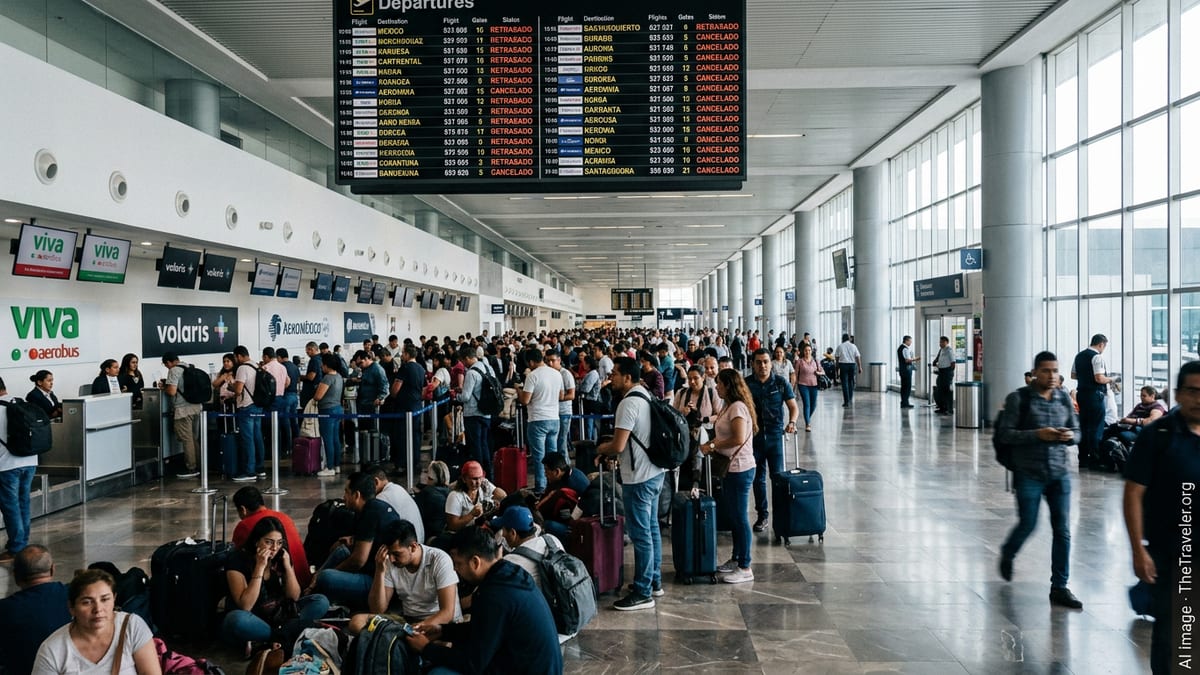
Air travel in and out of Mexico City and Monterrey faced fresh disruption this week, with at least 104 flight delays and 17 cancellations reported across multiple carriers, complicating plans for domestic and international travelers.
Get the latest news straight to your inbox!
Major Mexican Hubs Struggle With Fresh Wave of Disruptions
Mexico City’s Benito Juárez International Airport and Monterrey International Airport, two of the country’s busiest hubs, have once again found themselves at the center of a wave of flight disruptions. Monitoring data and airport operations reports indicate that more than one hundred flights experienced significant delays while nearly twenty were canceled within a short window, affecting both domestic and cross-border routes.
The latest interference comes during an already pressured period for Mexican aviation, as carriers balance strong demand for both leisure and business travel with operational constraints, aircraft availability issues and tight turnaround schedules. Travelers connecting through Mexico City to destinations such as Cancún, Guadalajara and international gateways in the United States and Canada were among those caught up in the delays.
Monterrey, a key industrial and corporate hub, saw knock-on effects as late-arriving aircraft from Mexico City and other cities compressed schedules and led to further slippage throughout the day. With several airlines concentrating capacity on the Mexico City–Monterrey corridor, even localized disruptions quickly cascaded across timetables.
While some flights eventually departed with lengthy delays, others were scrubbed entirely, leaving passengers scrambling for last-minute rebookings, hotel rooms and alternate routes.
VivaAerobus, Volaris, AeroMéxico, Mesa and Others Hit
Low cost operators VivaAerobus and Volaris, along with flag carrier AeroMéxico, were among the most affected airlines, joined by regional and partner carriers including Mesa Airlines and others operating codeshare services. The mix of domestic point to point routes and international connections amplified the impact, as disruptions on short sectors rippled into long haul operations.
On the core Mexico City–Monterrey route, which is typically served by VivaAerobus, Volaris and AeroMéxico with dense frequencies throughout the day, delayed turnarounds compressed already tight schedules. Aircraft starting the morning only slightly behind plan were running hours late by afternoon, leaving airport departure boards dominated by revised times and “delayed” notices.
U.S. regional operator Mesa Airlines, which provides feeder services for larger U.S. carriers and coordinates schedules with Mexican partners, also experienced schedule interference where its operations connected with flights from Mexico City and Monterrey. Passengers on transborder itineraries reported missed connections, extended ground waits and rebookings onto later services.
Although some international carriers serving Mexico City and Monterrey registered only isolated delays, the clustering of problems among Mexican airlines underscored the strain on domestic networks and the sensitivity of tightly banked schedules.
Operational Pressures, Weather and Airspace Constraints
Airline and airport sources pointed to a combination of operational and environmental pressures behind the latest wave of delays and cancellations. Periodic congestion in Mexico City airspace, routine runway saturation at peak hours and tight aircraft utilization across low cost fleets have all limited the system’s ability to absorb even minor disruptions.
At Mexico City’s main airport, late gate changes, ground handling bottlenecks and crew rotation constraints further slowed turnarounds. When individual departures slipped beyond their assigned slots, knock-on effects were felt on later flights using the same aircraft or crew, especially on high frequency routes like Mexico City–Monterrey.
Weather has also played a recurring role in recent weeks, with intermittent low clouds, fog and seasonal storms periodically affecting operations at both airports. Even when conditions improve quickly, backlogs of delayed departures can take hours to clear, making it difficult for airlines to recover full schedule regularity the same day.
For carriers such as VivaAerobus and Volaris, which rely on high daily utilization of narrowbody fleets, any unplanned maintenance event or required software update can tighten capacity further. Flag carrier AeroMéxico, though operating with a more diverse network and fleet, is not immune when Mexico City’s constrained infrastructure limits its flexibility to reshuffle aircraft and crews.
Traveler Impact: Missed Connections and Overnight Stays
The operational turbulence translated directly into disrupted plans for hundreds of passengers traveling through Mexico City and Monterrey. Reports from both airports described long lines at check in counters and customer service desks as travelers sought information on revised departure times, missed connections and ticket changes.
Business travelers shuttling between Monterrey and the capital reported same day meeting itineraries being thrown into disarray as morning delays bled into afternoon schedules. Leisure travelers connecting onward to beach destinations or international flights faced the risk of missed onward segments, with some forced into unexpected overnight stays or reroutes through alternative hubs.
Families traveling with children and elderly passengers were particularly vulnerable to the uncertainty, often waiting for hours in crowded departure halls as departure times shifted repeatedly. Without timely communication, many found themselves relying on airport displays and word of mouth rather than proactive notifications.
While airlines provided rebooking options where space allowed, peak season load factors across popular Mexican routes meant that same day alternatives were limited. In several cases, travelers accepted rerouting via secondary airports or different cities in order to reach their final destinations within a reasonable timeframe.
What Airlines and Airports Are Advising Now
In response to the latest disruptions, airlines operating at Mexico City and Monterrey have urged passengers to build extra time into their travel plans, especially when making tight domestic or international connections. Carriers are encouraging customers to monitor flight status frequently through mobile apps and to arrive at the airport well ahead of scheduled departure times.
Customer service teams for VivaAerobus, Volaris, AeroMéxico and partner airlines have been fielding increased volumes of calls and digital inquiries, with a focus on rebooking options, refund eligibility and, where applicable, compensation rules for significant delays or cancellations. Travelers are being reminded to keep boarding passes and receipts on hand in case they need to document extra expenses incurred during long disruptions.
Airport authorities at both Mexico City and Monterrey have reiterated that they are coordinating closely with airlines and air traffic control to smooth peak traffic flows and reduce congestion on the ground. Additional staff have been deployed during busy periods to manage queues, assist with wayfinding and help passengers understand their options when flights are delayed or canceled.
For now, with demand remaining high and schedules running close to capacity, travelers planning itineraries through Mexico City or Monterrey in the coming days are being advised to stay flexible, monitor conditions closely and prepare for the possibility of further schedule changes as airlines work to stabilize operations.