

More news on this day
Passengers traveling through Amman’s Queen Alia International Airport are facing fresh disruption after 19 delays and 27 cancellations hit services linking the Jordanian capital with Riyadh, Doha, and Cairo, adding a new layer of uncertainty to an already fragile Middle East air travel network.
Get the latest news straight to your inbox!
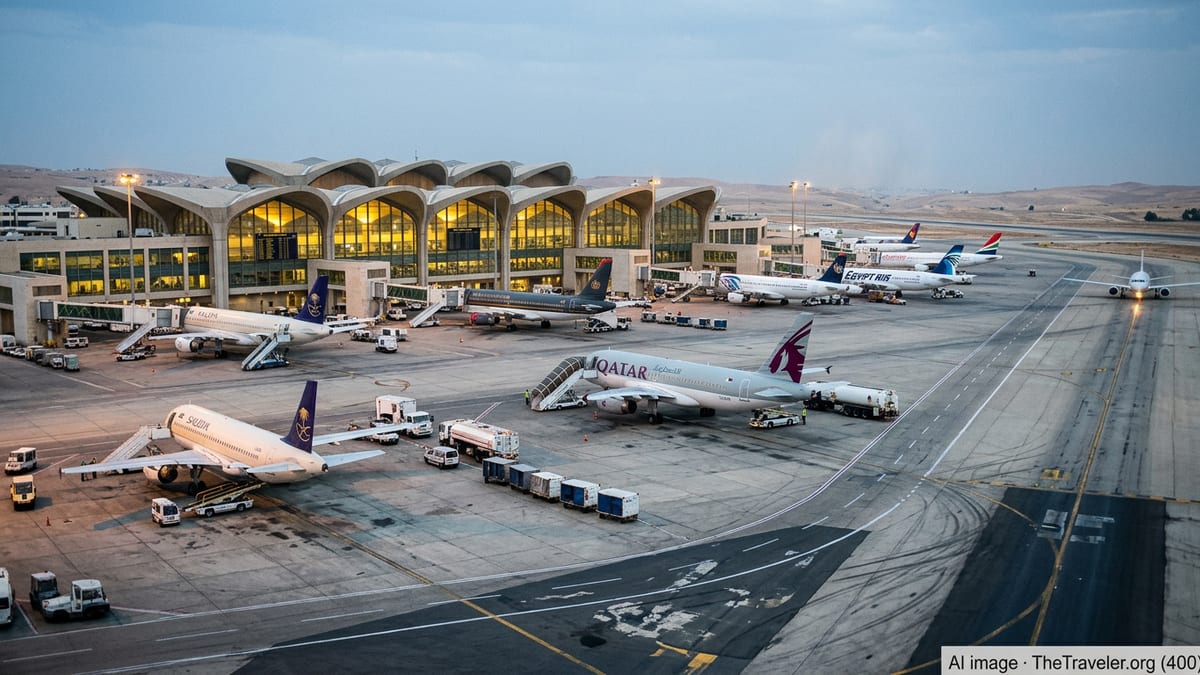
Regional Turbulence Reaches Amman Hub
Publicly available flight tracking data and regional aviation reports indicate that Queen Alia International Airport, Jordan’s primary gateway, has become a flashpoint for delays and cancellations as airlines recalibrate operations in response to shifting security and airspace conditions. Recent figures show 19 delayed and 27 cancelled flights connected with Saudia, Royal Jordanian, Qatar Airways, and Egypt Air on routes touching Amman, Riyadh, Doha, and Cairo, compressing capacity on some of the region’s most heavily used corridors.
The latest disruption follows weeks of instability for Middle East aviation, with airspace adjustments and route suspensions rippling across hubs such as Doha and Riyadh. Monitoring platforms tracking flight movements through Queen Alia show repeated schedule changes, short-notice cancellations, and extended ground times for aircraft, particularly on services that would normally provide onward connections across the Gulf, North Africa, and Europe.
While operations at Queen Alia have gradually expanded from the most restrictive phases of recent airspace closures, travel conditions remain volatile. Published coverage focused on the region notes that many carriers are still operating limited schedules or daylight-only services into Jordan and neighboring states, which constrains flexibility when disruptions occur and increases the likelihood that delays cascade into outright cancellations.
According to industry data collated over the past several weeks, Jordan’s main airport has been operating under “open but limited” conditions, with Royal Jordanian carrying much of the load on key routes while partner and competitor airlines adjust exposure. The fresh cluster of delays and cancellations involving Saudia, Qatar Airways, and Egypt Air underscores how even incremental schedule changes at one hub can ripple rapidly across interconnected networks.
Saudia, Royal Jordanian, Qatar Airways, and Egypt Air Under Strain
The four airlines at the center of the latest disruption represent a cross-section of the region’s national carriers and key network operators. Saudia, the Saudi flag carrier, has already been adapting its Riyadh and Jeddah operations amid broader Gulf-wide route changes, and regional advisories in early March highlighted temporary suspensions and rerouting affecting flights to Amman and Doha. When schedules tighten in Riyadh, knock-on effects quickly reach Queen Alia, where Saudia’s services provide important links for travelers heading deeper into the kingdom or onward to Asia and Europe.
Royal Jordanian, for its part, remains the backbone of scheduled traffic at Queen Alia. Operational updates shared through travel advisories and logistics briefings in recent days describe Jordan as open but limited, with services concentrated on core destinations, including Riyadh, Doha, and Cairo where conditions permit. With many foreign carriers trimming flights into Amman or restricting operations to certain hours, any disruption to Royal Jordanian rotations can have outsized impact on passenger options.
Qatar Airways has been grappling with its own constraints centered on Doha, where restricted airspace and security considerations have led to a reduced or highly modified schedule. Press statements and public travel alerts this month describe a patchwork of limited operations and relief services rather than the dense global schedule usually associated with Hamad International Airport. These limitations affect Amman–Doha connectivity directly and also undermine Queen Alia’s role as a stepping-stone for passengers relying on Qatar Airways for long-haul connections.
Egypt Air’s network pressures have also fed into the turbulence around Amman. Cairo remains a major hub for travelers seeking alternative routings when Gulf gateways are disrupted, but recent advisories point to targeted cancellations and longer transit times on some Egypt Air services. With Amman–Cairo flights forming part of many contingency itineraries for travelers avoiding higher-risk airports, cancellations on this route can close off one of the few remaining fall-back options.
Impact on Amman, Riyadh, Doha, and Cairo Passengers
The concentration of delays and cancellations between Amman, Riyadh, Doha, and Cairo has particular significance because these cities serve as regional junctions. Many passengers on these routes are not traveling point-to-point but are instead connecting between Europe, Asia, the Gulf, and North Africa. When a Royal Jordanian or Saudia flight between Amman and Riyadh is delayed or cancelled, publicly available data on missed onward connections suggests that travelers can quickly find themselves stranded with limited rebooking choices.
For those connecting via Doha, the situation is even more delicate. With Qatar’s airspace subject to intermittent closure and restrictions in recent weeks, Qatar Airways has publicly outlined a reduced schedule, with some days dominated by limited relief flights rather than regular commercial services. This means that an Amman–Doha cancellation rarely affects just one leg; it can disrupt multi-country itineraries reaching as far as London, Bangkok, or Sydney, leaving passengers scrambling for alternative routes at short notice.
Cairo’s role as a regional back-up hub has been partially constrained as well. According to travel-industry briefings, Egypt’s main airports remain open but with thinner schedules and extended routing times due to detours around sensitive airspace. Egypt Air cancellations linking Cairo to Amman, combined with earlier cuts to flights serving certain higher-risk destinations, reduce the number of workable one-stop combinations for travelers trying to avoid hubs with more severe restrictions.
At Queen Alia itself, the operational picture is one of intermittent congestion rather than a full shutdown. Travelers arriving into Amman report staggered queues at check-in and transit counters as airline staff work within sharply defined windows for departures and arrivals. Because many carriers are prioritizing daytime operations in line with risk assessments, canceled evening flights leave little time to recover the schedule, contributing to the cluster of 19 delays and 27 cancellations now recorded on the Amman–Riyadh–Doha–Cairo corridor.
Travelers Confront Uncertain Timetables and Limited Alternatives
For individual passengers, the numbers translate into practical difficulties that go beyond longer wait times. Data from flight-status portals show multiple services being retimed repeatedly in the hours before departure, only to be cancelled outright once operational or security constraints tighten. This pattern has been visible on several recent days for both Royal Jordanian and its regional counterparts operating into Riyadh, Doha, and Cairo.
Publicly shared accounts on travel forums and social platforms describe travelers facing overnight stays in Amman or Riyadh after missed connections, with some rebooked on indirect itineraries through relatively less affected airports in Oman or Europe. Because airline schedules into Jordan and neighboring states are already thinner than usual, the pool of spare seats is small, and re-accommodating passengers from 27 cancelled flights can take several days.
The knock-on effect reaches those still planning journeys into late March and April. Discussions among travelers booking from Europe to Amman or Cairo show growing uncertainty about whether flights will operate as ticketed or be subject to rolling cancellations as conditions evolve. Some are shifting to carriers that route through airports seen as more stable, while others are delaying travel altogether until published schedules stabilize and airspace restrictions ease.
Aviation analysts monitoring the situation say the pattern of scattered but significant disruption at Queen Alia and its partner hubs is consistent with a region operating under ongoing security and operational constraints rather than a short, weather-driven event. With core airlines such as Saudia, Royal Jordanian, Qatar Airways, and Egypt Air all adjusting timetables in real time, passengers on the Amman–Riyadh–Doha–Cairo axis are likely to face further irregularities even if overall flight numbers gradually recover.
What the Disruption Signals for Middle East Air Travel
The cluster of 19 delays and 27 cancellations on these four carriers and four routes is modest compared with the hundreds of disruptions logged across the wider Middle East in recent weeks, but it offers a snapshot of how fragile the regional network remains. Queen Alia’s experience illustrates the challenges facing mid-sized hubs that depend on a mix of local flag carriers and powerful neighbor airlines to sustain connectivity.
Recent compilations of delay and cancellation data across the Gulf, Levant, and North Africa show that major hubs such as Dubai, Doha, Riyadh, and Cairo have all weathered waves of disruption linked to airspace closures, security alerts, and shifting route economics. Jordan’s main gateway sits downstream from many of those decisions, and the latest figures for Amman-bound flights operated by Saudia, Royal Jordanian, Qatar Airways, and Egypt Air point to a network that is still recalibrating.
For now, publicly available information suggests that travelers can still reach Amman, Riyadh, Doha, and Cairo, but only with a greater tolerance for last-minute changes. Industry observers note that airlines are using schedule cuts and selective cancellations as a way to manage risk while keeping core corridors open. Until airspace patterns and security conditions become more predictable, airports like Queen Alia are likely to see periodic flares of travel turmoil similar to the latest wave of delays and cancellations.
For passengers, the practical message is to treat schedules on the Amman–Riyadh–Doha–Cairo routes as provisional, even when flights appear confirmed. With carriers regularly adjusting operations in response to regional developments, the experience at Queen Alia International Airport this week underlines how swiftly plans can unravel across one of the Middle East’s most important travel crossroads.