

More news on this day
Travelers moving through New York’s John F. Kennedy International Airport on March 10 faced mounting disruptions as at least 118 delays and nine cancellations rippled across departures and arrivals operated by Delta Air Lines, American Airlines, JetBlue, British Airways and other major carriers, complicating journeys for passengers from New York, New Jersey, Connecticut and beyond.
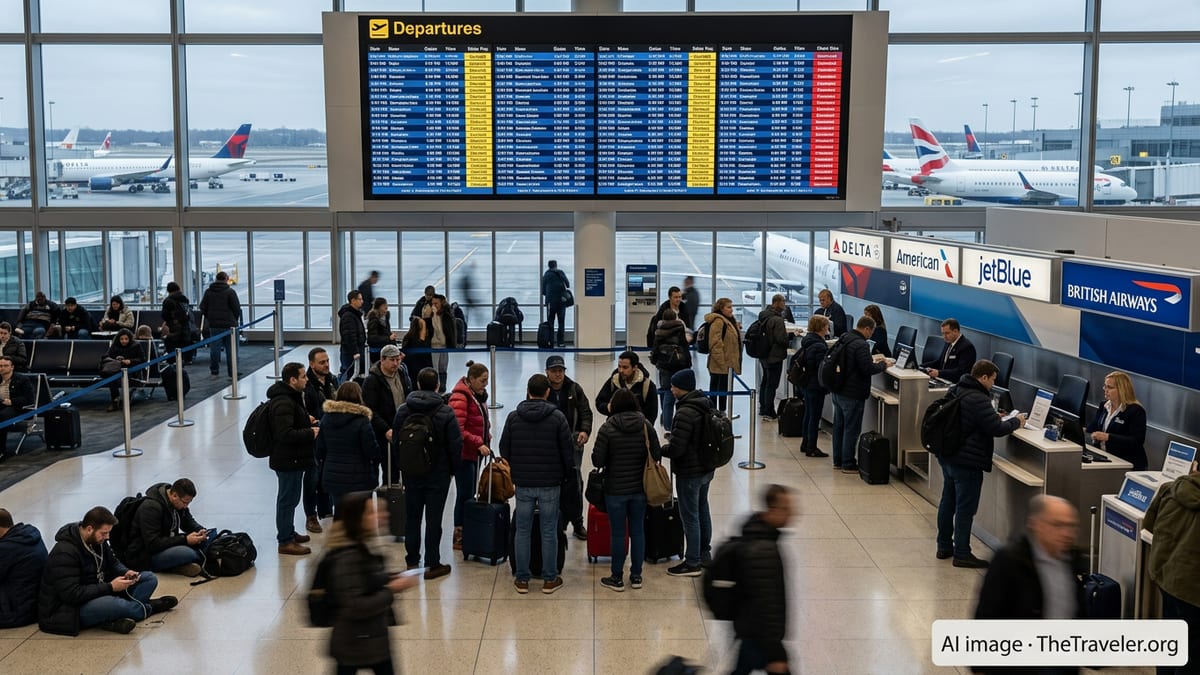
Operational Turbulence Hits Major Carriers at JFK
Flight-tracking data on Tuesday showed a broad but uneven impact across airlines serving JFK, with a cluster of morning and midday departures pushed back and a smaller number of flights scrubbed entirely. While the total of 118 delays and nine cancellations represents only a fraction of daily movements at one of the nation’s busiest gateways, the timing around peak travel periods amplified the disruption for thousands of passengers across the tri-state region.
Delta, American Airlines and JetBlue collectively accounted for a substantial share of the affected schedule, according to real-time aviation data, as crews and aircraft were repositioned and flight plans refiled. International partners, including British Airways and other European and transatlantic operators, also reported delays on several services into and out of JFK, compounding the knock-on effects for connecting travelers destined for cities across the United States and overseas.
For many passengers, relatively modest delays of 30 to 90 minutes proved consequential, forcing missed connections at downstream hubs and requiring last-minute rebooking. Airline staff at JFK reported heavier-than-usual lines at rebooking desks and customer service counters, even as most flights continued to operate.
Tri-State Travelers Confront Longer Lines and Missed Connections
The impact of Tuesday’s disruptions extended well beyond Queens, as travelers originating in New York City’s outer boroughs, northern New Jersey and southwestern Connecticut scrambled to adjust their plans. Many had started their journeys hours earlier on commuter rail and highway routes feeding into the airport, only to be met with crowded terminals and rolling departure-time changes on the boards.
At Terminal 4 and Terminal 5, passengers described packed security lanes and gate areas as families, business travelers and international visitors juggled work calls, visa appointments and connecting itineraries. Those with same-day links to cities such as Los Angeles, Miami, London and Madrid were among the most vulnerable, with even brief outbound delays at JFK narrowing connection windows at onward hubs.
Some travelers from New Jersey and Connecticut reported weighing whether to divert to Newark Liberty International Airport or LaGuardia Airport for alternative flights. However, with airlines consolidating operations and many routes operating close to capacity, same-day options were limited and often required lengthy detours through distant hubs.
JetBlue Ground Stop and Broader System Strains
The day’s operational challenges at JFK unfolded against the backdrop of a brief nationwide ground stop requested by JetBlue earlier on March 10, after the carrier reported a technology issue affecting its systems. The Federal Aviation Administration confirmed that it temporarily halted JetBlue departures before lifting the restriction once the airline addressed the problem, allowing flights to resume.
While the ground stop was short-lived, it added pressure to an already tight operating environment in the New York airspace. JetBlue, which maintains a significant presence at JFK, spent much of Monday and early Tuesday recovering from the earlier disruption, working through a backlog that had already produced more than 150 delays and several cancellations systemwide in the preceding 24 hours.
Aviation analysts noted that even minor technology outages or schedule adjustments can quickly cascade across complex airline networks, particularly at slot-constrained airports such as JFK. When combined with routine challenges such as crew duty-time limits, air traffic control spacing and ground congestion, a handful of early disruptions can multiply into dozens of delayed departures by midday.
Weather, Congested Airspace and Tight Schedules Expose Vulnerabilities
Although Tuesday did not bring a major storm to New York City, intermittent low clouds, gusty winds and periodic traffic-management initiatives imposed by air traffic controllers contributed to slower-than-normal operations at JFK. The airport’s tightly choreographed takeoff and landing patterns leave little margin when visibility drops or crosswinds increase, often forcing brief ground holds and extended taxi times.
New York’s exceptionally busy airspace, shared by JFK, LaGuardia and Newark, further magnifies the impact of any constraint. When controllers meter departures or arrivals for safety, flights from multiple carriers and airports must compete for limited slots, and even airlines with otherwise healthy operations can incur delays that reverberate throughout the day.
Industry observers say the episode highlights how fragile peak-hour schedules can be, especially in late winter and early spring when weather conditions are changeable and airline networks remain lean from off-peak adjustments. The combination of full flights, tightly timed aircraft rotations and long-haul international services leaves carriers with fewer backup options when something goes wrong.
Airlines Urge Passengers to Check Status and Allow Extra Time
In response to the disruptions, airlines serving JFK urged passengers to monitor their flight status closely through mobile apps, text alerts and airport information screens. Several carriers offered limited change-fee waivers or flexible rebooking options for those willing to shift to later flights, particularly on heavily delayed routes.
Airport and airline representatives also encouraged travelers with departing flights on March 10 and March 11 to arrive earlier than usual, citing ongoing congestion at check-in counters and security checkpoints. Passengers with international itineraries, or those requiring special assistance or document checks, were advised to build in additional buffer time to avoid missing boarding cutoffs.
For travelers still set to pass through JFK over the coming hours, the message is one of cautious patience: Most flights are operating, but schedules remain fluid. As airlines work to clear residual delays and reposition aircraft, conditions at New York’s main international gateway are expected to gradually stabilize, though further timetable adjustments remain possible if weather, technology or airspace constraints resurface.