

More news on this day
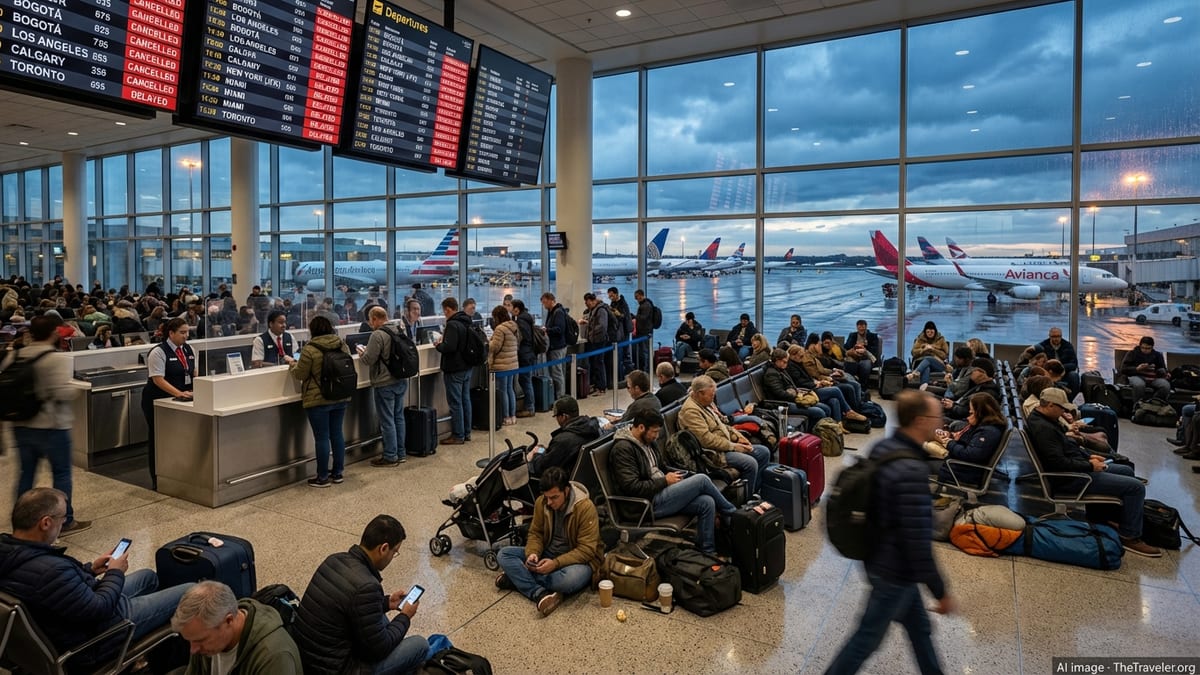
Passengers departing New York’s John F. Kennedy International Airport on April 2 faced mounting disruptions as regional and international carriers reported extensive delays and a growing number of cancellations on routes across the United States and Canada.
Get the latest news straight to your inbox!
Operational Strains Hit Regional and International Carriers
Publicly available flight data for April 2 shows knock-on delays affecting a range of operators serving New York, Chicago, Montreal and other major hubs. Regional partners such as Endeavor Air and Republic Airways, which operate connecting services for larger U.S. airlines, appeared among the carriers experiencing schedule pressure alongside British Airways and Jazz Aviation.
Metrics compiled in recent U.S. Department of Transportation air travel consumer reports indicate that Endeavor Air and Republic Airways typically post high on time performance at major airports, including New York and Chicago. The elevated disruptions on April 2 therefore reflect unusual strain relative to their usual reliability rather than long term deterioration in service.
Jazz Aviation, which operates as Air Canada Express on many cross border routes to and from Montreal, has also been under close scrutiny since a serious runway incident involving one of its flights at New York LaGuardia in late March. While that event occurred at a different airport, its proximity in time has added to traveler sensitivity around schedule changes on regional links between New York and Canadian cities.
For British Airways, which relies on a mix of its own metal and U.S. codeshare partners to feed transatlantic services, disruption on domestic legs can quickly cascade into missed connections. Several British Airways coded regional flights involving Chicago reported same day cancellations or multi hour delays, compounding stress for travelers aiming to connect onward to or from New York.
Chicago Links See Cancellations and Rolling Delays
Routes touching Chicago emerged as some of the most affected on April 2. Flight tracking boards showed multiple cancellations on services feeding O’Hare International Airport, including American Airlines regional operations that carry British Airways codes. One such San Antonio to Chicago flight operating under several partner designators, including British Airways, was listed as canceled after being scheduled for midafternoon departure.
British Airways coded flights between Midwestern and Great Lakes cities also saw shifting departure times. An Indianapolis to Chicago service, operated by a U.S. partner airline, was recorded as canceled shortly before departure. Additional American Airlines services between Chicago and regional markets such as Omaha were flagged with departure pushes approaching two hours, further tightening connection windows for passengers relying on O’Hare to reach New York.
United Airlines operations into Chicago were not immune. A Montego Bay to Chicago service scheduled for the afternoon was rescheduled more than two and a half hours later than planned, according to real time status boards. That adjustment, while categorized as a delay rather than a cancellation, still created uncertainty for passengers aiming to connect onward to the East Coast.
These disruptions at Chicago have a direct bearing on New York bound traffic because many itineraries between secondary U.S. cities and JFK rely on same day connections through O’Hare. Even when New York flights depart close to schedule, missed inbound connections can leave travelers stranded or rebooked onto later departures.
Montreal and Cross Border Traffic Under Pressure
Montreal bound and Montreal originating travelers also experienced a more fragile network on April 2. Jazz Aviation, which operates Air Canada Express services between major U.S. gateways and Canadian cities including Montreal, plays a central role in cross border connectivity. Earlier federal data sets already highlighted the carrier among those experiencing extended tarmac delays on some long haul international routes touching New York area airports.
Recent safety events have heightened regulatory and public attention on cross border regional operations. In late March, an Air Canada Express flight operated by Jazz Aviation was involved in a runway collision with an emergency vehicle at LaGuardia. While the incident did not involve JFK, it has placed Jazz operations in the New York region under intense review, adding complexity to any recovery from weather or airspace related disruption.
For passengers, the practical impact is a more brittle schedule on routes between New York and major Canadian hubs such as Montreal and Toronto. Even modest delays on feeder legs can translate into missed international departures, especially for travelers connecting from U.S. interior cities through New York before continuing north of the border.
Publicly available information on April 2 showed a patchwork of delay codes and rolling schedule changes on cross border routes, rather than a single clear cause such as severe weather at one airport. That pattern is consistent with broader system pressure where congested airspace, operational constraints and ongoing investigations overlap.
Ground Stops and Wider System Stress at JFK
The turbulence at JFK on April 2 did not occur in isolation. Industry briefings on that date pointed to a Federal Aviation Administration traffic management plan that moved from general risk forecasts into at least one live bottleneck affecting flows along the U.S. East Coast. The same plan outlined the potential for ground stops and formal delay programs at several large airports, including JFK, O’Hare, Boston, Newark and Washington National.
Advisories described a combination of airspace congestion and weather variability as contributing factors, increasing the likelihood of holding patterns, reduced arrival rates and extended taxi times. For an already busy hub such as JFK, even short periods of constrained arrival or departure capacity can ripple quickly through regional schedules operated by carriers like Endeavor Air and Republic Airways.
Real time boards during the afternoon and evening of April 2 showed a mix of delayed departures to and from JFK, including JetBlue and other carriers on domestic and international routes. On some services, scheduled departure times slipped by more than an hour, reflecting the downstream impact of earlier airspace flow restrictions and late inbound aircraft.
As operations compressed into narrower time windows, airlines faced the choice of holding flights for connecting passengers where feasible or allowing some connections to misalign in order to keep aircraft and crew closer to their end of day positions. For travelers, that translated into crowded gate areas, rolling estimated times of departure and heightened competition for limited rebooking options.
What Travelers Can Expect in the Coming Days
While the most acute difficulties at JFK and its connecting hubs were centered on April 2, the pattern highlights how sensitive the U.S. air travel system remains to overlapping pressures. Carriers such as Endeavor Air and Republic Airways, which generally maintain strong on time records at large airports, can still see rapid deterioration in performance when ground stops, weather issues and prior safety investigations intersect.
Published on time statistics from the U.S. Department of Transportation continue to show relatively high completion and punctuality rates for these regional airlines over longer periods. Travelers, however, are likely to remember the concentrated disruption more vividly than the many uneventful operating days that surround it.
For routes connecting New York with Chicago and Montreal, public data suggests that schedules will gradually normalize as airspace constraints ease and investigations proceed on a separate track. Nonetheless, industry observers note that spring often brings volatile weather patterns across the Midwest and Northeast, meaning that additional pockets of delay remain possible even without major technical failures.
Passenger advocates advise that during such periods of heightened risk, travelers build extra connection time into itineraries involving JFK, O’Hare or key Canadian gateways, especially when journeys depend on multiple regional segments operated by different carriers. Flexible planning, along with careful monitoring of flight status on the day of travel, can reduce the chances that a localized disruption cascades into an extended stranding.