

More news on this day
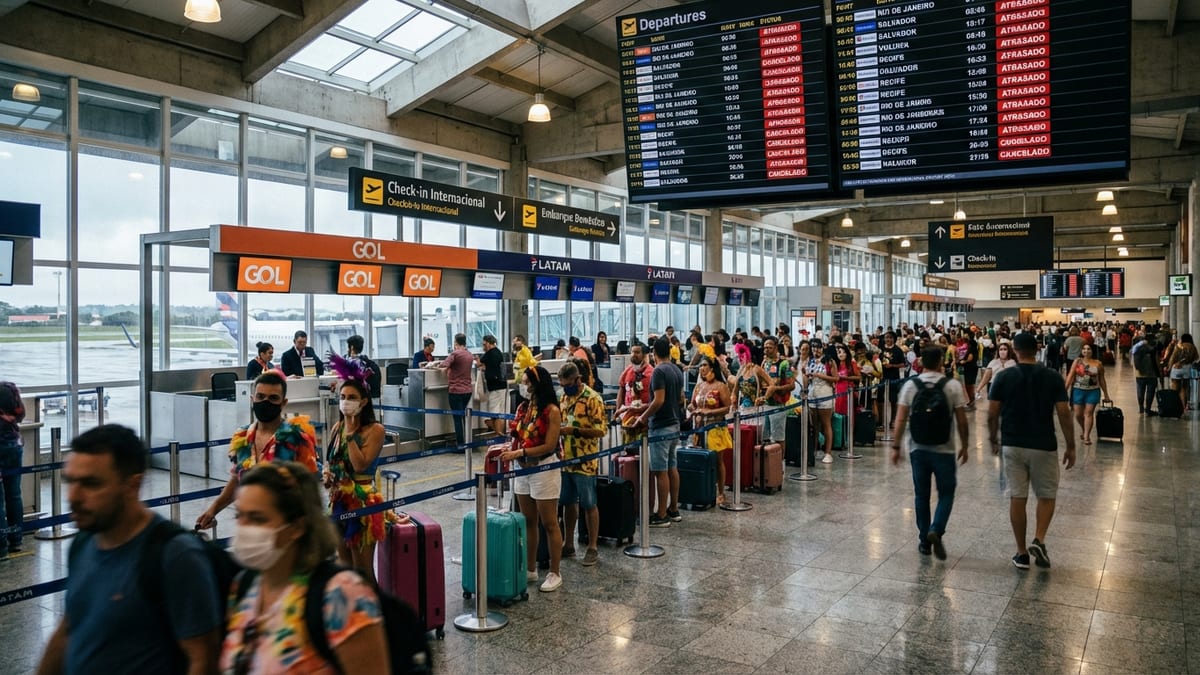
Brazilian air travelers faced fresh turbulence this Carnival week as GOL Linhas Aéreas and LATAM Airlines reported multiple cancellations and dozens of delays at São Paulo’s main airports, snarling domestic and international connections at one of Latin America’s busiest aviation hubs.
Fresh Disruption at Brazil’s Largest Aviation Hub
The latest wave of operational problems hit during one of the peak travel periods of the Brazilian year, with São Paulo’s Guarulhos and Congonhas airports under pressure from heavy Carnival traffic. While only four flights operated by GOL Linhas Aéreas and LATAM Airlines were fully cancelled, a far higher number suffered significant delays, leaving passengers in lengthy queues at check in, security, and boarding gates.
At Guarulhos, Brazil’s primary international gateway, departure boards across Terminals 2 and 3 showed a growing list of late departures to key domestic cities such as Brasília, Recife, and Porto Alegre, as well as long haul routes to Europe and the Caribbean. Congonhas, the central city airport that functions as a vital shuttle link for business and political traffic, also reported knocked on delays on shuttle corridors to Rio de Janeiro and Belo Horizonte as aircraft and crews fell out of rotation.
Airport staff reported that most operations continued, but with tight margins eroded by the combination of saturated schedules, stormy seasonal weather, and residual congestion from earlier disruptions over the Carnival weekend. With São Paulo already projected to handle well over a million passengers during the extended holiday window, even a small cluster of cancellations and late departures produced outsized effects.
Passengers arriving early on Tuesday expecting a quick getaway instead found crowded terminals, boarded and de boarded aircraft, and customer service desks struggling to reroute travelers whose connections through São Paulo were no longer viable.
GOL Linhas and LATAM at the Center of the Turbulence
GOL Linhas Aéreas and LATAM Airlines, Brazil’s two largest carriers by market share, sat at the core of the disruption. Together they operate a dense network through Guarulhos and Congonhas, using the airports as critical hubs for domestic and regional connections. Even when the number of outright cancellations remains in single digits, delays on high frequency trunk routes quickly reverberate across their timetables.
Industry observers noted that both airlines entered the Carnival period with ambitious schedules and tight aircraft utilization, a strategy that maximizes capacity but leaves little slack when storms, airspace restrictions, or ground handling bottlenecks appear. The result on Tuesday was a chain of late departures that ultimately forced the cancellation of four flights when crews and aircraft could no longer be turned in time for subsequent operations.
GOL’s point to point Boeing 737 network and LATAM’s mixture of narrowbody and widebody aircraft meant that both domestic and international customers were affected. Travelers heading to northeastern beach destinations such as Fortaleza and Salvador reported delays of more than an hour, while some long haul passengers connecting to Europe and North America saw their itineraries reshuffled onto later departures or different routings altogether.
While neither airline immediately confirmed the exact causes of each disrupted flight, preliminary reports from airport authorities suggested a cocktail of factors, including crew duty time limits, congestion from earlier weather related holds, and aircraft allocated at short notice to cover other late running services.
Carnival Rush Magnifies Operational Strains
The setbacks in São Paulo did not occur in isolation. They capped several days of mounting pressure across Brazil’s air transport system as millions of Brazilians traveled for Carnival, pushing airports and airlines toward their capacity limits. Operators had already forecast double digit increases in passenger numbers compared with last year, with Guarulhos alone planning to process more than a million travelers over the holiday window.
In practice, the surge translated into packed terminal buildings, longer security lines, and heavily loaded departure banks at peak times. When even a handful of flights went off schedule, knock on effects rippled across the network, particularly at hub airports where tight connection windows are common. São Paulo, Brasília, and Rio de Janeiro were all contending with the lingering effects of earlier storms and temporary airspace restrictions over the weekend.
Compounding the strain, Brazil’s air traffic management system has faced intermittent weather related slowdowns, requiring increased spacing between arrivals and departures and forcing airlines to hold aircraft on the ground or in the air. With runway slots already fully allocated for Carnival, there was little room to re sequence flights without affecting downstream operations, especially at curfew constrained airports such as Congonhas.
For travelers, the result was a sense of déjà vu after a succession of difficult travel days. Many had already heard of or experienced major delays and diversions during the weekend, including drone related airspace closures and isolated technical incidents. The latest cancellations and delays in São Paulo reinforced the impression of a system operating without sufficient buffers during high season.
Passenger Experiences: Missed Connections and Long Queues
Inside the terminals, the operational realities played out in personal stories of frustration and improvisation. Business travelers rushing back from Carnival breaks reported missed client meetings and rebooked itineraries, while families with children in tow waited through repeated departure time revisions posted on overhead screens.
At Guarulhos, long lines formed at airline customer service counters as passengers whose onward connections were no longer feasible sought re accommodation, hotel vouchers, or meal assistance. Some travelers who had planned tight domestic or international connections through São Paulo found themselves rerouted via Brasília, Rio de Janeiro, or even other South American hubs in order to reach Europe or North America.
In Congonhas, where the majority of flights are short haul domestic services, late arriving aircraft translated into a rolling pattern of pushed back departure times throughout the day. Frequent fliers on the São Paulo to Rio shuttle reported waiting in packed gate areas as boarding was repeatedly paused to allow time for refueling, crew changes, or late inbound aircraft still taxiing to the gate.
Social media amplified the mood inside the airports, with photos of crowded departure lounges, sleeping travelers, and overflowing baggage carousels circulating widely. While some passengers praised ground staff for remaining calm under pressure, others complained of limited communication from airlines and a lack of clear information about revised schedules and compensation rights.
Major Airports in São Paulo Grapple With Capacity Limits
The day’s events highlighted structural constraints at São Paulo’s two main airports. Guarulhos, though expanded in recent years with additional terminals and upgraded runways, continues to operate near its practical capacity during peak holiday periods. Heavy banked waves of departures in the early morning and late evening periods create pinch points where any disturbance can cause cascading delays.
Congonhas, meanwhile, is limited by its inner city location, shorter runways, and strict operating curfews intended to limit noise and environmental impacts on surrounding neighborhoods. These constraints mean that airlines cannot simply add extra flights or shift operations into later hours to recover from disruption, leaving them reliant on schedule reshuffles and passenger rerouting instead.
On Tuesday, air traffic control and airport operations teams in São Paulo focused on maintaining safety margins while attempting to restore punctuality. Priority was often given to long haul international departures, which are harder to re schedule and impact wider global networks, as well as to flights carrying significant numbers of connecting passengers.
Still, the need to sequence aircraft carefully on heavily used runways slowed the recovery process. Observers noted that even as airlines recovered some of their earlier delays, new weather cells and inbound congestion added fresh layers of complexity throughout the afternoon and evening.
Airlines and Authorities Respond to Mounting Scrutiny
Both GOL and LATAM moved quickly to reassure passengers that safety remained the paramount concern and that teams were working to stabilize schedules. Customer advisories urged travelers to arrive early at the airport, monitor flight status through official channels, and allow extra time for connections, especially those involving transfers between Guarulhos and Congonhas.
Brazilian aviation authorities and airport operators have also come under renewed scrutiny as repeated episodes of disruption coincide with major travel peaks. Officials pointed to investments in terminal capacity, runway improvements, and technology systems, while acknowledging that rapid demand growth and more frequent severe weather events are testing the system’s resilience.
Consumer advocates argued that airlines and regulators alike must do more to provide timely information, enforce passenger protections, and ensure that contingency plans are robust enough to handle foreseeable surges in demand. They also called for clearer reporting on the root causes of cancellations and extended delays, distinguishing between uncontrollable external factors and issues within airlines’ direct operational control.
In the wake of earlier incidents across Brazil’s airports during this Carnival season, including drone incursions and localized technical problems, calls have grown for stronger coordination between air traffic management, law enforcement, and airport security to minimize the chances that non operational events will cascade into nationwide disruption.
What Travelers Should Know About Their Rights
For passengers whose flights were among the four cancellations or caught up in severe delays, understanding applicable rights and remedies is crucial. Unlike in the European Union, Brazil does not operate under a single regulation identical to EC 261, but national rules do require airlines to provide varying levels of assistance depending on the length of a delay and the nature of the disruption.
In practical terms, travelers facing extended waits can expect basic support such as food and drink vouchers, communication assistance, and, when overnight stays are required, hotel accommodation and transfers. When cancellations or long delays are attributable to factors within the airline’s control, such as crew scheduling or certain maintenance issues, passengers may also seek refunds or rebooking on alternative services without additional cost.
Consumer organizations advise travelers to keep detailed records of disruption, including boarding passes, receipts for out of pocket expenses, and screenshots of airline communications. These can be useful if a dispute arises over compensation, refunds, or insurance claims. International passengers connecting through São Paulo should also check whether parts of their journey fall under other jurisdictions that may offer additional protections.
With Carnival travel demand still high, experts recommend that passengers build extra buffer time into itineraries, favor earlier departures in case of later day congestion, and consider travel insurance policies that explicitly cover delays, missed connections, and unexpected overnight stays.
Outlook for the Remainder of Carnival Week
Looking ahead, airlines, airports, and passengers alike are bracing for several more days of intense traffic before post Carnival demand begins to ease. Forecasts suggest that strong passenger flows will continue into the end of the week as revelers return home and business travel resumes in earnest.
GOL and LATAM are expected to maintain full schedules from São Paulo while monitoring weather patterns and operational performance closely. Any further disruptions, whether from storms, airspace issues, or isolated technical events, could again push the system toward its limits, particularly during already crowded departure waves.
Airport managers at Guarulhos and Congonhas are emphasizing real time coordination with airlines and air traffic control to smooth peak flows and minimize bottlenecks at check in, security, and boarding. Additional staff have been deployed in terminals to guide passengers, manage queues, and respond quickly if sudden changes to flight plans occur.
For now, the episode serves as a reminder of how finely balanced Brazil’s air transport network can be during major holidays. Even with only four cancellations attributed to GOL and LATAM on Tuesday, the combination of those lost flights and widespread delays was enough to disrupt the journeys of hundreds of travelers and underscore the importance of resilience planning at the country’s principal aviation gateway.