

More news on this day
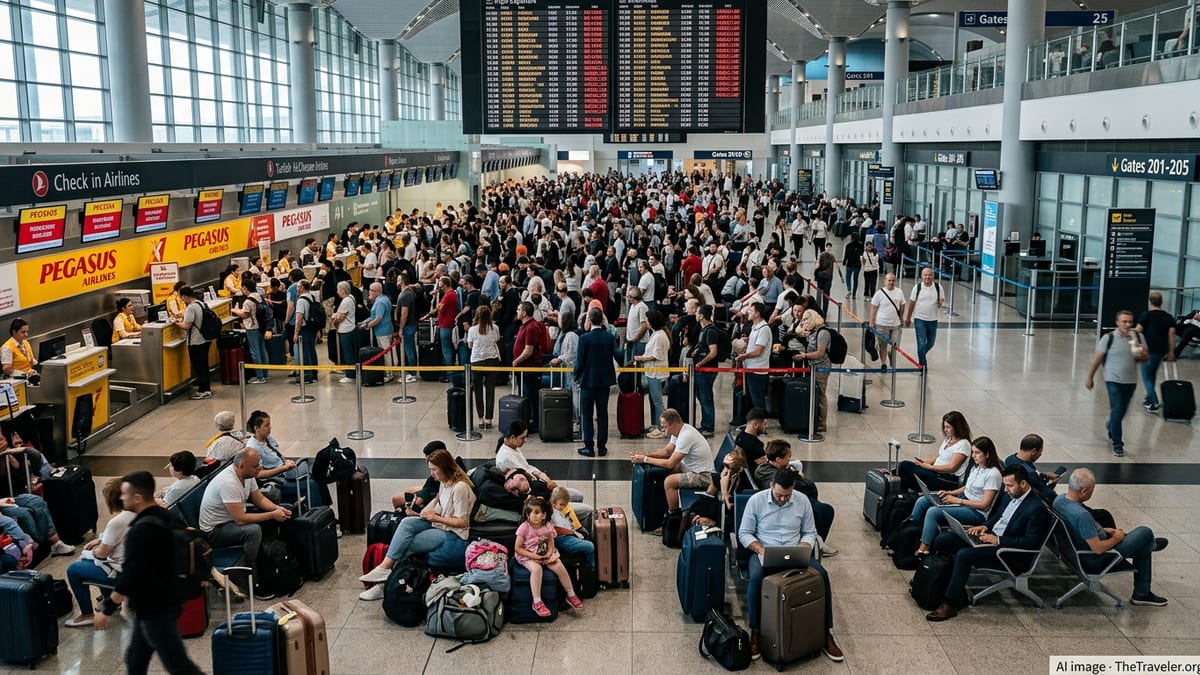
Passengers faced long queues, missed connections and mounting frustration at Istanbul’s Sabiha Gökçen Airport today as at least 18 flights were cancelled and 43 delayed, disrupting services by Pegasus, Turkish Airlines, Air Arabia, FlyDubai, Qatar Airways, Lufthansa and other carriers on key routes linking Istanbul with Dubai, Frankfurt, Cairo and Paris.
Wide Ripple Effects Across Key Regional Hubs
The disruption at Sabiha Gökçen, Istanbul’s busy airport on the Asian side of the city, rippled quickly across some of the Middle East and Europe’s most important air corridors. Cancellations and delays hit a mix of short and medium-haul services, with passengers reporting missed onward connections from Dubai, Frankfurt, Cairo and Paris as schedules were repeatedly revised.
Low-cost carrier Pegasus, which uses Sabiha Gökçen as a primary base, appeared to be among the hardest hit, with multiple services to and from Gulf destinations such as Dubai and Kuwait showing as cancelled or heavily delayed on flight-tracking platforms. Some passengers bound for the United Arab Emirates described scrambling to rebook on alternative departures from Dubai and Sharjah after Istanbul legs were disrupted or aircraft were re-allocated at short notice.
Legacy and regional carriers were also affected. Flights marketed or operated by Turkish Airlines, Air Arabia, FlyDubai, Qatar Airways and Lufthansa all reported schedule changes on routes intersecting with Istanbul’s airspace, leading to knock-on delays at connecting hubs in Doha, Dubai, Frankfurt and Cairo. Airline call centres and help desks at Sabiha Gökçen saw a spike in demand as travellers requested rebooking, hotel vouchers and revised itineraries.
With affected itineraries spanning multiple jurisdictions, passengers faced differing compensation rules depending on whether they were flying under Turkish, European Union or Gulf regulations. Travel agents in Istanbul said they were fielding urgent questions from travellers unsure of their rights or whether they could claim reimbursement for hotels, meals and missed connections.
Scenes of Congestion and Confusion Inside the Terminal
Inside Sabiha Gökçen’s terminal, departure boards flickered with status changes as “scheduled” flights shifted to “delayed” and then, in some cases, to “cancelled.” Check-in halls grew increasingly crowded through the day as passengers queued at airline counters, clutching paper boarding passes and mobile phones while trying to secure seats on later departures.
Families with children and elderly travellers were particularly affected, with many forced to spend extended hours in the terminal’s public areas and gate lounges. Some reported difficulty obtaining clear guidance on whether their flights would eventually operate, and whether they should proceed through security or remain landside in case of rebooking.
Airport staff and ground-handling teams faced the dual challenge of managing frustrated travellers while coordinating with airline operations to reposition aircraft and crews. Announcements over the public-address system urged passengers to monitor screens and stay in close contact with their airlines, but intermittent updates added to confusion for those unfamiliar with the airport or with limited language support.
Food outlets and seating areas near the international gates saw heavy use as delays stretched into several hours for some services. Travellers described using charging stations and work benches to keep devices powered as they waited for confirmation of new departure times or rerouted itineraries through other European or Gulf hubs.
Airlines Struggle to Restore Schedules
While no single cause fully explained the scale of disruption, airline operations teams spent much of the day reworking rotations, sourcing replacement aircraft and attempting to align crew duty hours with revised departure windows. For point-to-point carriers like Pegasus, a cancellation at Sabiha Gökçen often meant an aircraft and crew out of position for subsequent legs, compounding delays throughout the network.
Network carriers such as Turkish Airlines, Qatar Airways and Lufthansa, which rely on tightly timed waves of connecting flights at their respective hubs, also had to unravel complex chains of connections. A delayed arrival into Istanbul, for example, could trigger missed onward connections in Doha or Frankfurt, requiring passengers to be rebooked on later long-haul services and putting additional pressure on seat availability.
Airline representatives urged passengers to use official apps and digital channels rather than relying solely on airport departure boards, stressing that rebooking options and electronic vouchers would appear first in mobile and web interfaces. They also reminded travellers that those who had booked through third-party platforms might need to coordinate with their original travel provider to change itineraries or request refunds.
Industry observers noted that any prolonged disruption at a busy secondary hub like Sabiha Gökçen can take days to fully unwind, particularly when aircraft and crews are stretched across dense schedules serving multiple regional capitals. Some late-evening departures were expected to operate with residual delays as airlines attempted to position fleets for a more stable start to operations the following morning.
Global Travellers Face Missed Holidays and Business Plans
The impact of the cancellations and delays extended well beyond Istanbul. Holidaymakers connecting from European cities such as Paris and Frankfurt to sun destinations in the Middle East and beyond reported losing their first night of hotel bookings or arriving too late for planned tours and events. Others travelling for weddings, conferences or medical appointments in Dubai, Cairo and other cities faced the prospect of rescheduling time-sensitive commitments.
Business travellers transiting through Sabiha Gökçen on tightly planned itineraries were among those hardest hit, as long layovers and missed meetings eroded productivity. Some corporate travel managers advised staff to build additional buffer time into itineraries touching Istanbul and other congested hubs, citing a pattern of knock-on delays that can arise when weather, airspace restrictions or technical issues converge.
Travel insurance providers reported increased inquiries from policyholders asking whether missed connections, lost prepaid accommodation or added hotel nights in Istanbul would be covered. Policies vary widely, with coverage often dependent on the length and cause of the delay, as well as whether travellers accepted airline-provided alternatives.
For backpackers and budget-conscious travellers relying on low-cost fares through Sabiha Gökçen, last-minute rebooking costs were particularly painful. With same-day alternative flights sometimes priced significantly higher, some stranded passengers opted to stay overnight in Istanbul and continue their journeys on later dates rather than absorb the full cost of new tickets.
Advice for Passengers Travelling Through Istanbul and the Region
Travel experts recommended that passengers scheduled to fly through Sabiha Gökçen in the coming days check their flight status repeatedly in the 24 hours before departure and again on the way to the airport. Airline apps and SMS alerts can provide early notice of schedule changes, giving travellers more time to adjust ground transport, hotel check-ins and onward connections.
Passengers with critical time-sensitive plans, such as cruises, major events or visa appointments, were advised to consider arriving at their final destination at least a day early when itineraries involve multiple connections through busy hubs like Istanbul, Dubai or Doha. Building extra buffer time into complex itineraries may help reduce the risk that a disruption at one airport cascades into missed plans at the destination.
Consumer advocates also encouraged travellers to familiarize themselves with the compensation rules that apply to their specific tickets, particularly for flights departing from or arriving in the European Union where standardized passenger rights regulations are in effect. Keeping receipts for meals, ground transport and emergency accommodation can help support later claims when airlines are responsible for extended disruptions.
With congestion and operational pressures likely to remain a reality at major airports across the region, today’s scenes at Sabiha Gökçen served as a reminder of how quickly an ordinary travel day can unravel. For many passengers, the experience underscored the value of flexible tickets, comprehensive travel insurance and a clear understanding of their rights when flights are delayed or cancelled.