

More news on this day
Travelers moving through Phoenix Sky Harbor International Airport on March 24 faced growing disruption as Southwest Airlines and Horizon Air suspended two key flights, contributing to more than 100 delays and creating a ripple effect across major routes linking Phoenix with cities including Las Vegas, Toronto, London and Albuquerque.
Get the latest news straight to your inbox!
Two Suspended Flights Trigger Wider Operational Strain
Publicly available flight-tracking boards and airport-status data on Monday and early Tuesday indicated that one Southwest Airlines departure and one Horizon Air service from Phoenix were suspended, removing key capacity on already busy corridors. While the two flights represent a small share of Sky Harbor’s daily schedule, their timing and destination mix pushed additional pressure onto remaining services at peak periods.
The suspended Southwest flight was linked to a high-demand domestic route, while the Horizon service affected a regional connection commonly used for onward international links. Both carriers operate as important connectors at Phoenix, where Southwest maintains a major focus-city presence and Horizon feeds traffic into its parent Alaska Airlines’ wider North American network.
Travel operations data showed that as the suspensions took effect, other departures on overlapping routes quickly began to absorb rebooked passengers. The added volume, combined with existing weather and air traffic control constraints in other parts of the network, contributed to a rising number of delays and tighter seat availability on remaining flights.
Airline scheduling tools and airport dashboards suggested that recovery was likely to be gradual rather than immediate, with aircraft and crews needing to be repositioned and some later rotations departing out of sequence.
More Than 100 Delays Across the Phoenix Network
By mid-morning on March 24, airport-monitoring services and airline status pages showed that Phoenix Sky Harbor had logged more than 100 delayed flights, spanning both departures and arrivals. Many of those delays fell in the 30 to 90 minute range, but some extended longer as congestion built across domestic and transborder routes.
Reports indicated that knock-on effects were visible on services linking Phoenix with Las Vegas, Albuquerque and other Southwest corridor cities. These short-haul hops are often tightly scheduled, so a delay early in the day can propagate through multiple subsequent legs, amplifying disruption as the hours pass.
International and long-haul services were also affected, particularly connections involving Toronto and London that rely on timely feeder traffic from Phoenix and other Western U.S. gateways. Even when the long-haul flights themselves departed relatively close to schedule, late-arriving passengers and baggage created stress points at check-in, security and boarding.
Operational data suggested that some airlines adopted rolling delay strategies, updating departure times in increments as they waited for aircraft and crew clearances. This approach kept more options open for rerouting but added uncertainty for travelers watching constantly shifting times on airport displays and mobile apps.
Key Routes to Las Vegas, Toronto, London and Albuquerque Disrupted
The disruption at Phoenix was felt most acutely along several high-profile routes that serve as vital business and leisure links. Short Phoenix to Las Vegas flights, typically used by both business travelers and vacationers, saw multiple services pushed back as aircraft arriving late from other cities struggled to turn around on time.
Regional links between Phoenix and Albuquerque, important for connecting smaller communities into the national and international network, also experienced schedule pressure. Publicly available information showed repeated gate changes and rolling delays as airlines attempted to consolidate loads and optimize scarce aircraft time.
On the international side, travelers connecting between Phoenix and Toronto, either non-stop or via Western U.S. hubs, faced tighter transfer windows and in some cases misconnected itineraries. Published coverage of current North American operations highlights that airports handling cross-border traffic remain sensitive to even relatively small schedule shifts, due to customs processing times and stricter minimum connection requirements.
Long-haul traffic involving London was similarly exposed. When domestic feeders into transatlantic departures run late, passengers can miss onward flights entirely, triggering rebookings that may push travel into the following day. That pattern appeared to be emerging for a subset of Phoenix-originating passengers, based on airline rebooking advisories and inventory snapshots.
What Travelers at Phoenix Are Experiencing
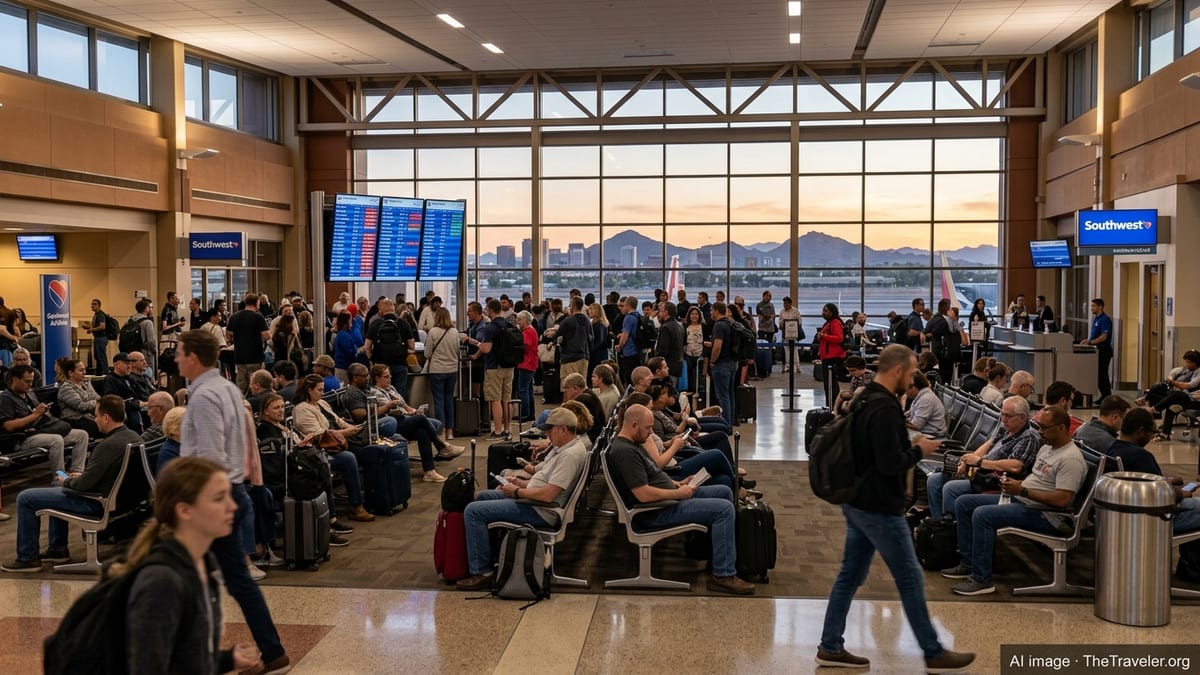
Accounts shared on public forums and real-time airport-status snapshots point to crowded gate areas, heavier-than-normal lines at customer service counters and a greater reliance on self-service tools as the disruption unfolded. Many travelers appeared to be juggling same-day changes on their smartphones while also queuing at staffed desks in search of earlier alternatives.
Security checkpoints at Sky Harbor remained manageable compared with peak-holiday surges, according to recent visitor reports, but the pattern of rolling delays kept passengers inside the terminals for longer stretches. That in turn increased demand for seating, charging points and food outlets in departure areas, particularly in Southwest’s and Alaska’s primary concourses.
Travelers with checked baggage faced added uncertainty, especially if their itineraries involved rebooking onto new routes or overnight stays. When a flight is suspended rather than simply delayed, bags may need to be retrieved from the system or re-tagged entirely, extending processing time at baggage services counters.
Families and leisure travelers making multi-city trips through Phoenix reported on social platforms that even relatively short delays were enough to disrupt carefully planned connections to cruises, tours or events in Las Vegas and beyond, underlining how fragile complex itineraries can be when hub operations come under strain.
Outlook for Recovery and Practical Advice for Passengers
Based on typical recovery patterns at large U.S. hubs, publicly available operational data suggests that Phoenix Sky Harbor is likely to see residual delays through at least the late evening of March 24, with some aircraft and crews remaining out of position into March 25. The actual pace of normalization will depend on how quickly carriers can restore regular rotations and whether additional weather or airspace constraints emerge elsewhere in the network.
Travel analysts note that after a day with more than 100 delays, some capacity distortions can linger even once headline numbers improve. Early-morning flights on March 25 may still bear the imprint of Tuesday’s disruption, either through substituted aircraft types, reduced seat availability or schedule adjustments intended to restore buffers.
For passengers set to fly through Phoenix within the next 24 to 48 hours, publicly accessible guidance from airlines and consumer advocates emphasizes frequent checks of flight status through official airline channels, enabling app notifications and arriving at the airport with additional time, especially for international departures or tight connections.
Experts in air travel planning also recommend that travelers build backup options into their itineraries where possible, such as identifying alternative routings through other hubs or being prepared to accept rebooking via different carriers when interline agreements allow. In a period when even a pair of suspended flights can contribute to triple-digit delays, flexibility remains one of the most valuable tools available to passengers.