

More news on this day
Passengers moving through Nashville International Airport today are facing mounting frustration as SkyWest, Jazz, Southwest, Endeavor Air and American Airlines record nine flight cancellations and more than one hundred delays, disrupting tightly scheduled connections on some of the airport’s busiest routes to Atlanta, Chicago, San Diego, Montreal, Albany and other key cities.
Get the latest news straight to your inbox!
Ripple Effects Hit Key Domestic and Cross-Border Routes
The disruptions at Nashville International Airport are concentrated on trunk routes that serve as vital connectors for both business and leisure travelers. Flights to major hubs such as Atlanta and Chicago are experiencing rolling delays, complicating onward connections across the U.S. network and into Canada and Mexico.
Regional carriers SkyWest and Endeavor Air, which operate many flights under major airline brands, have shouldered a portion of the irregular operations, particularly on short-haul links feeding into Delta and United hubs. Delayed departures from Nashville are in turn arriving late to connecting airports, compressing turnaround times and amplifying congestion across multiple schedules.
Southwest Airlines, a dominant low-cost presence at Nashville, is also reporting extended delays on popular point-to-point services, including Chicago Midway and San Diego. These routes are heavily used by weekend travelers and conference traffic, and even modest schedule slippage is forcing passengers to rebook ground transport and hotel check-ins at the last minute.
Internationally oriented itineraries have not been spared. Jazz, operating as Air Canada Express, has seen delays cascade onto flights linking Nashville with Montreal via Canadian hubs, interrupting cross-border business travel and complicating onward connections to Europe. Travelers bound for smaller markets such as Albany are reporting missed links and long rebooking queues as limited regional capacity fills up quickly.
Operational Strains Across Multiple Airlines
While the total of nine cancellations at Nashville is modest compared with the nationwide tally of disrupted flights, the breadth of airlines affected underscores how tightly interwoven U.S. and regional carrier operations have become. SkyWest and Endeavor Air, often operating under the banners of major network airlines, have limited slack in their fleets, meaning a single delay early in the day can echo through multiple rotations.
American Airlines, which relies on a mix of mainline jets and regional partners out of Nashville, is working to consolidate lightly booked departures, upgauge aircraft where possible and reroute customers through alternative hubs. However, with major airports such as Chicago and Atlanta also managing elevated levels of delays, options to absorb misconnected passengers remain constrained.
Southwest, operating a high-frequency model with fast turn times, is particularly vulnerable when weather, airspace constraints or staffing imbalances interrupt the flow of aircraft. A delayed arrival into Nashville often triggers a late departure on the next leg, affecting passengers not just on one route but across a chain of city pairs that may include San Diego, Chicago, Atlanta and beyond.
Jazz and other regional partners are contending with their own staffing and aircraft availability challenges, especially on transborder services. When a Montreal-bound aircraft departs late or is reassigned, replacement capacity is not always immediately available, leading to gaps in the schedule that are felt acutely by travelers on less frequent routes.
Passenger Experience Marked by Crowded Gates and Uncertain Timelines
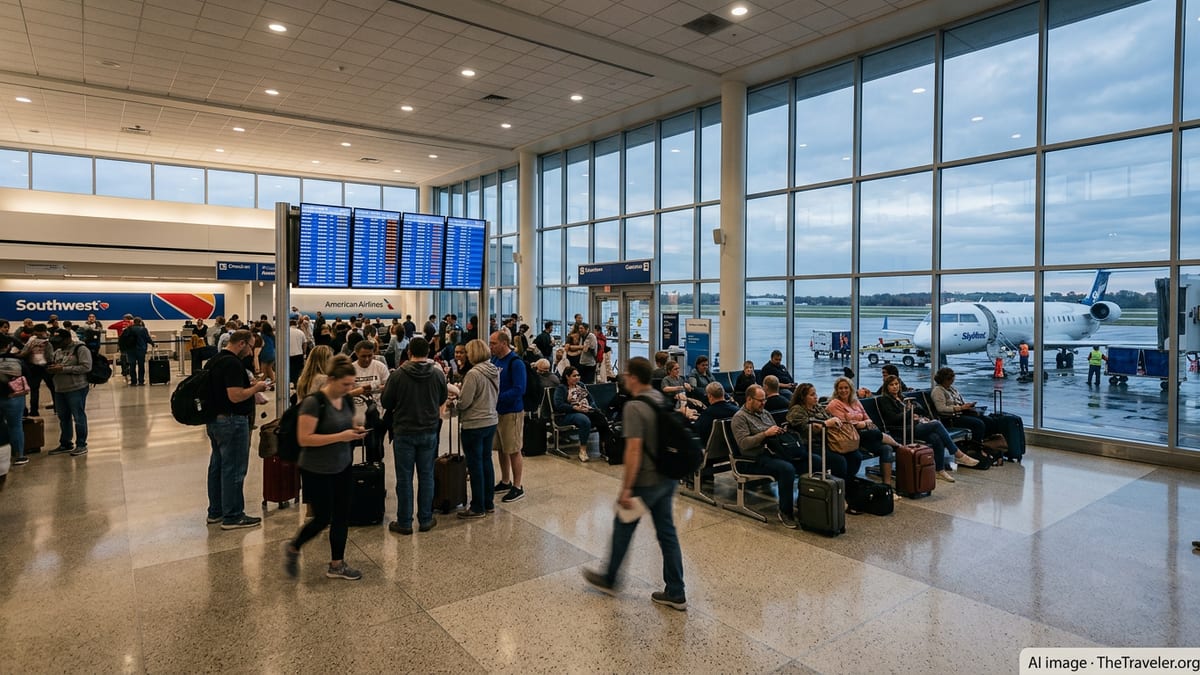
Inside Nashville International’s concourses, the day’s irregular operations have translated into crowded gate areas, snaking customer-service lines and departure boards dominated by amber and red status updates. Families heading to spring vacations, touring musicians moving between shows and corporate travelers bound for same-day meetings are all finding their plans reshuffled.
Travelers on delayed flights to Chicago and Atlanta, two of the most important connecting hubs in North America, report repeated updates pushing back departure times in small increments. That pattern, common during broader network strain, can make it difficult for passengers to judge whether to rebook immediately or wait in hopes of an eventual departure.
Those aiming for San Diego and other West Coast destinations face a different kind of pressure. Long-haul domestic flights that depart late from Nashville can arrive well after midnight local time, causing missed rental car pickups and complicating access to public transit options that may not run at off-peak hours.
Cross-border travelers connecting via Montreal or other Canadian gateways have been particularly sensitive to the uncertainty. Some are weighing whether to proceed with tight connections that risk overnight misconnects, especially when immigration processing and re-screening add additional time to already compressed transfer windows.
Advice for Travelers Departing or Connecting Through Nashville
For passengers with imminent departures from Nashville, airlines and airport officials are urging proactive use of carrier mobile apps and text alerts. Real-time notifications can provide earlier warning of creeping delays than static departure screens, allowing travelers to contact call centers or use self-service tools to secure scarce alternative seats.
Those with flexible itineraries are being advised to consider earlier flights on the same route or to route through less congested hubs when possible. For example, passengers traveling to the Midwest might explore options through alternative connecting cities if Chicago continues to experience high levels of delay, while those bound for the West Coast may benefit from connections through secondary hubs with more available capacity.
At the airport, travelers facing multi-hour waits are encouraged to remain airside once through security, as re-clearing checkpoints during busy periods can add further stress and time pressure. Keeping boarding passes, identification and any airline communications readily available can also speed interactions with gate and service agents who are managing heavy workloads.
For international and cross-border itineraries involving Montreal and other Canadian cities, travelers should pay close attention to minimum connection times and any visa or entry requirements that could be affected by significant delays. Documenting disruption details and keeping receipts for meals or lodging may also prove useful later if airlines provide goodwill compensation or if travelers seek reimbursement under applicable consumer-protection policies.
Broader Context of Continuing U.S. Air Travel Disruptions
The strains visible at Nashville International Airport today are part of a wider pattern of volatility across the U.S. aviation network in early 2026. A combination of lingering staffing imbalances, tight aircraft utilization, intermittent weather systems and airspace constraints have periodically pushed daily operations close to capacity, leaving little room to absorb even minor shocks.
Recent nationwide tallies have shown thousands of delayed flights and hundreds of cancellations on the busiest travel days, with major hubs such as Chicago, New York and Atlanta repeatedly among the most affected. In that environment, secondary airports like Nashville can quickly feel the knock-on effects when inbound aircraft or crews arrive late from already stressed parts of the network.
For airlines including SkyWest, Jazz, Southwest, Endeavor Air and American Airlines, the current episode at Nashville serves as another reminder of how closely their fates are intertwined. Disruptions at one airport or within one carrier’s operation can propagate rapidly, affecting travelers on routes that may seem, at first glance, far removed from the original problem.
As the day progresses, operations teams across the affected airlines will focus on resetting the schedule for tomorrow, repositioning aircraft and rebalancing crews in an effort to restore normal service. For passengers, however, the immediate priority remains far more basic: getting out of Nashville and back on their way to Atlanta, Chicago, San Diego, Montreal, Albany and the many other destinations now linked by a common day of delay.