

Hundreds of passengers were left sitting in departure lounges and queuing at service counters at Tokyo’s Narita and Haneda airports on Tuesday after a fresh wave of disruption saw 183 flights delayed and four canceled, hitting services operated by Japan Airlines, All Nippon Airways and Jetstar on busy routes linking Tokyo with Osaka, Shanghai, Bangkok and long haul destinations.
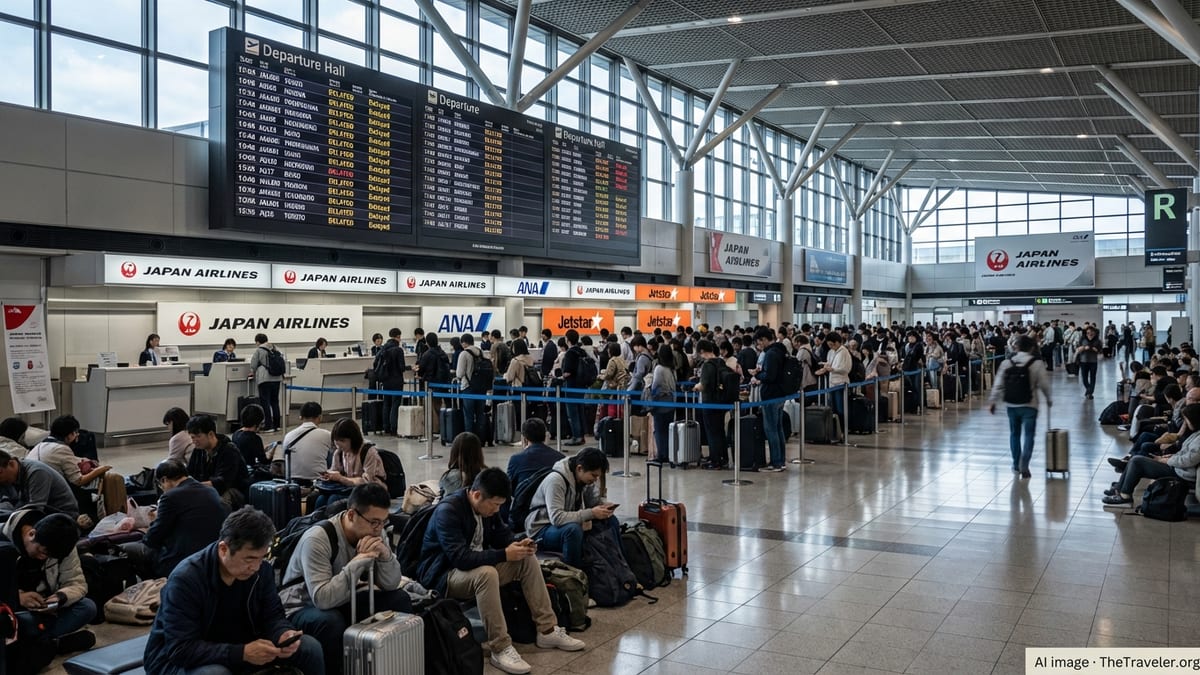
Tokyo Hubs Buckle Under Fresh Operational Strain
The latest disruption unfolded across the morning and early afternoon at Narita International Airport and Tokyo International Airport, commonly known as Haneda, as departure boards filled with delay notices. While both airports are accustomed to surges in traffic, aviation data showed an unusually high concentration of late departures, with some services pushed back by more than two hours.
Ground staff at both hubs reported mounting pressure as delayed aircraft and crews struggled to turn around in time for subsequent flights. With Japan’s aviation sector already operating close to capacity during the busy winter travel period, even relatively minor schedule changes cascaded quickly through domestic and regional networks. Passengers heading for connecting flights in Osaka, Shanghai and Bangkok were among those most affected.
Officials at the airports cited a mix of factors behind the backlog, including tight aircraft rotations, congested airspace over East Asia and short-term staffing constraints in ground handling. While weather in the Tokyo region remained largely cooperative, earlier low cloud and congestion around peak departure times contributed to a stack-up of aircraft waiting for slots.
By late afternoon, operations had begun to stabilize, but the residual impact was still apparent, with some evening departures forecast to leave behind schedule and crew rosters needing overnight adjustment.
Japan Airlines, ANA and Jetstar Among Hardest Hit
Flag carrier Japan Airlines and its rival All Nippon Airways bore the brunt of the disruption, reflecting their dense schedules into and out of Tokyo’s two main airports. Many of the affected flights were high-frequency domestic and short haul services that feed into long haul operations, amplifying the network effect as aircraft and crews arrived late into Narita and Haneda.
Japan Airlines reported delays across multiple trunk routes linking Tokyo with Osaka and Sapporo, along with late running on key international sectors. Several services to and from Shanghai and Bangkok left well behind schedule, leaving transfer passengers facing missed connections and overnight rebookings on onward flights. Airline staff at transfer counters worked to reissue boarding passes and distribute hotel vouchers where required.
ANA, which has been actively rebuilding its international network and refining its boarding and airport procedures, also saw a number of delays cluster around its mid-morning and early afternoon waves. Flights that normally operate with relatively tight turnaround windows at Narita, including services to major Chinese and Southeast Asian gateways, were especially vulnerable to knock-on delays once inbound aircraft arrived late.
Jetstar, a key low cost operator at Narita and other Japanese airports, experienced disruptions on several of its regional services, including flights to major East Asian cities. Budget carriers typically operate tight schedules with limited slack in aircraft and crew rotations, leaving little room to recover when delays begin to accumulate. Passengers on Jetstar services reported long queues at customer service desks as they sought new itineraries or compensation under applicable regulations.
Routes to Osaka, Shanghai and Bangkok Disrupted
Some of the busiest corridors in Northeast and Southeast Asia were among those affected, underscoring the importance of Tokyo’s airports as regional hubs. Services linking Tokyo with Osaka, a key domestic trunk route that also serves as a feeder to international flights, were delayed throughout much of the day. That in turn affected passengers connecting onward from Osaka’s Kansai International Airport to other Asian cities.
Flights between Tokyo and Shanghai, already operating in a more constrained environment following capacity adjustments by Chinese carriers, were particularly sensitive to delays. Even modest schedule disruptions left limited options for same day reaccommodation, prompting some travelers to accept rerouting through alternative Chinese gateways or via third countries in order to reach their destinations.
Bangkok-bound services from Narita and Haneda also faced knock-on effects. These high demand leisure and business routes typically run near full capacity during peak periods, making it difficult for airlines to rebook passengers en masse when a flight is significantly delayed or canceled. With aircraft sometimes arriving late from previous sectors in Southeast Asia, the rotation pattern created additional stress on operators’ ability to maintain punctuality.
Beyond these headline routes, the disruption rippled through a wide array of secondary destinations, both within Japan and across the broader region. Regional cities in China, South Korea and Southeast Asia saw arrivals and departures adjusted as carriers worked to rebuild their schedules and reposition aircraft.
Inside the Passenger Experience at Narita and Haneda
For travelers on the ground, the operational dynamics translated into long, uncertain waits. At Narita, passengers reported dense crowds forming around information screens as departure times were repeatedly revised in small increments, a pattern that often signals ongoing crew or slot coordination challenges. Some travelers chose to remain near their gates, fearing a sudden shift back to an earlier departure once an aircraft or crew became available.
Check-in and transfer counters at Haneda were equally busy, with airline staff attempting to rebook those at risk of missing onward connections. For long haul passengers arriving from North America and Europe, tight transit windows meant that even modest delays on inbound flights could jeopardize onward departures to other Asian destinations. In some cases, airlines arranged overnight accommodation and meal vouchers as they placed passengers on flights the following day.
Families traveling with small children and elderly passengers faced particular difficulties as they navigated crowded terminals and extended waiting times. Seating near power outlets and quieter corners of the concourses became scarce, while lines at food outlets and convenience stores lengthened as the day wore on. Some travelers described a lack of clear, consistent announcements in multiple languages, despite improvements in bilingual signage and digital notifications since Japan’s tourism rebound.
Against this backdrop, airport staff worked to maintain order and provide updates via public address systems and mobile apps. While the tone in the terminals remained mostly calm, frustration mounted among those who had already endured prior delays on earlier legs of their journeys, especially where compensation rules were complex or varied by airline and route.
Staffing Pressures and Tight Schedules Expose Fragile System
The disruption highlighted underlying structural pressures that have been building in Japan’s aviation system since international travel began recovering. Narita has previously acknowledged that shortages of ground staff limit its ability to handle all the additional flights airlines would like to operate, even when runway slots are technically available. That gap between theoretical capacity and on-the-day operability leaves schedules vulnerable when irregularities strike.
At the same time, major carriers have been running increasingly tight aircraft rotations to maximize asset utilization. This approach, while efficient in normal operations, affords limited buffer time when aircraft arrive late because of air traffic restrictions, congestion at overseas airports or minor technical inspections. A delay of under an hour on an early morning sector can grow into a multi hour disruption by mid-afternoon as it propagates through the rotation.
Staffing constraints are not limited to ground handling. Cabin crew and cockpit crews are subject to strict duty time regulations, meaning that schedule slippage can push them up against legal limits. When that occurs, airlines must call in reserve crews or, in some cases, cancel flights entirely if replacements are unavailable. The four cancellations recorded on Tuesday reflected a combination of such crew time issues and operational bottlenecks in aircraft positioning.
Industry analysts note that these challenges come at a time when Japanese carriers are also contending with fluctuating demand on China and Southeast Asia routes, ongoing fleet renewal programs and the need to maintain high safety and reliability standards. The net result is a system that can appear robust under normal conditions yet proves unexpectedly fragile under stress.
Economic and Tourism Ripple Effects Across the Region
The knock-on consequences of delays and cancellations in Tokyo extend well beyond the terminals. Business travelers connecting through Narita and Haneda to reach regional meetings and conferences faced lost hours and, in some cases, missed events altogether. For companies that rely on same day or overnight connections between major Asian financial centers, such disruptions carry real economic costs.
Tourism flows also risk being affected if repeated episodes of large scale delay discourage visitors from planning tight itineraries that depend on smooth connections in Japan. With Tokyo, Osaka and other Japanese cities serving as gateways for multi country trips across East and Southeast Asia, a disruption at Narita or Haneda can derail long planned vacations that link Japan with neighboring destinations such as Thailand or China.
Air cargo operations, while more flexible than passenger networks, can feel the impact indirectly. When passenger flights that carry belly hold freight are delayed or canceled, shippers may face longer transit times or need to shift urgent shipments to dedicated cargo carriers at short notice. That can raise costs and strain already complex supply chains.
Local economies in Osaka, Shanghai and Bangkok may also see short term effects as visitors arrive late, cut stays short or cancel segments entirely. Hotels, tour operators and small businesses in popular districts rely heavily on predictable arrival patterns from regional flights. When those patterns are disrupted without much warning, occupancy and revenue can fluctuate sharply.
Airlines and Airports Move to Clear Backlog and Rebuild Confidence
As the day’s disruption unfolded, airlines and airport operators focused on clearing the immediate backlog and restoring passenger confidence. Operations control teams at Japan Airlines, ANA and Jetstar worked to prioritize flights with large numbers of connecting passengers or limited alternative services, sometimes swapping aircraft between routes to optimize utilization.
At Narita and Haneda, airport operators coordinated closely with air traffic control to smooth departure flows and minimize further airborne holding. Additional staff were deployed in key passenger areas, including transfer corridors and immigration zones, to help guide travelers whose plans had changed. Information desks extended operating hours and increased multilingual staffing to handle a surge in queries.
Carriers encouraged passengers with flexible plans to voluntarily switch to later flights or travel on less congested days, offering fee waivers and, in some cases, fare adjustments. Such measures can help spread demand more evenly across the schedule while giving operations teams more breathing room to reset aircraft and crew rotations.
Looking ahead, both airlines and airports are expected to review the day’s events in detail, examining where communication, staffing and scheduling adjustments could reduce the likelihood that a similar pattern of delays will recur. Among the options under consideration are slightly longer turnaround windows on key regional routes, targeted hiring in ground handling and the use of more dynamic, real time rebooking tools to move passengers onto alternative flights more efficiently.
What Travelers Should Know for Upcoming Flights
For passengers with upcoming travel through Narita or Haneda, the latest disruption serves as a reminder to build additional flexibility into itineraries. Travel planners and frequent flyers alike often recommend leaving generous connection times when linking domestic and regional flights to long haul services, especially during peak seasons and weekends when traffic is heaviest.
Checking flight status through airline apps and airport information channels well before leaving for the airport can help travelers stay ahead of developing issues. In the event of delays, those who have already registered their contact details with airlines are more likely to receive timely notifications about gate changes, revised departure times or automatic rebookings onto alternative services.
Passengers may also wish to familiarize themselves with each carrier’s policies on delays, cancellations and overnight accommodation, as the rules can vary significantly depending on whether a disruption is within the airline’s control or linked to external factors. Travelers on complex multi airline itineraries should pay particular attention to which carrier is responsible for each leg of their journey when seeking assistance.
While Tuesday’s wave of delays underscored the vulnerability of tightly wound schedules at Tokyo’s key hubs, industry experts stress that overall reliability in Japan’s aviation system remains comparatively high by global standards. Even so, as demand continues to grow and operational margins tighten, days like this underline the importance of resilience measures for both carriers and the passengers who depend on them.