

More news on this day
A Delta Air Lines Airbus A330 operating Flight DL104 from São Paulo Guarulhos to Atlanta experienced an apparent left-engine failure and fire shortly after takeoff on March 29, 2026, prompting an emergency return that briefly disrupted nighttime operations and left hundreds of international travelers facing diversions, delays, and unscheduled overnight stays.
Get the latest news straight to your inbox!
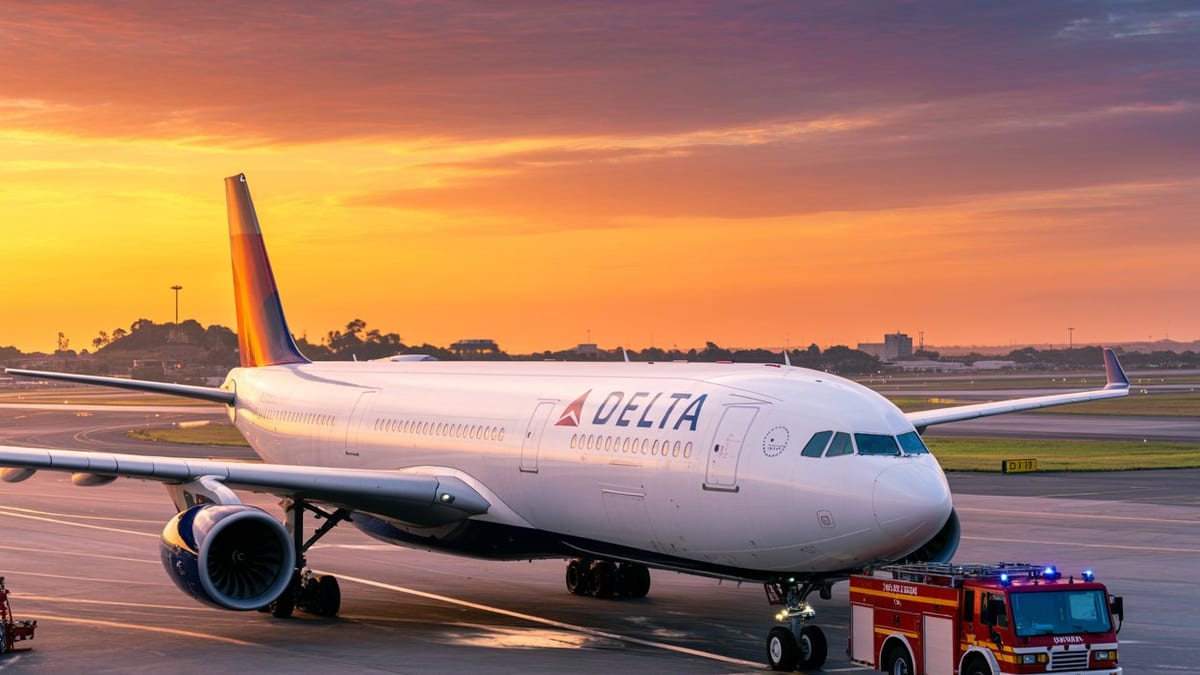
Image by Travel And Tour World
What Happened on Delta Flight DL104
Publicly available flight-tracking data and eyewitness accounts posted on social media describe Flight DL104, an Airbus A330-300, departing São Paulo/Guarulhos International Airport on the night of March 29 when the aircraft suffered a sudden problem with its left engine just seconds after lifting off the runway. Videos shared online appear to show bright flashes and flames from the engine as the jet climbed away from the field before beginning a turn back toward the airport.
According to these accounts, fragments from the affected engine were seen falling near the runway area, where a localized fire was quickly contained by airport emergency teams. The aircraft remained airborne long enough to complete a controlled circuit back to Guarulhos, where it landed safely. Subsequent posts from passengers indicate that the widebody was met on arrival by firefighting and rescue vehicles and then escorted to a remote stand.
Information shared by aviation enthusiasts and passengers suggests that no injuries were reported among the roughly 280 people on board, though many described a cabin filled with the sound of loud bangs, vibration, and the smell of smoke before the situation stabilized. After landing, travelers were taken by bus back to the terminal for reprocessing, while the A330 remained out of service pending technical inspection and engine replacement.
Initial descriptions of the event are consistent with a high-energy engine failure and external fire, a type of occurrence that remains rare but is specifically rehearsed in simulator training. Aviation safety data for the Airbus A330 family indicate that twin-engine widebodies are designed to continue flying safely on a single engine, and early accounts from DL104 point to an outcome in which structural damage was contained and the crew was able to bring the aircraft back under full control.
Ripple Effects on Guarulhos Airport Operations
The incident occurred during one of Guarulhos’s busiest periods of the day, when long-haul departures to North America and Europe are concentrated in a relatively tight nighttime window. The temporary runway closure required for inspection and debris removal led to delays for several outbound flights, while arriving aircraft were placed in holding patterns or briefly diverted to alternate airports in southeastern Brazil.
Terminal operations reports and passenger posts show that airlines adjusted by holding boarding for some departures, swapping aircraft where possible, and rerouting connecting customers whose itineraries relied on the now-canceled DL104 leg to Atlanta. Some transiting travelers were rebooked onto Delta’s other Brazil services or onto joint-venture partner LATAM flights, but limited spare capacity during the peak overnight period meant that a number of passengers were shifted to flights departing 24 hours later.
Within the airport itself, the most immediate impact was felt in the international departures zone of Terminal 3, where security and immigration checkpoints briefly saw surges as passengers from the disrupted flight were escorted back into the terminal. Ground handling teams also had to accommodate extra buses, emergency vehicles, and stand changes as authorities prioritized access around the disabled widebody and the affected runway intersection.
Despite the disruption, publicly available arrival and departure data from March 30 suggest that Guarulhos operations normalized gradually over the early morning hours, with most subsequent long-haul departures departing within one to two hours of schedule. The single-aircraft nature of the incident limited the broader network impact, but the timing at the heart of the overnight departure bank magnified its short-term effect on connections.
Traveler Experience: From Takeoff Scare to Overnight Disruption
Posts from passengers on DL104 and from travelers elsewhere in Terminal 3 portray a night that shifted abruptly from routine departure rituals to confusion, anxiety, and logistical headaches. Those on board describe feeling the aircraft shudder and hearing loud bangs during the initial climb, followed by an abrupt leveling-off and announcement of a return to the airport. Some reported seeing flames reflected on the wing surface, while others focused on the calm tone of the cabin crew as they prepared the cabin for an overweight landing.
After the aircraft touched down and was secured, travelers were bussed back to the terminal, where they joined lines for immigration, baggage claim, and rebooking. For connecting passengers headed beyond Atlanta, the missed overnight transatlantic and North American bank meant a cascade of missed onward flights. Many reported being redirected to hotels near Guarulhos and given meal vouchers while alternative itineraries were arranged for departures the following day.
Inside the terminal, the incident also affected travelers on unrelated flights. Some described long waits at gate and check-in counters as airline staff dealt first with the emergency return and then with rebooking for the full A330 load. Screens in the departure hall showed DL104 as canceled, and a handful of other departures as delayed, contributing to crowded seating areas and late-night queues at food outlets and currency exchanges.
Despite the inconvenience, accounts posted in the hours after the event show a recurring theme of relief among passengers that the flight returned safely and that the fire near the runway was contained quickly. Several travelers contrasted the dramatic visuals of the engine fire with the relatively orderly handling on the ground, noting that while their trips were significantly delayed, the overall experience underscored the layered safety measures built into modern commercial aviation.
Safety Context and A330 Fleet Implications
The Delta incident at Guarulhos follows a series of isolated engine events involving Airbus A330 aircraft across various airlines in recent years, including an engine fire on a Delta A330 at Orlando International Airport in April 2025 that led to an evacuation by slides during pushback. While each case involves different technical causes, publicly available safety databases show that such high-profile failures remain statistically rare compared with the total number of A330 cycles flown worldwide.
Analysis of past A330 engine events indicates that most have been contained within the engine nacelle, with fire detection and suppression systems activating as designed. The airframe is engineered with redundancy in flight controls, hydraulics, and electrical systems so that the loss or shutdown of a single engine does not compromise fundamental controllability. Early evidence from São Paulo, including the successful return and lack of reported injuries, appears aligned with this broader safety record.
For Delta, the São Paulo incident is likely to trigger detailed inspections of the affected engine type across its A330 fleet, as well as close coordination with the engine manufacturer and regulators. Previous high-energy engine failures on other aircraft types have led to temporary service bulletins, revised inspection intervals, and in some cases accelerated component replacement programs. Any similar actions here could influence aircraft availability and scheduling on the airline’s Brazil and broader long-haul network in the short term.
The Brazilian and United States investigative authorities are expected to examine recovered engine fragments, maintenance records, and flight data to determine whether the failure was linked to a specific part, a maintenance oversight, or a rare material defect. Findings from comparable investigations have often resulted in industry-wide recommendations, such as enhanced borescope inspections or software updates to engine monitoring systems, which ultimately feed back into safer operations globally.
What the Incident Means for Future Flights at São Paulo
São Paulo/Guarulhos is a critical South American gateway, particularly for northbound long-haul traffic to the United States and Europe. The Delta A330 engine fire highlights how a single serious event can temporarily strain airport resources and disrupt complex connection patterns, especially during the dense overnight departure wave. At the same time, the swift containment of the runway-area fire and the safe recovery of the aircraft suggest that emergency planning and infrastructure at GRU functioned largely as intended.
Operationally, the event may prompt further review of debris inspection procedures, nighttime staffing levels for firefighting units, and coordination protocols between airport operations, air navigation services, and airline control centers. Publicly available information from similar incidents at other hubs shows that airports often respond by refining runway sweep patterns, updating emergency checklists, and conducting additional multi-agency drills focused on engine failures at or just after liftoff.
For travelers, the near-term effect is likely to be most visible in schedule adjustments and equipment changes on the São Paulo to Atlanta route while the damaged A330 remains grounded. Delta has already relied extensively on the A330 family for its Brazil services, and any prolonged fleet constraint could lead to frequency tweaks or temporary use of alternative widebody types on certain days. Passengers connecting through Guarulhos in the coming weeks may see slightly longer scheduled layovers built into itineraries to preserve connection reliability.
In the longer view, the March 29 event is expected to be absorbed into the aviation system’s continuous safety-learning process rather than marking a turning point for travel to and from São Paulo. The combination of a dramatic engine fire, a safe return, and manageable network disruption reflects both the inherent risks of high-performance jet operations and the multiple safeguards designed to keep those risks at very low levels for passengers crossing one of South America’s busiest international hubs.