

More news on this day
A Delta Air Lines Airbus A330 departing São Paulo reportedly suffered an engine fire shortly after takeoff, scattering debris over the airport vicinity and forcing an emergency return that has renewed scrutiny of widebody engine reliability on long-haul routes.
Get the latest news straight to your inbox!
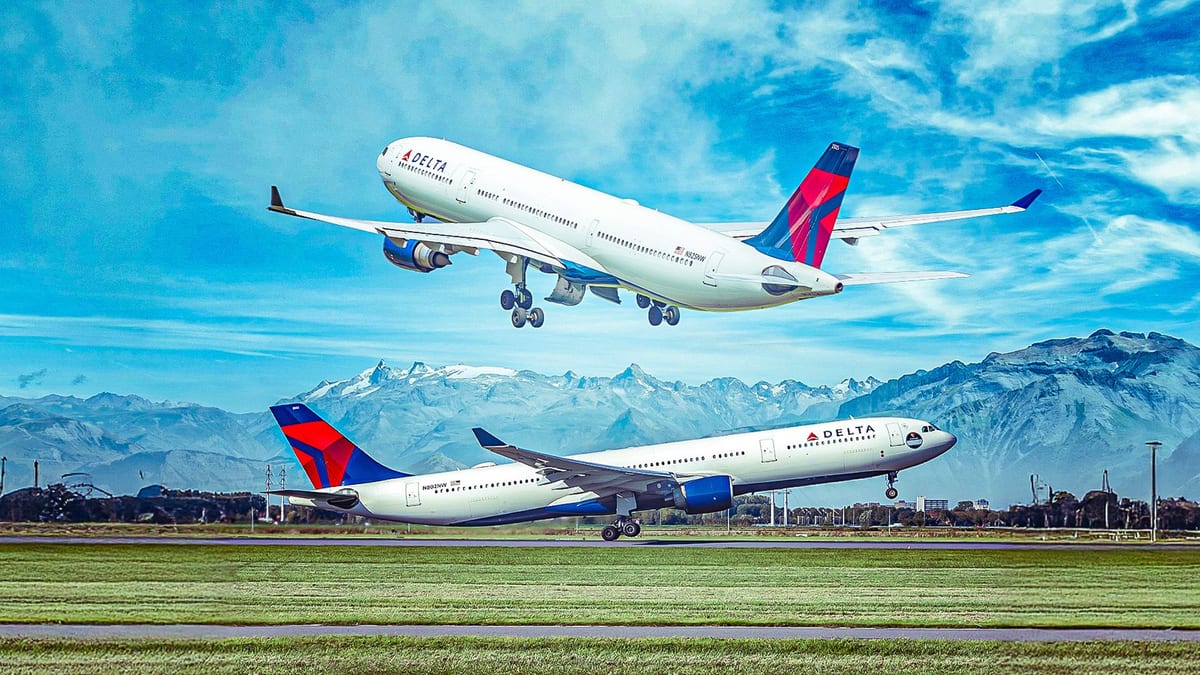
Image by Simple Flying
Fire Erupts Minutes After Night Departure
Publicly available flight tracking data and local media coverage indicate that the incident involved a Delta-operated Airbus A330 on an international service departing São Paulo/Guarulhos International Airport in the late evening. Shortly after lifting off from the main runway and beginning its climb, the crew received indications of an engine problem consistent with an in-flight fire alert.
Reports describe visible flames and sparks coming from one of the aircraft’s engines as it climbed away from the airport, with witnesses on the ground and in the terminal area observing an abnormal glow on the wing. As the flight transitioned from initial climb, the crew is understood to have halted the ascent, reduced speed and initiated a turn to remain close to the airport while they worked through established emergency procedures.
The aircraft leveled off at a relatively low altitude compared with a standard climb profile for the route, circling to set up for an expedited return to Guarulhos. Flight data reviewed by aviation observers show a brief cruise at holding altitude, consistent with a crew performing checklists, coordinating with air traffic control and configuring the jet for a single-aisle return approach.
Although detailed cockpit actions have not been released, comparable long-haul events involving Delta’s A330 fleet in recent years have typically seen the affected engine shut down as a precaution once the crew verifies a credible fire or severe damage indication. In such cases, the aircraft is designed to continue flying safely on the remaining engine while heading back to land.
Debris Reported Across Airfield and Surrounding Area
Local coverage from São Paulo notes that fragments believed to have originated from the affected engine were later found on and near airport grounds. According to these early reports, debris included pieces of metallic material and insulation consistent with components from nacelles or internal engine structures exposed to high heat.
Some of the debris is understood to have fallen within secure areas of the airport perimeter, including maintenance and service zones adjacent to the runway system. Additional pieces were reportedly recovered in nearby off-airport locations, prompting checks of perimeter roads and industrial lots beneath the aircraft’s initial departure path.
At Guarulhos, emergency response protocols call for inspection of runways and taxiways following any suspected engine failure or debris release. Information shared by aviation incident trackers suggests that at least one runway inspection took place soon after the Delta jet’s return, with airport staff searching for any material that could present a hazard to subsequent departures or landings.
There have been no verified reports of injuries on the ground linked to the debris, and airport operations appear to have continued with temporary adjustments while inspections were completed. The presence of visible engine fragments, however, is likely to factor prominently into any formal assessment of the severity of the failure.
Safe Landing and Passenger Evacuation Outcome
After roughly a short holding period near the airport, the A330 lined up for an approach back into Guarulhos, where firefighters and airport medical teams had been pre-positioned along the runway and taxiways. Tracking data and publicly available incident summaries indicate that the aircraft completed a single-engine landing without further mechanical complications, coming to a stop under escort from airport fire vehicles.
Passengers were kept on board while emergency crews visually assessed the aircraft and confirmed that there were no active flames or fuel leaks. Subsequent footage and passenger accounts circulating on social media suggest that travelers disembarked using mobile stairs at a remote stand, a standard practice when a jet returns under emergency conditions but remains structurally intact.
There have been no indications of serious injuries among passengers or crew associated with the São Paulo event, aligning with recent patterns in engine-fire incidents involving modern widebody aircraft, where robust containment systems and conservative flight crew decisions have limited physical harm even in dramatic-seeming scenarios.
Delta has previously rebooked passengers following significant technical returns on its A330 fleet, such as an Atlanta to São Paulo service that turned back on January 1, 2025 after an engine fire warning shortly after departure. Publicly available information shows that such events typically result in overnight delays or aircraft substitutions while maintenance teams perform detailed inspections and engine work.
Focus on Engine Type, Inspection Regime and Fleet History
The São Paulo incident adds to a small but closely watched series of engine-related events across the global A330 fleet. Coverage in aviation industry outlets notes that Delta operates a mix of Airbus A330-300 and A330-900neo aircraft on long-haul routes between North and South America, with engines from major manufacturers that have already been the subject of previous reliability bulletins and service directives.
In earlier cases, such as a transatlantic Delta A330 diversion to the Azores in July 2025 following an engine shutdown, investigations have often focused on specific components within the high-pressure turbine and combustor sections. These are areas where thermal stresses, material fatigue and maintenance practices intersect, sometimes leading to premature wear or localized failures that can produce smoke, flames or the shedding of internal parts.
Engine makers and airlines are required to follow a regime of periodic inspections and overhauls governed by manufacturer guidance and airworthiness directives issued by regulators. After a severe event involving fire or suspected uncontained damage, an affected engine is typically removed from the wing for detailed teardown, with borescope inspections of critical sections and metallurgical analysis of any fractured components.
A review of publicly available safety data shows that while in-flight engine issues do occur, modern twin-engine widebodies have a strong safety record when it comes to safely completing emergency returns. The São Paulo episode is likely to be examined in that context, including how swiftly the crew responded to the warning, the condition of the engine cowling and fan blades, and any evidence that debris breached containment structures before dropping to the ground.
Regulators and Investigators Expected to Review Incident
Engine fires and debris-shedding events fall into categories routinely monitored by civil aviation authorities in Brazil and the United States. When they occur on international services, responsibility for any formal safety investigation is normally shared under established international frameworks, with data from flight recorders, maintenance logs and crew reports providing the foundation for analysis.
According to published coverage of comparable Delta incidents, regulators generally look first at whether existing inspection intervals and service bulletins would have been expected to detect the problem before failure. They also weigh how the engine behaved under stress, including whether fire-suppression systems activated as designed and whether any structural damage extended beyond the engine nacelle.
Findings from such reviews can lead to recommendations that ripple across the global fleet, ranging from targeted inspection mandates for a narrow set of engine serial numbers to broader guidance on maintenance procedures and parts traceability. In cases where debris has fallen within or beyond airport boundaries, investigators also revisit departure and arrival procedures to determine if any operational changes might further reduce risks to people and infrastructure on the ground.
For travelers using São Paulo as a gateway between South America and North America, the incident is a reminder that while engine events can appear dramatic, long-haul aircraft are engineered with significant performance margins. Industry data consistently show that twin-engine widebodies such as the A330 can sustain flight on a single engine to a safe landing, a capability once again brought into focus by Delta’s return to Guarulhos after the reported engine fire and debris release.