

More news on this day
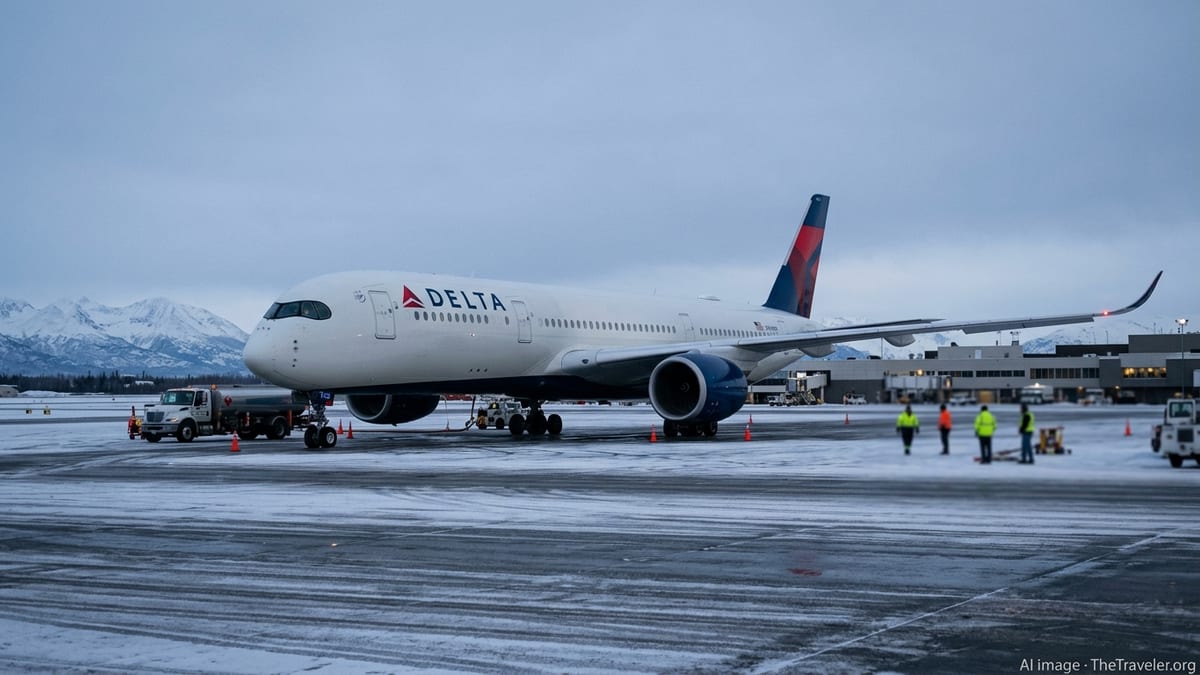
A Delta Air Lines Airbus A350 operating a long-haul international route was forced to divert to Anchorage in early 2026 after a passenger allegedly made racially charged threats and became physically intimidating on board, prompting an emergency landing that left hundreds of travelers unexpectedly stranded in Alaska.
Get the latest news straight to your inbox!
Emergency Diversion on Transpacific Route
Publicly available flight-tracking data and passenger accounts indicate that the diversion involved a Delta-operated Airbus A350 flying a transpacific route between the United States and Asia. The aircraft, which had departed from the Midwest and was en route to Tokyo, turned north toward Anchorage after crew members reportedly declared an onboard disturbance involving an aggressive passenger.
Reports shared by travelers on aviation and airline forums describe the incident as unfolding several hours into the flight, when the aircraft was already over far northern latitudes. Instead of continuing across the Pacific, the A350 descended toward Anchorage, where it made an unscheduled landing so that law enforcement personnel could meet the aircraft and remove the passenger.
Information posted by those on board suggests that the diversion added many hours to the journey and ultimately disrupted onward connections to Asia. Several travelers described confusion in the cabin as they waited for updates about the nature of the emergency and the length of the delay once on the ground in Alaska.
Passenger Allegations of Racist Language and Threats
According to publicly shared accounts from multiple passengers, the individual at the center of the incident allegedly directed racist language toward other travelers and cabin crew and made threats perceived as physically menacing. One description circulating online references the use of an ethnic slur and characterizes the behavior as escalating beyond verbal abuse into what aviation guidance would classify as threatening conduct.
Posts from those seated near the disturbance indicate that the passenger appeared to be intoxicated and that cabin crew repeatedly attempted to de-escalate the situation before the decision was made to divert. Some accounts suggest that the person’s behavior created particular alarm among passengers of color on board, who reported hearing racist remarks and witnessing confrontational body language.
While detailed official documentation of the event had not been widely disseminated at the time of writing, the consistency of descriptions across multiple independent accounts points to a pattern of abusive and racially charged conduct that left crew with limited options other than to request an immediate landing where security resources were available.
Anchorage Turnback Disrupts Travel Plans
The diversion to Anchorage significantly reshaped travel plans for more than 200 passengers. Accounts shared by those on the flight describe spending an extended period on the ground while the aircraft awaited clearance, refueling, and crew rest assessments. Some travelers reported being kept on board initially as procedures were completed, followed by deplaning and rebooking once it became clear that duty-hour limits would prevent the original crew from continuing to Asia.
Passengers described challenges obtaining updated connection information, replacement itineraries, and hotel vouchers in an airport that is not a primary Delta hub. Several recounted waiting in long lines at service desks or relying on mobile apps to secure new routings through West Coast gateways to reach their final destinations in Japan and beyond.
Despite the disruption, available information indicates that the aircraft landed safely in Anchorage and that no serious injuries were reported. Travelers later noted that local ground staff and flight crew members attempted to assist passengers with rebooking and accommodations under difficult operational circumstances.
Growing Spotlight on Inflight Misconduct
The Anchorage diversion echoes a wider pattern of disruptive passenger behavior reported across U.S. carriers in recent years, particularly on long-haul flights where alcohol consumption, extended confinement, and heightened tensions can lead to conflicts. Publicly available federal data and media coverage have highlighted hundreds of cases involving abusive language, physical altercations, or refusal to follow crew instructions.
On long transoceanic segments, a single incident can trigger substantial downstream effects. Diversions to remote or non-hub airports such as Anchorage can require additional fuel planning, specialized ground handling arrangements, and spare crew positioning before a flight can continue. Passengers often face missed connections, lost vacation time, and complex rebookings across multiple airlines.
Racially motivated abuse in particular has drawn increasing scrutiny from civil rights groups and aviation observers, who argue that such incidents create a hostile environment for targeted passengers and cabin crew. Published commentary following the Anchorage diversion has emphasized that verbal attacks grounded in race or ethnicity can be traumatizing even when they do not escalate to physical violence.
Operational and Legal Aftermath
Publicly available information shows that, in cases like the Anchorage diversion, the disruptive passenger is typically met by law enforcement upon landing and may face investigation under federal or local statutes related to interference with flight crew or disorderly conduct. Outcomes can include arrest, fines, or civil penalties, though specific case details are not always made public.
The airline, meanwhile, must manage both operational recovery and customer relations. For a widebody aircraft such as the A350, the unscheduled stop can lead to crew rest issues, maintenance checks, and aircraft repositioning, sometimes resulting in the cancellation of the onward leg or subsequent flights. Passengers may pursue compensation, mileage credits, or travel waivers depending on carrier policies and jurisdiction.
Aviation safety specialists note that diversions prompted by threatening behavior, including racially charged incidents, reflect a cautious approach that prioritizes the safety and psychological well-being of everyone on board. While costly and disruptive, emergency landings in locations like Anchorage underscore the principle that crew must have the flexibility to act decisively when a situation appears to cross the line from unruly to potentially dangerous.