

More news on this day
Delta Air Lines will launch new nonstop flights between New York–JFK and Malta in summer 2026, a seasonal route expected to reshape U.S. access to the central Mediterranean island nation.
Get the latest news straight to your inbox!
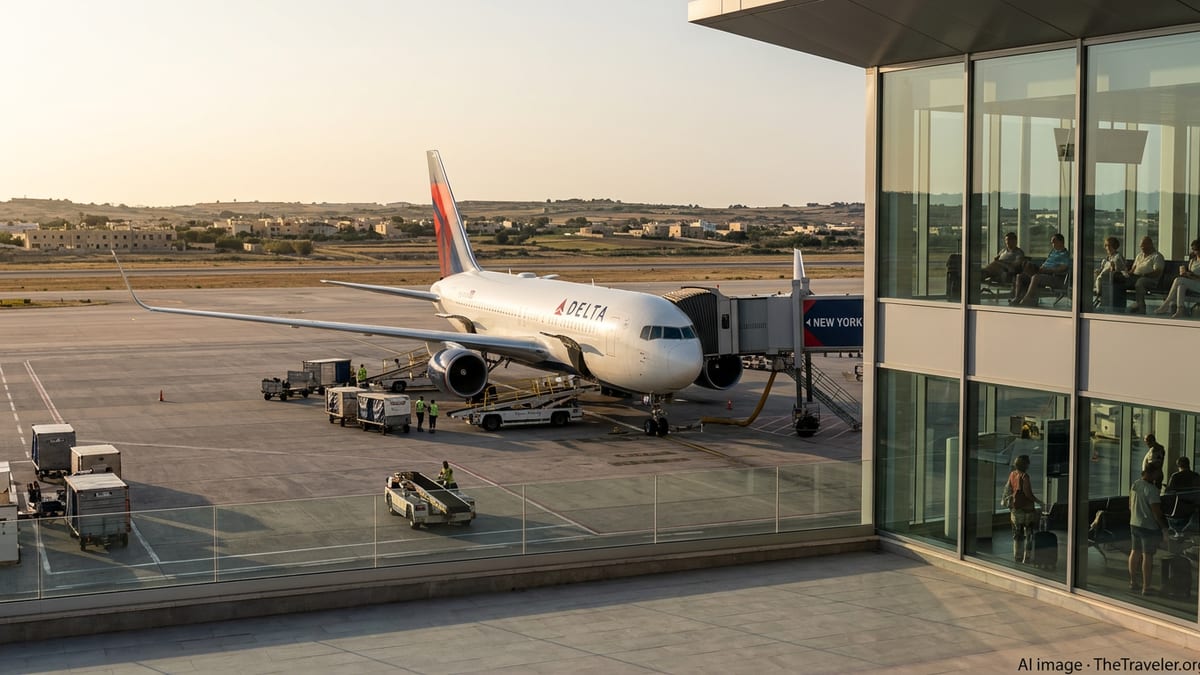
Details of Delta’s New JFK–Malta Route
Delta’s inaugural nonstop service from New York–JFK to Malta International Airport is scheduled to begin on June 7, 2026, operating three times per week during the summer season. The route, announced in late 2025 as part of the carrier’s record transatlantic expansion, marks Delta’s first-ever direct link to Malta and one of the island’s few nonstop connections to the United States.
The flights are expected to run with a Boeing 767-300ER, a widebody aircraft commonly used by Delta on transatlantic routes. The schedule is designed as an overnight eastbound service from New York, arriving in Malta in the morning to allow travelers to connect easily to hotels, ferries, and intra-island transport, while the westbound leg will depart Malta in the late morning or early afternoon and arrive in New York the same day.
As with Delta’s other long-haul services, the route is slated to offer multiple cabins, including Delta One business class, Premium Select, Comfort Plus, and Main Cabin. The airline is positioning the service as part of a broader push to give U.S. travelers more nonstop options to secondary European leisure destinations, complementing recent additions such as Catania and Porto.
The Malta service will be seasonal, focused on peak late spring and summer demand. Industry observers expect the operating window to run roughly from early June through late September 2026, aligning with Malta’s busiest tourism months and allowing Delta to redeploy aircraft to other markets in the off-season.
Why Malta and Why Now
Malta’s selection is closely linked to Delta’s high-profile “Route Race” initiative, in which SkyMiles members and Delta employees voted on a new European island destination for the 2026 schedule. While the vote split between Sardinia and Malta, Delta ultimately opted to launch both, signaling strong underlying demand for Mediterranean island escapes and the airline’s confidence in its New York transatlantic hub.
For Malta, the new flights arrive at a moment of steady tourism growth and increasing global visibility. The country has been actively promoting its mix of historic cities, UNESCO-listed sites, and seaside resort towns to U.S. travelers, but access has typically required connections through European hubs such as London, Rome, or Frankfurt. A nonstop link from JFK significantly shortens journey times and simplifies itineraries for American visitors.
The timing also reflects broader shifts in transatlantic aviation. With additional slots and infrastructure improvements at New York–JFK and robust summer demand for Europe, Delta has been using its New York hub to introduce routes to markets that were once considered too niche for nonstop service. Malta, with its English-speaking population, euro currency, and established tourism infrastructure, fits the profile of a destination ready for direct U.S. connectivity.
Analysts note that Delta is increasingly using targeted leisure routes to differentiate itself in a competitive New York market. By pairing Malta with new services to other Mediterranean islands and coastal cities, the carrier is betting that travelers will view JFK as a prime launch point for more specialized European vacations beyond the traditional big capitals.
What the New Route Means for U.S. Travelers
For American travelers, the biggest impact is convenience. A nonstop flight from New York to Malta eliminates at least one connection, reducing total travel time by several hours and minimizing the risk of missed onward flights or lost baggage during transfers. For East Coast residents, especially in the New York metropolitan area and along Delta’s domestic network feeding into JFK, Malta suddenly becomes a viable long-week vacation destination instead of a complex multi-leg journey.
The route is likely to stimulate competitive pricing and package deals as tour operators, cruise lines, and travel agencies respond to the new capacity. Travel advisers expect to see more bundled offerings that combine airfare with historic city stays in Valletta, beach time on Gozo or Comino, and excursions to archaeological and cultural sites across the islands.
The schedule will also benefit cruise passengers. Malta has become a popular embarkation and port-of-call point for Mediterranean cruises, but reaching ships often required overnight stays in other European cities. With direct JFK flights, U.S. cruisers can arrive closer to departure time and spend their pre- or post-cruise nights in Malta itself, encouraging more spending locally.
Beyond vacations, the route will improve access for the Maltese diaspora and business travelers. Technology, financial services, and film production have increasingly linked Malta with North America. A nonstop connection can shorten project timelines, facilitate site visits, and make the country more attractive for conferences and international events that draw U.S. participants.
Boost for Malta’s Tourism and Wider Economy
Tourism officials in Malta are framing the Delta launch as a strategic win that will diversify the country’s visitor base. While Malta has historically relied heavily on European markets such as the United Kingdom, Italy, and Germany, direct U.S. access opens up a higher-spend segment of long-haul visitors who tend to stay longer and invest more in cultural, gastronomic, and experiential travel.
Higher-spend travelers can provide a ripple effect across the local economy. Hotels in Valletta and resort areas are expected to see increased demand, particularly at the four- and five-star level. Restaurants, guides, boutique tour operators, and cultural institutions stand to benefit as itineraries increasingly incorporate museum visits, heritage tours, and culinary experiences alongside beach and leisure time.
Malta’s government has been encouraging more year-round tourism, highlighting mild shoulder-season weather and cultural programming outside peak summer. Even though Delta’s initial operation is seasonal, success in 2026 could strengthen the case for an extended season or additional U.S. services in future years. That potential growth would support ongoing investments in airport facilities, transportation links, and sustainable tourism initiatives.
The new flight is also likely to deepen business and institutional ties. Easier travel for U.S. university partners, corporate delegations, and film and gaming companies that already maintain a presence in Malta could translate into more joint ventures and projects. The direct route makes it simpler to position Malta as a meeting point between North America, Europe, and North Africa.
Positioning Delta for a Bigger Transatlantic Summer 2026
The JFK–Malta launch is part of a broader 2026 strategy in which Delta is touting its largest-ever summer transatlantic schedule. Alongside Malta, the airline is adding or expanding routes to other Southern European destinations, reinforcing New York–JFK’s role as a gateway not only to major capitals but also to emerging leisure hotspots.
For Delta, these kinds of focused seasonal routes help maximize aircraft utilization during peak months and respond flexibly to shifting demand patterns. By concentrating service in summer when American travelers flock to Europe, the airline can capture strong yields while maintaining the ability to reassign aircraft in the winter to business-heavy or sun-and-sand markets elsewhere.
The Malta service also underscores Delta’s evolving approach to customer engagement. By involving SkyMiles members and employees in choosing new island destinations, the company created a narrative around the route that goes beyond network optimization. That story is now being leveraged in marketing to position the 2026 flights as an opportunity for travelers to explore a destination they helped put on the map.
As airlines continue to rebuild and expand long-haul networks, Delta’s move into Malta illustrates how carriers are seeking out distinctive destinations that offer both strong leisure appeal and broader strategic benefits. For travelers in New York and beyond, the result in 2026 will be a more direct path to one of the Mediterranean’s most intriguing island nations.