

More news on this day
Delta Air Lines and United Airlines have steadily separated themselves from the rest of the U.S. airline pack, with an associate editor on the "Barron’s Roundtable" program arguing that the two carriers have effectively "clobbered" the broader airline stock market over a period marked by crises, consolidation, and shifting travel demand.
Get the latest news straight to your inbox!
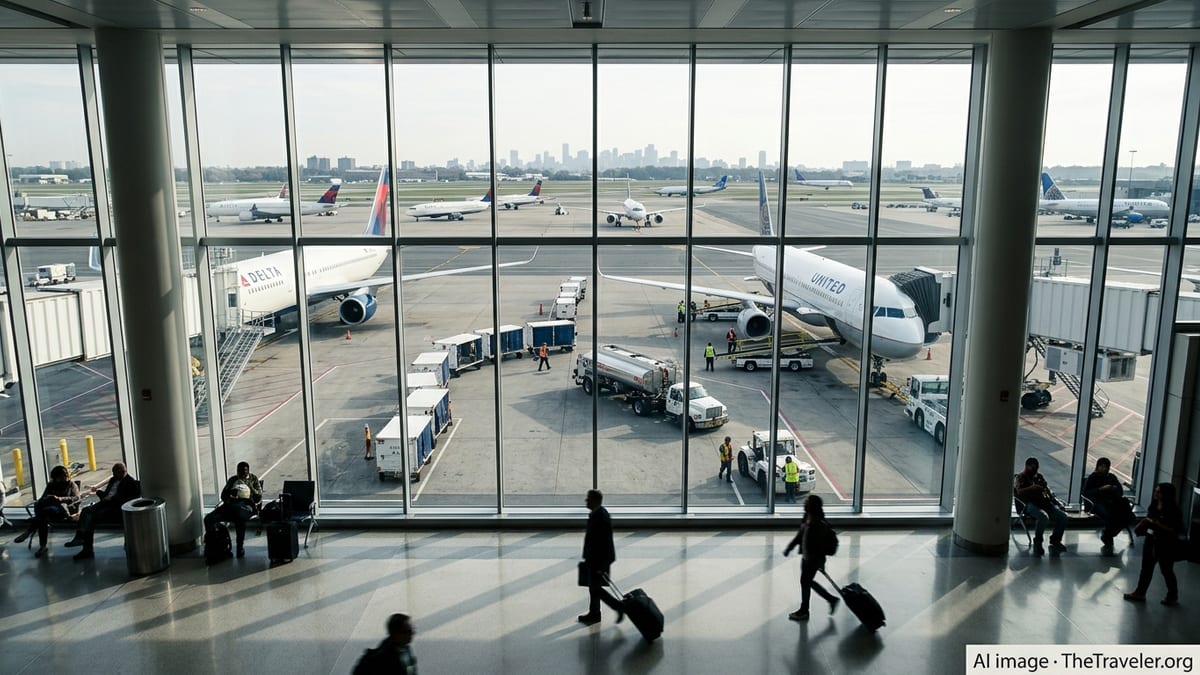
Airline Stocks Remain Turbulent While Two Carriers Stand Out
Publicly available performance data show that airline shares have endured a volatile decade, from the 2020 travel collapse to fuel price swings and operational meltdowns. Sector gauges such as the NYSE Arca Airline Index have lagged the wider market in several of those years, reinforcing the view that airlines remain a high-risk corner of the transportation industry.
Against that choppy backdrop, research coverage indicates that Delta Air Lines and United Airlines have been persistent outliers. Analyst notes and sector reviews describe both as structural winners, citing their network reach, premium cabins, credit card partnerships, and corporate travel exposure as advantages that have helped them outperform peers over multi‑year horizons.
Recent commentary highlighted on the "Barron’s Roundtable" program captures this divergence, characterizing Delta and United as having "clobbered" airline benchmarks and many competitors over the long term, even as short‑term swings periodically batter the group. The framing reflects a broader narrative across financial media that the legacy network carriers with diversified revenue have weathered the storm better than rivals focused on discount fares alone.
Market data compiled in independent research notes show that, over the past several years, both carriers have delivered stronger total returns than several large U.S. rivals, particularly those more exposed to domestic leisure traffic or higher unit costs. That relative strength, more than simple share price gains, underpins the view that they have outperformed the airline complex as a whole.
Profitability, Premium Demand and Loyalty Programs Drive the Gap
Financial disclosures and industry analyses point to consistent profitability as a key factor behind Delta’s and United’s stock performance. Reports summarizing recent years show Delta producing industry‑leading margins and positive earnings through multiple cycles, while United has moved from a laggard to a carrier with double‑digit pre‑tax margins and record revenue on several recent quarters.
Premium travel and loyalty revenue have been particularly important. Sector research notes that Delta’s higher‑yield cabins and its co‑branded credit card partnership have delivered growing, relatively resilient income streams. Similar coverage of United highlights growth in premium seating, international long‑haul routes, and mileage program revenues, which together have cushioned the impact of economic uncertainty on base fares.
Compared with carriers that lean heavily on low‑fare, point‑to‑point flying, these diversified models give Delta and United more levers to pull when the economic outlook darkens. Analysts often point out that high‑value business travelers and loyalty customers tend to return earlier in a recovery and are less sensitive to modest fare increases, supporting revenue per available seat mile even when leisure demand wobbles.
This operational and commercial mix has shown up in earnings season reactions. Backtests and earnings studies circulated in financial research indicate that positive surprises from Delta and United have often been rewarded with stronger post‑report share performance than the airline average, reinforcing investor confidence in management execution.
Sector Setbacks Have Not Spared the Leaders
The outperformance described on "Barron’s Roundtable" has not meant a smooth ride. Delta and United have both been caught in episodes that rattled airline stocks broadly, including profit guidance cuts, tariff uncertainty, and system outages that disrupted operations worldwide. In some periods, their shares fell sharply alongside the sector as investors reassessed travel demand and cost pressures.
Analyst downgrades in 2025 underscored those risks, with several major banks trimming price targets across U.S. airlines as economic clouds gathered. Reports show that Delta and United were not immune to those revisions, even if some brokerages continued to flag them as relative favorites within a troubled group.
Operational shocks have added to the turbulence. Public filings and news coverage of the 2024 technology outage linked to a cybersecurity software issue documented thousands of cancellations, with Delta in particular reporting significant financial impact and later pursuing legal action. United also experienced several days of disruption before restoring its schedule, illustrating how even best‑in‑class carriers can be sideswiped by external events.
Despite those setbacks, subsequent quarters often showed Delta and United returning to profitability more quickly than peers or maintaining stronger forward guidance. That pattern of recovery has been central to the perception that, over the long run, their stocks have fared better than the broader airline landscape.
How Delta and United Compare With Rival U.S. Airlines
Comparative data from investor presentations, municipal bond disclosures, and airline financial reports reveal stark contrasts within the U.S. carrier roster. Delta and United have been cited in official documents as delivering some of the strongest financial performance among major U.S. airlines in recent years, while several low‑cost or hybrid competitors have struggled with higher unit costs or operational stumbles.
Analyses of share price performance around key downgrades and earnings events have shown deeper or more prolonged drawdowns for certain rivals, particularly those hit by high debt levels, wage inflation, or persistent schedule reliability concerns. In some cases, independent shareholder communications have explicitly called out weaker carriers as underperformers across financial and service metrics.
By contrast, institutional research frequently groups Delta and United with a smaller cohort of legacy carriers seen as better positioned to balance domestic and international demand. Their global alliances, widebody fleets, and investments in airport hubs are viewed as strategic assets that support long‑haul profit pools less accessible to purely domestic competitors.
That relative advantage does not eliminate cyclical risk, but it helps explain why some portfolio managers and commentators now talk about a "two‑speed" airline sector, in which a handful of network operators have demonstrated an ability to compound value while others remain tethered to more fragile business models.
What the Divergence Means for Investors and Travelers
The argument that Delta and United have "clobbered" the airline stock market is ultimately about dispersion of returns in a sector that investors once treated as uniformly speculative. Publicly available market data and analyst commentary suggest that stock pickers who differentiated among carriers, favoring those with durable revenue streams and operational discipline, have been rewarded over multi‑year horizons.
For investors, the recent pattern reinforces the idea that airline exposure may be most compelling through individual leaders rather than broad sector baskets during periods of industry strain. Exchange‑traded funds tied to airline indexes have often been weighed down by weaker constituents, while top performers have at times broken out to new highs on company‑specific catalysts.
For travelers, the same dynamics help shape the experience on the ground and in the air. Stronger profitability has allowed Delta and United to keep investing in new aircraft, upgraded cabins, and hub infrastructure, even as rivals have delayed capital spending or cut schedules in response to financial pressure. Those investments, in turn, can support more reliable operations and a wider range of routes.
As global demand, economic conditions, and regulatory pressures continue to shift, it remains uncertain whether Delta and United can maintain their lead indefinitely. For now, however, the performance patterns highlighted by the "Barron’s Roundtable" commentary suggest that the two carriers occupy a distinct tier in both the stock market and the competitive landscape.