

More news on this day
Delta Air Lines passengers in Minneapolis and New York are facing a fresh wave of cancellations and delays today as a powerful late-winter storm disrupts operations across key hubs in the eastern United States.
Get the latest news straight to your inbox!
Storm System Slams Upper Midwest and East Coast Hubs
A sprawling March storm system affecting the Upper Midwest and the Eastern Seaboard is driving a sharp uptick in Delta flight cancellations, particularly at Minneapolis–Saint Paul International Airport and New York’s major airports. Publicly available weather data and airline tracking services indicate heavy snow and strong winds in Minnesota, combined with advancing bands of rain and thunderstorms along the East Coast, are constraining takeoffs and landings.
In Minneapolis, forecasters have highlighted a corridor of intense snowfall and gusty winds, reducing visibility and forcing airport operators to periodically slow or pause runway activity. According to published coverage on the developing storm complex, Minnesota authorities moved into emergency-preparedness mode ahead of the heaviest snow, a step that typically precedes widespread schedule cuts from airlines seeking to avoid stranding aircraft and crews.
At the same time, New York area airports are preparing for deteriorating conditions as the storm tracks east. Meteorological outlooks point to a mix of low clouds, rain, and potentially disruptive crosswinds later in the day, a combination that historically leads to ground delays and capacity reductions at congested airports such as John F. Kennedy, LaGuardia, and Newark.
Aviation analysts note that large carriers like Delta increasingly rely on proactive cancellations when storms affect multiple hubs at once. This strategy, while painful for travelers in the short term, is designed to prevent rolling delays and missed connections that can ripple through the network for days.
Delta Scales Back Schedules in Minneapolis First
Minneapolis–Saint Paul, one of Delta’s largest hubs, has been among the first to see significant schedule cuts as the storm’s heaviest snow bands focus on the Upper Midwest. Flight-tracking snapshots and passenger accounts posted publicly show numerous Delta departures from Minneapolis canceled or retimed, including both domestic and transatlantic services.
Reports indicate that Delta has been trimming flights through Minneapolis since the end of last week, initially targeting evening and overnight departures to limit the number of aircraft and crew exposed to worsening conditions. Over the weekend, as snowfall intensified and forecasts were updated, the pattern shifted toward a broader thinning of the schedule, affecting daytime departures and inbound connections as well.
Operational experts point out that Minneapolis presents unique challenges in this type of storm. Even with extensive de-icing infrastructure and a strong cold-weather record, sustained snowfall and gusty winds can require repeated runway clearing and more frequent de-icing cycles, slowing the entire operation. When that slowdown coincides with peak bank times for hub connections, airlines are more likely to cancel flights outright rather than risk extended holding times and missed onward connections.
Public discussions among travelers suggest that Delta has prioritized maintaining a core set of long-haul and high-demand routes from Minneapolis while suspending lower-frequency and regional services. This approach aims to protect international connectivity and key domestic links, even as overall capacity dips sharply.
New York Airports Brace for Thunderstorms and Wind
While Minneapolis grapples with heavy snow, New York is bracing for the storm’s volatile eastern edge, with forecasts calling for strong winds, low ceilings, and lines of thunderstorms sweeping through the mid-Atlantic and Northeast. Aviation planners warn that such conditions are particularly disruptive at New York’s tightly scheduled airports, where small reductions in arrival rates can quickly cascade into widespread delays.
According to recent operational guidance shared publicly by airlines during similar events, carriers typically respond to New York weather threats by trimming afternoon and evening flights, when congestion is highest and air traffic control programs are most restrictive. Early indications from flight-status platforms show a growing number of Delta cancellations and significant delays on routes touching New York, especially shorter-haul flights that can be consolidated onto fewer departures.
New York’s role as both an origin-and-destination market and a connecting gateway complicates the disruption. Travelers starting or ending journeys in the city may face long waits for the next available seat, while connecting passengers risk misaligned itineraries if upstream flights from the Midwest or South arrive late or are scrubbed entirely.
Publicly available information from prior weather events in the region indicates that recovery at New York airports can lag well beyond the end of active storms. Crews and aircraft displaced by earlier cancellations must be repositioned, and backlogged passengers re-accommodated, leading to residual disruptions that can stretch into the following day.
Passengers Face Rebooking Scramble and Limited Options
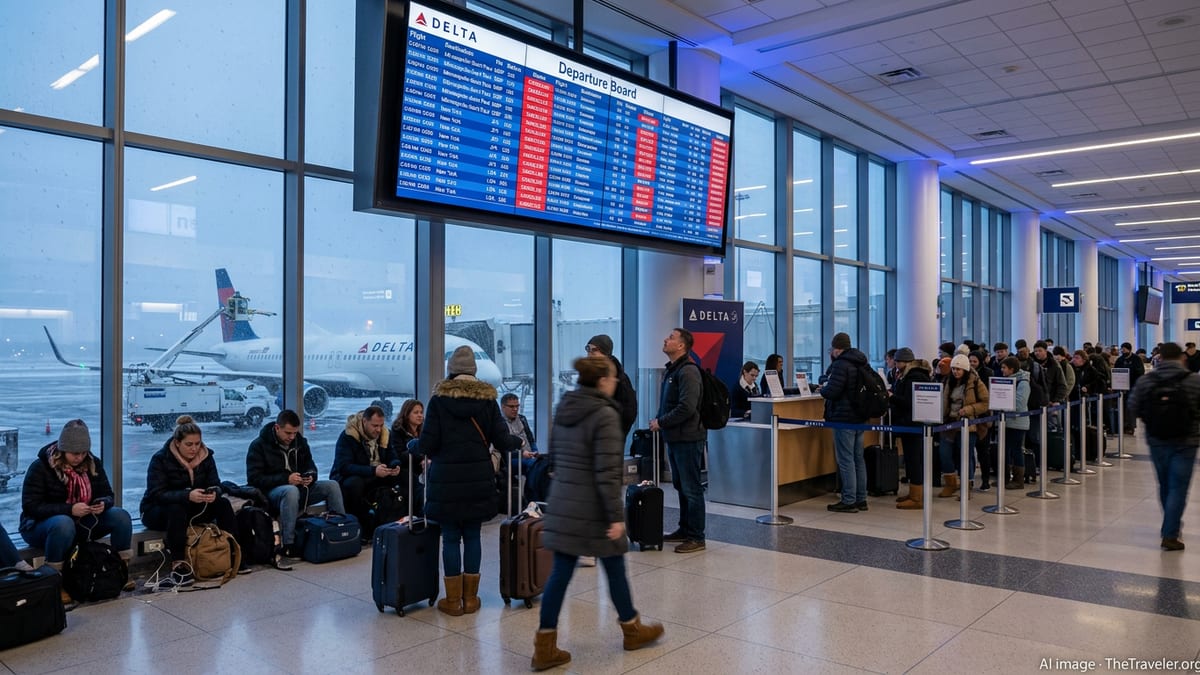
For Delta customers in Minneapolis and New York, the combined effect of snow, wind, and thunderstorms is translating into crowded terminals, long lines at service counters, and increasingly limited rebooking options. Travelers posting on public forums describe early-morning cancellation notifications followed by difficulty finding same-day alternatives, particularly on popular business routes and transatlantic services.
Industry guidance on Delta’s published policies indicates that when flights are canceled due to weather, customers are generally allowed to rebook without change fees within a specified window, subject to seat availability. However, when hundreds of flights across multiple hubs are affected at once, the pool of remaining seats tightens quickly, pushing some travelers to accept next-day or even later departures.
Consumer advocates frequently advise passengers in such situations to use a combination of tools, including airline mobile apps, websites, and airport kiosks, to secure new itineraries as soon as disruption alerts appear. In large-scale events like the current storm, phone hold times can stretch considerably, and same-day options may disappear within minutes of mass cancellation waves.
Publicly available commentary from experienced travelers also highlights the importance of monitoring both origin and destination conditions. A flight that appears unaffected when viewed solely from New York, for example, may still be at risk if its inbound aircraft is scheduled to arrive from storm-battered Minneapolis or another Midwest airport facing ground delays.
Further Disruptions Likely as Storm Tracks East
With the storm system still in motion and forecasts calling for severe weather across portions of the mid-South, mid-Atlantic, and Northeast through late Monday, additional cancellations and delays are likely for Delta and other carriers. Meteorologists tracking the event warn that successive rounds of snow, wind, and thunderstorms could affect different regions in rapid sequence, complicating efforts to restore normal flight operations.
For Minneapolis, the main concern over the next 24 hours is lingering snow and wind that could keep runway and taxiway conditions marginal, even after the heaviest bands pass. For New York, the focus is on the timing and intensity of thunderstorms and low-level wind shear, both of which can trigger stringent spacing requirements between aircraft and force temporary halts to arrivals and departures.
Aviation observers note that Delta’s network design, with large hubs in both the Upper Midwest and the Northeast, makes it particularly sensitive to a storm path that sweeps from Minnesota toward the Eastern Seaboard. As long as the same weather system is influencing both Minneapolis and New York, knock-on effects such as aircraft reassignments and crew time-limit constraints may continue to generate last-minute schedule changes.
Travelers booked on Delta flights to, from, or through Minneapolis and New York over the next two days are being urged, through airline advisories and broader travel coverage, to check their flight status frequently and to be prepared for evolving conditions. Even if skies appear clear locally, the broader network impact of the storm may still determine whether a given flight operates on time, late, or not at all.