

More news on this day
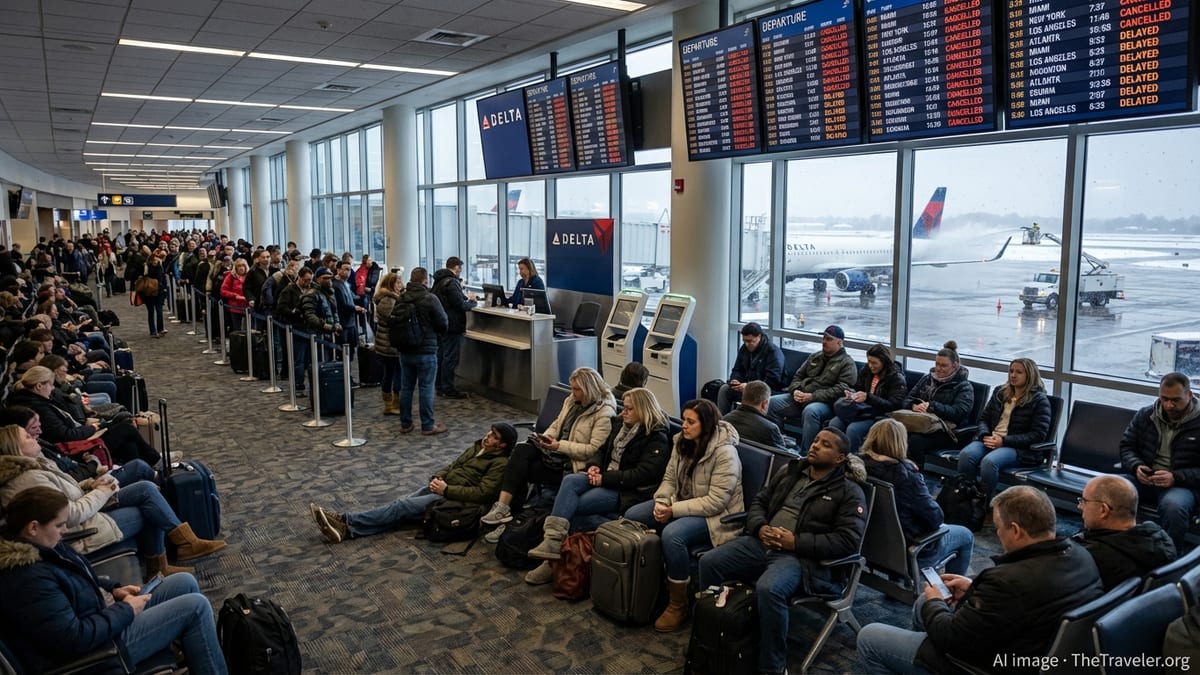
Thousands of travelers across the United States found themselves stranded in terminals and on tarmacs this weekend as Delta Air Lines canceled 346 flights and delayed another 578, disrupting operations at major hubs including Miami, New York, Los Angeles and Atlanta and rippling through domestic and international networks.
Storm Systems and Strained Operations Collide
The latest wave of disruption comes at a volatile moment for U.S. aviation, as airlines juggle heavy winter weather, surging passenger demand and lingering staffing and infrastructure pressures. Delta’s 346 cancellations and 578 delays represent one of the carrier’s most challenging operational days since the start of the year, and follow weeks of turbulence tied to powerful winter storms sweeping across the country.
Meteorologists have warned that a succession of storm systems, including recent nor’easter conditions in the Northeast and severe weather farther south, has created a narrow operating window for carriers. Airlines can often manage localized weather, but when systems stretch from the Mid Atlantic through New England and back into the Midwest and South, even well-planned schedules begin to buckle under the strain.
Delta, long regarded as one of the most reliable major U.S. airlines, has invested heavily in recovery tools and predictive scheduling, yet the scale and timing of the storms have repeatedly tested the resilience of its network this winter. The airline has emphasized that safety remains its first priority, with proactive cancellations used to avoid aircraft being trapped at vulnerable airports and to protect crews and passengers from the most dangerous conditions.
Industry analysts note that while weather may be the trigger, the impact is magnified by the current structure of U.S. air travel. Packed load factors, limited spare aircraft and tight crew rosters leave little slack when operations are disrupted. Once a critical mass of cancellations and delays is reached at an airline’s hubs, the resulting domino effect can take days to unwind.
Major Hubs from Atlanta to Los Angeles Hit Hard
Hartsfield Jackson Atlanta International Airport, Delta’s largest hub and the busiest airport in the United States, has again been at the center of the chaos. Long lines snaked outside Delta customer service desks, and departure boards pulsed with red and orange notifications as waves of cancellations and rolling delays cascaded through the day’s schedule.
In New York, disruptions at both John F. Kennedy International and LaGuardia further snarled one of the country’s most important aviation corridors. With winter weather bearing down on the region, Delta cancelled and delayed a significant share of its departures to protect crews and aircraft positioning, a move that left passengers bound for Florida, the Midwest and Europe scrambling for alternatives.
Farther south, Miami International Airport saw a spike in stranded travelers as Delta’s cancellations knocked out key connections for passengers heading to the Caribbean and Latin America. Families returning from cruises and winter getaways queued for rebooking, many facing unexpected overnight stays as remaining seats on later flights quickly filled.
On the West Coast, Los Angeles International Airport also felt the ripple effects. While weather conditions there were less severe, Delta flights arriving from or heading to storm affected regions were delayed or cancelled, creating pockets of congestion at terminals that are already operating near capacity during peak hours.
Passengers Face Hours Long Lines, Missed Events and Mounting Costs
For passengers caught in the disruption, the statistics translate into very personal stories of missed events, mounting expenses and physical exhaustion. Across affected airports, travelers sat slumped against terminal walls, camped out on thin airport blankets or lined up for hours in front of overburdened service counters hoping to secure a seat on the next available flight.
Business travelers reported missing client meetings and conferences they had been planning for months, while international passengers worried about expiring visas, tight connection windows and the knock on effects of rebooking long haul itineraries. For leisure travelers, especially families with young children, the challenge was more immediate: finding food, places to rest and ways to keep children calm in terminals that felt increasingly overcrowded.
Many passengers turned to Delta’s mobile app and website to rebook flights, as the airline urged customers to use digital channels rather than join already lengthy in person queues. While some were able to secure new itineraries quickly, others found that available options were limited or involved multiple connections and overnight layovers far from their original destinations.
Financial strain compounded the inconvenience. Travelers described paying out of pocket for last minute hotel rooms, ride share fares to alternative airports, and meals outside their budgets. Although Delta typically offers to rebook customers on its own flights at no additional fare, compensation for hotels and other expenses often depends on the cause of the disruption and the specific terms of each ticket, leaving many passengers uncertain about what they could claim back.
Delta’s Response: Fee Waivers, Rebooking and Network Recovery
As cancellations and delays mounted, Delta activated its standard disruption playbook, including waiving change fees for affected routes and encouraging customers to shift their travel outside the worst of the weather window. The airline said it was working to automatically rebook passengers on the next available flights, with notifications sent through text messages, email and app alerts.
Operationally, Delta moved to consolidate lightly booked flights, reposition aircraft and call in reserve crews where possible to restore stability to its schedule. These recovery steps are complex and often invisible to the public, but they are critical in determining how quickly an airline can return to normal after a day of major disruption.
At the same time, the carrier faced a delicate communications challenge. Airlines must balance transparency about the scale of problems with reassurance that solutions are in motion. Delta representatives urged passengers to regularly check their flight status before leaving for the airport and to consider rebooking to later dates if their travel was flexible, a message aimed at reducing congestion in already packed terminals.
Travel experts say the airline’s response reflects an industry wide shift toward preemptive cancellations and more flexible policies when severe weather threatens. By scrubbing flights in advance and offering waivers, carriers can avoid last minute chaos at the gate and reduce the number of passengers and aircraft stranded in the wrong place. However, for those whose trips fall on the wrong day, the result can still feel like a sudden and complete breakdown of the system.
Broader Industry Pressures and a Difficult Winter Season
Delta’s troubles are part of a wider pattern across U.S. aviation this winter. Competing airlines have likewise faced days with hundreds or thousands of cancellations and delays as weather systems, air traffic control staffing challenges and infrastructure constraints collide with high travel demand. Flight tracking data has regularly shown spikes in nationwide disruption on storm days, with major hubs from Chicago to Boston and Dallas to Washington experiencing significant operational stress.
The scale of the issues reflects how finely tuned modern airline networks have become. Carriers seek to maximize aircraft utilization and minimize idle time on the ground, strategies that are financially efficient but leave little room for error. When a storm closes runways or slows air traffic flow, flights begin to back up quickly, and recovery can stretch well beyond the end of the actual weather event.
For Delta, the timing is particularly sensitive. The airline, like its peers, has been working to reassure investors that it can navigate more frequent extreme weather events while still meeting financial targets. That means investing in technology, crew scheduling systems and de icing capacity, while also managing labor costs and keeping ticket prices competitive in a crowded market.
Yet even with these investments, episodes such as the latest 346 cancellations and 578 delays highlight the limits of what airlines can control. Weather, airspace congestion and airport infrastructure are variables that can only be partially mitigated, and passengers are increasingly aware that even the most reputable carriers are not immune from sudden, large scale breakdowns.
Advice for Affected and Future Delta Travelers
For travelers still caught in the current disruption, aviation analysts and passenger advocates offer several pieces of practical advice. First, they recommend relying on the airline’s app or website as a primary tool for rebooking, since digital platforms often provide faster access to remaining seats than in person counters. Screenshots of original itineraries, receipts and any communication from the airline can also be useful later if passengers seek reimbursement.
Those with time sensitive commitments, such as international connections, cruises or major events, are urged to proactively contact Delta and, where relevant, hotels, tour operators or cruise lines to explain the situation. Some third party providers offer limited flexibility when disruptions are clearly beyond a traveler’s control, though policies vary widely.
Looking ahead, the episode may shift how some passengers plan trips during peak winter months. Travel planners suggest building in extra buffer days when journeys involve critical dates, such as weddings, job interviews or medical appointments. Booking earlier departures in the day can also improve odds of avoiding the worst knock on effects, since morning flights are less exposed to the cumulative impact of rolling delays.
Travel insurance remains another tool, but policies differ significantly in what they cover. Some products reimburse only a portion of out of pocket costs or apply strict definitions of what qualifies as a covered event. Passengers are encouraged to review terms carefully and to weigh whether higher coverage tiers are worthwhile given the increasing volatility of winter travel.
Airports, Crews and Customers Under Mounting Stress
The human impact of persistent disruptions extends beyond passengers. Ground staff, gate agents, flight attendants and pilots have faced grueling schedules as they work to move aircraft, rebook customers and handle the emotional toll of repeated cancellations. Many front line employees bear the brunt of traveler frustration despite having little control over weather or high level operational decisions.
Airport infrastructure has also been pushed to its limits. De icing operations, runway clearing, baggage handling systems and terminal amenities all come under heavy strain when storms hit. At some hubs, passengers reported full restrooms, limited seating and long waits for food and water as concessions struggled to keep up with demand from crowds that swelled throughout the day.
Mental health advocates warn that the cumulative stress of such episodes can weigh heavily on both travelers and aviation workers. Families with children, elderly passengers and those with disabilities are especially vulnerable when assistance services are stretched thin. Some airports have begun deploying additional volunteers or customer care teams during major disruptions, but coverage and training remain uneven across the system.
As disruptions become more frequent, there are growing calls for coordinated planning among airlines, airport authorities and regulators to improve communication, prioritize vulnerable travelers and ensure that minimum standards of care are upheld when thousands of people are unexpectedly stranded for hours or days.
What This Means for the Rest of the Winter Travel Season
The wave of cancellations and delays at Delta offers a stark preview of what the rest of the winter season could bring if major storm systems continue to roll across key aviation corridors. Forecasts suggest that active weather patterns may persist, raising the risk of additional days in which thousands of flights are affected nationwide.
For travelers, that means increased uncertainty around itineraries that would have seemed routine in past years. For airlines, it heightens the urgency of refining playbooks for rapid recovery, improving digital tools and expanding the pool of reserve crews and aircraft that can be tapped in a crisis.
In the immediate term, Delta’s focus will be on clearing the backlog of stranded passengers and restoring confidence in its schedule. That process is likely to continue into the coming days, as missed connections are reassembled and aircraft are repositioned across the network. Even once operations normalize, however, the memory of crowded terminals in Miami, New York, Los Angeles, Atlanta and other cities is likely to linger for many of the travelers whose plans were upended.
The episode underscores a broader reality: in an era of busier skies and more volatile weather, even a single day of disruption at a major airline can briefly reshape the entire U.S. travel landscape, leaving thousands of people far from where they expected to be.