

More news on this day
Thousands of Delta Air Lines passengers across the United States faced fresh disruption on Thursday as a wave of 33 cancellations and more than 300 delays rippled through major hubs from Los Angeles and Salt Lake City to Atlanta, Detroit and smaller regional gateways, stranding travelers, stretching airport operations and testing the resilience of an already weather-battered winter schedule.
Fresh Disruptions After a Punishing Winter for Airlines
The latest bout of Delta disruptions came as the carrier and the broader US aviation system are still working to stabilize operations after an exceptionally turbulent winter of storms, staffing strains and lingering technology concerns. While Thursday’s totals are modest compared with the multi-thousand-flight meltdowns that have periodically dominated headlines, the concentration of problems at some of Delta’s most critical hubs meant the impact was felt widely across the network.
Operational data from flight-tracking services indicated that Delta was contending with 33 flight cancellations alongside more than 300 delayed departures and arrivals over the course of the day. The knock-on effects pushed connection times to the breaking point for some passengers and left others facing unexpected overnight stays, particularly at hub airports where banks of flights are tightly choreographed to move passengers through in waves.
Industry analysts say the pattern reflects a system that remains highly sensitive to even modest disruptions. After a series of major weather events and a recent spate of airport-specific slowdowns, both airlines and air traffic control remain under pressure, forcing carriers like Delta to build more slack into schedules while still trying to meet robust demand for domestic and international travel.
For travelers, the statistics translate into longer lines at customer service counters, crowded gate areas and a familiar sense of uncertainty about when they will actually reach their destinations, even on days that do not feature headline-grabbing storms or nationwide outages.
Los Angeles and the Western Network Feel the Strain
At Los Angeles International Airport, one of Delta’s most important West Coast gateways, a series of rolling delays affected flights up and down the Pacific corridor as well as key transcontinental services. Travelers reported departure boards peppered with yellow and red notices indicating late departures, gate changes and creeping pushback times that shifted in 15- and 30-minute increments.
Gate agents at LAX spent much of the morning and afternoon rebooking passengers who had already missed tight eastbound connections, particularly those aiming for evening departures to Detroit and Atlanta. While relatively few flights out of Los Angeles were outright canceled, even minor schedule slips had a cascading effect for customers attempting to complete multi-leg itineraries across the Delta network.
Operational experts note that the West Coast is particularly vulnerable on days like this because early delays can echo across the system well into the evening. A late departure from Los Angeles to Salt Lake City or Minneapolis can easily ripple into missed connections for passengers headed for smaller Midwestern or Mountain West cities, reducing the effective resilience of Delta’s carefully timed banked hub schedules.
Despite the disruption, most Delta flights at Los Angeles were still departing, albeit behind schedule, as the airline sought to preserve as much of its capacity as possible while crews and aircraft repositioned around previous days’ weather and maintenance knock-ons.
Sioux Falls and Smaller Cities Highlight Network Vulnerabilities
Beyond the big coastal and hub airports, Thursday’s disruptions underscored how vulnerable travelers in smaller markets remain when a major carrier trims even a handful of flights. Sioux Falls, a regional station served primarily through connections to Delta’s hubs, saw its limited schedule squeezed as downstream delays and a small number of cancellations forced aircraft and crews to be reassigned.
For passengers in cities like Sioux Falls, even a single canceled outbound or inbound flight can mean an entire day lost. With less frequent service and fewer alternative routings, options to rebook can be limited, particularly when multiple carriers are all managing the after-effects of winter storms and earlier disruptions elsewhere in the system.
Local travelers reported long queues at check-in and ticketing counters as agents worked through rebooking options that often involved overnight stays in hub cities or itineraries re-routed through alternative airports such as Minneapolis or Denver. In some cases, passengers opted to abandon air travel altogether, turning to long drives rather than risk further uncertainty.
The situation in Sioux Falls mirrors challenges seen at small and mid-sized airports across the country whenever major carriers pare back flying for operational reasons. With fewer redundant flights and limited spare aircraft, each schedule adjustment has an outsized impact on local communities that depend on reliable air service.
Salt Lake City and Atlanta Hubs Under Heavy Pressure
Salt Lake City and Atlanta, two of Delta’s primary domestic hubs, bore a significant share of Thursday’s disruption. At Salt Lake City International, a combination of morning operational delays and aircraft repositioning issues contributed to a line of departures running behind schedule, affecting both short-haul regional flights and longer transcontinental sectors.
Travelers connecting through Salt Lake City described packed concourses and gate areas as multiple delayed flights boarded simultaneously, compressing what is usually a carefully staggered flow of passengers through security checkpoints and jet bridges. As delays mounted, some later departures were held to accommodate inbound travelers stranded in other parts of the system, trading on-time performance for reduced misconnects.
In Atlanta, Delta’s largest hub and the world’s busiest airport by passenger volume, even a relatively small percentage of delayed flights translated into hundreds of affected travelers. With so much of Delta’s network pulsing through Hartsfield-Jackson, any schedule disruption, however modest in scale, can quickly balloon into long customer service lines and crowded concourses as passengers seek alternative routings or same-day standby options.
Operational planners at Delta have attempted to build more resilience into hub schedules after previous meltdowns, particularly following last year’s major winter storms and technology outages that hit Atlanta hard. But as Thursday’s performance showed, the sheer density of the operation there leaves little margin when multiple factors, from crew availability to weather and air traffic control spacing, converge on the same day.
Detroit and the Upper Midwest Manage Weather and Congestion
Detroit Metropolitan Wayne County Airport, another key Delta hub, also experienced knock-on effects as Thursday’s disruptions unfolded. While weather at Detroit itself remained generally manageable, earlier-week storms in the Upper Midwest and Great Lakes region had already stretched crew rotations and aircraft utilization, leaving less cushion for dealing with fresh delays.
Several Delta departures out of Detroit left behind schedule as crews and aircraft repositioned from other parts of the network. For passengers headed to smaller regional cities in Michigan, Ohio and neighboring states, short-haul flights were particularly vulnerable to last-minute time changes, as the airline weighed whether to prioritize longer-haul sectors with more passengers on board.
Travelers connecting through Detroit reported that airport staff worked to keep communication flowing, with frequent public address announcements and app-based updates, but some customers still found themselves learning of missed connections only after landing, when their subsequent flights had already departed or been significantly delayed.
The situation highlighted how dependent the Midwest remains on smooth operations at a handful of major hubs. When Detroit, Minneapolis or Chicago absorb delays, the effects are quickly felt at secondary airports, amplifying the reach of what may begin as a relatively localized operational challenge.
From Winter Storm Fern to Ongoing Schedule Recovery
Thursday’s travel snags did not occur in isolation. They follow weeks of heavy strain on Delta’s network, punctuated most dramatically by the late-January blast of Winter Storm Fern, which forced the airline to cancel thousands of flights across several days and temporarily shut down major operations at its Atlanta hub. Those large-scale disruptions continue to reverberate in the form of tighter crew schedules and aircraft maintenance backlogs.
More recent weather over the Presidents Day period added a further layer of complexity, as a new system triggered hundreds of additional cancellations and delays at northeastern airports just days earlier. Even as Delta has restored the majority of its planned flying, the combination of weather-related reroutes, out-of-position aircraft and crews nearing regulatory duty limits has left the airline more susceptible to smaller-scale disturbances like those seen on Thursday.
Analysts say that in this environment, airlines are often forced to make tactical choices between preserving the overall integrity of the schedule and protecting individual flights. Canceling a small number of services outright can, in some circumstances, prevent much larger downstream disruption, even though the short-term experience for customers on those flights is significantly worse.
For passengers, however, the distinction offers little comfort. Many travelers affected by Thursday’s cancellations and delays were already on edge after earlier winter disruptions, and some voiced concerns that the system appears increasingly fragile, with the slightest push tipping operations into delay-prone territory.
Passenger Experiences: Long Lines, Missed Connections and Rebookings
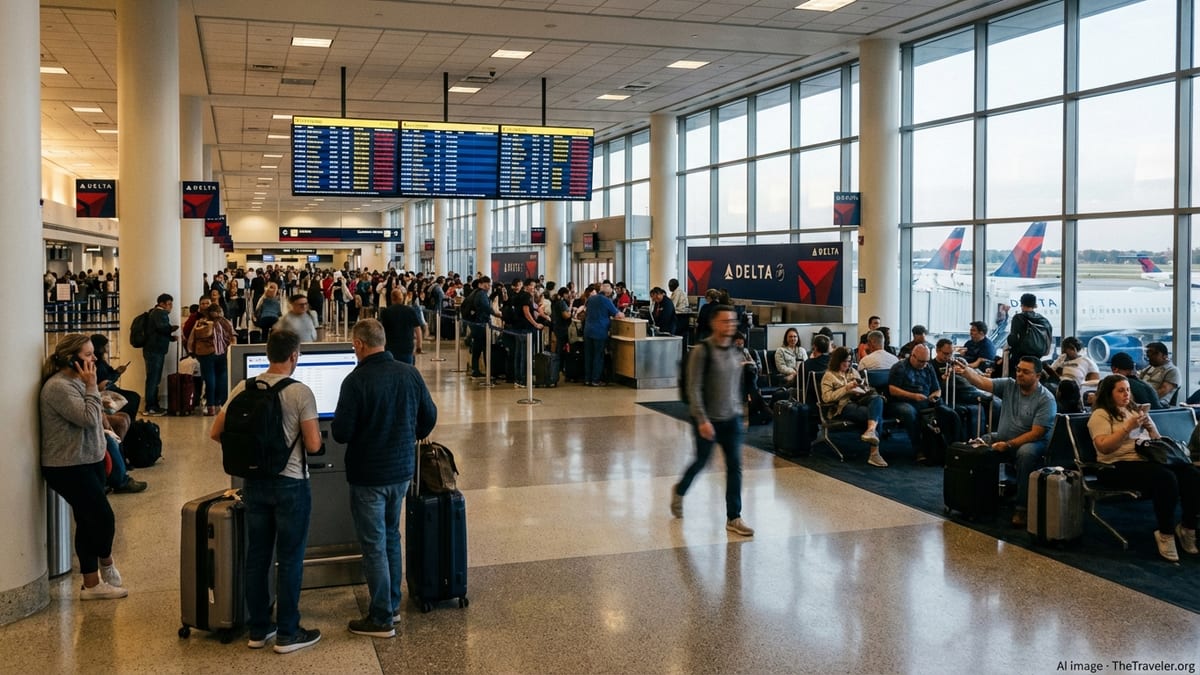
Inside terminals from Los Angeles to Atlanta, the human cost of the day’s disruptions was visible in snaking lines at customer service counters, crowded seating areas and groups of passengers huddled around departure boards refreshing mobile apps for updates. Families traveling with young children, business travelers on tight schedules and international visitors alike found their carefully timed itineraries unraveling.
Missed connections were a recurring theme, particularly for passengers attempting to complete same-day multi-leg journeys through Delta’s hubs. Even delays of 45 to 60 minutes on the first leg of a trip were enough to push some travelers onto much later departures, extending domestic journeys by several hours and, in some cases, forcing unplanned overnight stays in hub cities.
Reports from affected airports indicated that Delta deployed additional staff to assist with rebookings and to distribute meal vouchers and hotel information where overnight disruptions were unavoidable. Many passengers were encouraged to use the airline’s app or automated kiosks to secure new itineraries, a strategy that has become increasingly common as carriers attempt to ease pressure on in-person service desks during irregular operations.
Still, not all travelers were satisfied. Some voiced frustration over inconsistent communication, noting that gate agents and app notifications sometimes offered conflicting information about departure times or upgrade and standby priority. Others questioned why relatively clear weather at their departure airport could coincide with major schedule problems, underscoring the challenge of explaining network-wide disruptions that often originate far from where passengers actually board.
What Travelers Can Do When Disruptions Hit
For those caught up in Thursday’s wave of Delta disruptions, travel experts recommend a series of steps that can help minimize stress and, in some cases, shorten delays. Chief among them is staying as proactive as possible with information, including closely monitoring airline apps, signing up for text alerts, and keeping an eye on overall airport status through flight-tracking tools when problems seem to be spreading.
Passengers are also advised to build more buffer time into itineraries during peak disruption seasons, such as the heart of winter or major holiday periods. Longer layovers can reduce the risk of missed connections when the first leg of a journey runs late, and early-morning departures are often less susceptible to cascading delays that build over the course of the day.
Travelers facing cancellations or severe delays should familiarize themselves with airline policies on rebooking, meal vouchers and hotel accommodations, as well as federal rules governing passenger rights during extended disruptions. While US regulations are less prescriptive than those in some other regions, airlines generally provide some level of assistance when delays are within their control and may offer additional goodwill gestures to frequent flyers or severely affected customers.
Looking ahead, industry observers say that as long as weather volatility, tight staffing and aging technology continue to intersect, days like Thursday are likely to recur. For now, Delta’s 33 cancellations and more than 300 delays serve as another reminder that even when the skies appear relatively clear, the complex machinery behind modern air travel can falter, leaving passengers from Los Angeles and Sioux Falls to Salt Lake City, Atlanta and Detroit unexpectedly grounded.