

More news on this day
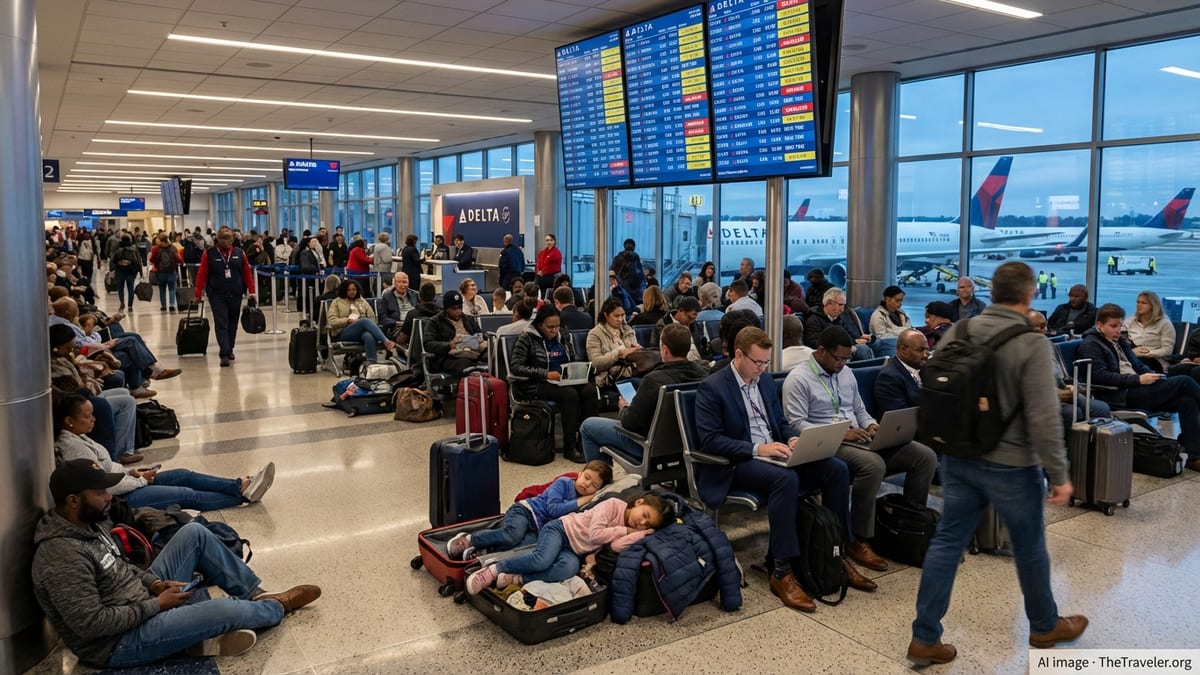
Thousands of Delta Air Lines passengers across the United States faced unexpected airport overnights, missed connections, and hours-long queues on Thursday as the carrier logged 33 cancellations and more than 300 delayed departures and arrivals, snarling travel at major hubs and regional gateways from Los Angeles and Sioux Falls to Salt Lake City, Atlanta, Detroit, and beyond.
Systemwide Disruptions Ripple Through Delta Network
Flight-tracking data on Thursday painted a picture of a strained operation across Delta’s domestic network, with the airline recording 33 flight cancellations and well over 300 delays as of late afternoon. While the disruption represented a small fraction of Delta’s hundreds of daily departures, the clustering of problems at key hubs meant an outsized impact on travelers and tight connection windows.
At Hartsfield-Jackson Atlanta International Airport, Delta’s largest hub, rolling delays stacked up through the day as inbound aircraft arrived late and ground operations struggled to reset schedules. Passengers reported departure boards filled with yellow and red notices, with some short-haul flights posting delays of more than an hour even as crews worked to keep aircraft cycling through constrained gate space.
In Salt Lake City and Detroit, which serve as important connecting points for travelers throughout the Mountain West and upper Midwest, the pattern was similar. Aircraft arriving late from weather-hit or congested airports elsewhere in the United States cascaded into subsequent departures. What began as modest timetable slippage in the morning evolved into missed connections and rebookings by the afternoon peak, leaving airport agents juggling standby lists and hotel vouchers.
Smaller but strategically important airports also felt the strain. In Sioux Falls, South Dakota, where options are limited and many travelers rely on a single daily Delta connection to hubs like Minneapolis or Salt Lake City, the late running of even one departure meant missed medical appointments, funerals, and business meetings downline. With few alternative carriers or frequencies, some passengers were facing waits of a full day or more for new seats.
Los Angeles and the West Coast Feel the Pinch
On the West Coast, Los Angeles International Airport saw a wave of Delta delays particularly concentrated on midmorning and early afternoon services. Crowded security lanes and heavy traffic around the terminals combined with late-arriving aircraft from the Midwest and East Coast, putting additional pressure on already busy departure banks to and from cities such as Salt Lake City, Seattle, and Atlanta.
Passengers transiting through Los Angeles described gate changes issued with little notice and boarding processes that were repeatedly paused while ground crews awaited inbound flight crews or final maintenance clearances. At least one flight from Southern California into Salt Lake City was held for more than an hour beyond its scheduled departure, with the airline citing “operational conditions” while keeping the aircraft at the gate.
Regional West Coast airports that feed Delta’s network also experienced knock-on effects. Flights operating into Salt Lake City, the main western hub that connects travelers onward to destinations such as Boise, Spokane, and various Mountain West ski gateways, were affected by late aircraft originating in Los Angeles and other California cities. For Delta customers connecting to long-haul services to the East Coast from these western spokes, even modest schedule slips turned what was meant to be a smooth transfer into a scramble across terminals.
For leisure travelers headed toward winter sun destinations or national parks, flexibility was limited. Many had booked months in advance on specific routings. With peak-season cabins nearly full, rebooking onto near-term alternatives often meant rerouting through entirely different hubs, sometimes adding many hours and a second or third connection to originally straightforward itineraries.
Atlanta and Detroit Hubs Struggle to Absorb the Shock
At Atlanta, where Delta operates the world’s largest hub, disruption on Thursday overlapped with ongoing construction projects that have already extended walking times and added congestion in certain concourses. Airline advisories in recent weeks have urged passengers to arrive earlier than usual for both domestic and international departures, citing longer connection times and busy security checkpoints. That advice looked prescient as delays accumulated, leaving travelers clustering around charging stations and information screens, trying to understand whether their connections would hold.
Flight operations teams at Atlanta worked to prioritize banked departures to critical markets such as New York, Chicago, and Los Angeles while dealing with aircraft and crew imbalances caused by late-running services from secondary cities. Some shorter regional hops were pushed back to keep long-haul and high-demand services closer to schedule, a triage strategy airlines commonly employ during periods of stress. For passengers on those shorter legs, however, it meant a higher risk of misconnected bags and same-day cancellations.
Detroit Metro Airport, another cornerstone of Delta’s network, saw a similarly uneven pattern. While many flights operated on time, a cluster of delayed departures in the early afternoon quickly consumed spare gate and taxiway capacity. Ground staff described a “hurry up and wait” rhythm as aircraft pushed from gates only to queue for departure slots or wait for connecting passengers from inbound flights that had themselves been delayed elsewhere in the network.
For business travelers shuttling between Detroit and major East Coast financial centers, even relatively brief delays had consequences in the form of missed meetings, rescheduled presentations, and unexpected overnight stays. Corporate travel managers monitoring their employees’ movements reported a spike in assistance requests, particularly from travelers who were less familiar with Delta’s hub layouts and rebooking procedures.
Sioux Falls and Smaller Cities Exposed by Limited Alternatives
If large hubs like Los Angeles, Atlanta, and Detroit bore the headline-grabbing numbers, smaller markets such as Sioux Falls experienced some of the most acute individual impacts. With only a handful of daily departures on mainline carriers, even a single Delta cancellation or multi-hour delay effectively erased a day’s worth of options for some passengers.
At Sioux Falls Regional Airport, travelers bound for family events, medical procedures, and regional business meetings faced difficult choices as Delta’s schedule wobbled. Some accepted multi-stop routings via alternate hubs when seats were available, sometimes adding an entire day of travel to itineraries that would normally take just a few hours. Others opted to cancel trips altogether and drive to nearby cities by car, particularly when their journeys were confined to the upper Midwest.
The situation highlighted a persistent vulnerability in the US aviation system: smaller and mid-sized communities are disproportionately affected when major network carriers experience operational shocks. With a limited mix of airlines and fewer overlapping routes, disruptions that might be manageable at a large hub can quickly spiral into trip-ending events for passengers in cities served by only one or two daily flights on a given carrier.
Local tourism and hospitality operators reported a flurry of last-minute cancellations tied to the interruption. Hotels expecting guests from Delta flights into Sioux Falls saw bookings evaporate, while rental car counters dealt with a wave of travelers who suddenly needed one-way vehicles after abandoning disrupted itineraries and opting to complete their journeys on the highway instead of in the air.
Salt Lake City’s Role as a Pressure Valve
Salt Lake City International Airport, which has emerged as a highly efficient performer in national on-time rankings, found itself acting as a pressure valve within Delta’s system as Thursday’s disruptions unfolded. The hub is a central cog in connecting traffic between West Coast origins, interior Mountain West markets, and destinations further east, making it especially sensitive to any irregular operations elsewhere in the network.
Flight status boards at Salt Lake City showed a familiar pattern of rolling delays as aircraft and crews arriving late from Detroit, Minneapolis, and other Midwestern points attempted to turn quickly for westbound and southbound departures. While the airport’s relatively strong long-term on-time performance offered some resilience, even well-run hubs can only absorb so much irregularity before buffers begin to erode.
Delta customers caught mid-journey in Salt Lake City reported spending several hours in terminal seating zones watching their connection times shift. Some appreciated the transparency of frequent app notifications and gate announcements, while others complained that the reason for the holdup was often described only as “operational,” a catch-all term that offered little practical information.
Airport authorities worked with airline station managers to keep concessions open and staffed throughout the delay period, recognizing that passengers facing long waits are more likely to require additional food, beverages, and basic necessities. Retail operators reported brisk sales of travel pillows, phone chargers, and toiletries as travelers who had not planned to spend extended time in the terminal stocked up.
Passenger Experiences: Long Queues, Missed Connections, Frayed Patience
Across the affected airports, the passenger experience on Thursday followed a familiar pattern for modern US air disruptions. Check-in counters and service desks quickly grew overwhelmed as travelers sought to rebook missed connections or obtain meal and accommodation vouchers when delays stretched beyond several hours. In some cases, passengers waited more than an hour in line to speak to an agent in person, even as the airline urged customers to use mobile tools and automated kiosks.
Families traveling with small children reported particular challenges. With limited seating in some gate areas and busy restrooms, keeping young travelers fed, entertained, and calm during long waits tested parents’ patience. Some passengers described sitting on terminal floors next to power outlets, trying to charge devices and manage work or school obligations remotely while monitoring shifting departure times on airline apps.
For international travelers returning to or departing from US cities on Delta connections, the situation carried added complexity. Disrupted domestic segments threatened to break carefully timed links with onward transatlantic or Latin American flights. While some travelers were successfully rerouted through alternate hubs or rebooked onto later long-haul departures, others were forced into overnight stays, triggering visa questions, additional hotel costs, and the need to update ground transportation and lodging arrangements at their final destinations.
Although no major safety incidents were reported in connection with the disruption, the day underscored the fragile nature of airline schedules that often operate with minimal slack. Once delays pass a certain threshold, each late aircraft risks becoming a new source of knock-on disruption, especially at hub airports where dozens of flights are interconnected within tight departure banks.
Delta’s Operational Record and the Broader Context
The turbulence for Delta on Thursday unfolded against a backdrop of generally strong long-term operational performance. In recent years, the carrier has consistently posted among the lowest cancellation rates and highest on-time percentages of any major US airline, helping to attract both corporate contracts and loyal leisure customers seeking reliability.
Industry analysts noted that even well-run carriers are not immune to the combined pressures of winter weather, air traffic control constraints, and complex crew-scheduling rules. When several of these factors converge, the finely tuned timetables that govern modern hub-and-spoke systems can unravel quickly. Thursday’s wave of delays and cancellations for Delta followed a broader pattern of elevated disruption across multiple US carriers during the winter travel period.
As federal officials continue to study the root causes of recurring aviation bottlenecks, including staffing shortfalls in key air traffic control facilities and the growing sensitivity of airline operations to regional weather events, experts say airlines will be urged to build more resilience into their schedules. That could include longer planned connection windows, additional spare aircraft, and more flexible crew basing, though each measure carries cost implications that carriers must weigh against competitive pressures.
For Delta, Thursday’s operational stumble will likely be absorbed into a still-solid annual reliability record, but it serves as a reminder that even top-performing airlines can experience days when multiple weak points align. Travelers caught in the disruption are now left to decide whether the episode was an unfortunate one-off or a signal to diversify their future flight choices across a broader mix of carriers and routings.
What Travelers Can Do When Schedules Unravel
The latest round of Delta disruptions offers practical lessons for travelers navigating an era of increasingly unpredictable air schedules. Experts recommend booking the earliest feasible departures of the day, when aircraft and crews are generally in position and the system has more slack to absorb unforeseen issues. For connections, especially through busy hubs like Atlanta, Los Angeles, and Detroit, leaving at least 90 minutes between flights can provide a critical buffer.
Passengers are also urged to keep airline apps up to date and enable notifications, which often deliver rebooking options before gate agents can assist everyone in line. In many cases, travelers can select alternative flights or same-day standby directly within the app, reducing the need to wait at a service desk. Maintaining digital copies of boarding passes and trip details can streamline the process if systems experience intermittent outages.
When disruptions do lead to overnight stays or extended delays, understanding airline policies becomes essential. While the specifics vary based on the cause of the disruption and the jurisdiction, carriers may offer meal vouchers, hotel accommodations, or partial refunds under certain circumstances. Travelers who document their expenses and maintain clear records of delay durations are often better positioned to seek compensation or goodwill gestures afterward.
For now, passengers flying on Delta in the days ahead are being advised to monitor their itineraries closely, arrive early at major hubs where construction or congestion can lengthen transit times, and build additional flexibility into travel plans. As Thursday’s events showed, even a manageable number of cancellations and delays can ripple outward quickly when they strike at the heart of a sprawling national network.