

More news on this day
Delta Air Lines is pushing back against early claims that a disruptive passenger tried to breach the cockpit on a Houston to Atlanta flight this week, saying the individual never accessed or attempted to access the flight deck even as the Boeing 717 diverted back to Houston under an emergency declaration.
Confusion After Emergency Return to Houston
The incident unfolded in the early hours of Wednesday, February 18, when Delta Flight 2557 departed William P. Hobby Airport in Houston bound for Hartsfield Jackson Atlanta International Airport. Roughly 15 to 20 minutes into the flight, the crew declared an emergency and requested an immediate return to Hobby, citing a disruptive passenger on board.
Air traffic control audio captured the pilot telling controllers that a passenger had stood up and tried to access the cockpit, prompting a request for law enforcement and medical personnel to meet the aircraft on arrival. The flight landed safely back in Houston at around 5:40 a.m. local time, where it was met by police and airport responders on the tarmac.
Initial local media reports and statements from Houston police framed the episode as a potential cockpit breach or attempted breach, language that quickly traveled across national outlets and social media. Images from the scene showed the Delta jet parked at the gate surrounded by law enforcement vehicles as passengers deplaned and officers boarded the aircraft.
Despite the disruption, there were no immediate reports of serious injuries. After the detained passenger was removed and the aircraft inspected, Flight 2557 later continued on to Atlanta, arriving approximately 80 to 90 minutes behind schedule, according to multiple passenger accounts and airline statements.
Delta Pushes Back on Cockpit Breach Narrative
As headlines focused on a supposed attempt to storm the cockpit, Delta moved swiftly to challenge that characterization. In a statement provided to several news organizations, the airline said the man at the center of the disturbance “approached crew and customers” and exhibited “unruly and unlawful behavior,” but did not make contact with or try to access the flight deck.
Delta reiterated that its cockpit doors remained secure throughout the incident and that standard safety protocols were followed. The company emphasized that, under federal regulations introduced after the September 11 attacks, cockpit doors on commercial aircraft are reinforced and kept locked in flight, with highly restricted access procedures.
The statement effectively walked back earlier impressions created by emergency radio traffic and initial law enforcement comments suggesting a more direct threat to the flight deck. The clarification underscores how fast-moving accounts in the immediate aftermath of in-flight incidents can differ from later, more carefully vetted versions of events.
While Delta confirmed that the unruly passenger was detained upon landing and that one traveler reported being assaulted, the airline has stopped short of publicly describing the episode as an attempted hijacking or as a targeted attack on the cockpit. Instead, it has framed the incident squarely as a case of serious onboard misconduct.
Passenger Accounts Describe Chaotic Scene Onboard
Passengers on Flight 2557 have painted a vivid picture of a chaotic few minutes in the cabin as the man at the center of the disturbance moved forward, shouted, and then allegedly turned violent. Several travelers told television affiliates that the man had announced he wanted to speak with the pilot and moved toward the front of the aircraft before being confronted by crew.
One passenger described the man “punching everybody” in his immediate vicinity, before lunging toward a window-seat traveler, grabbing his shirt and hair. Others recounted how flight attendants and passengers scrambled over seats and down the narrow aisle as they tried to separate the two and restrain the aggressor.
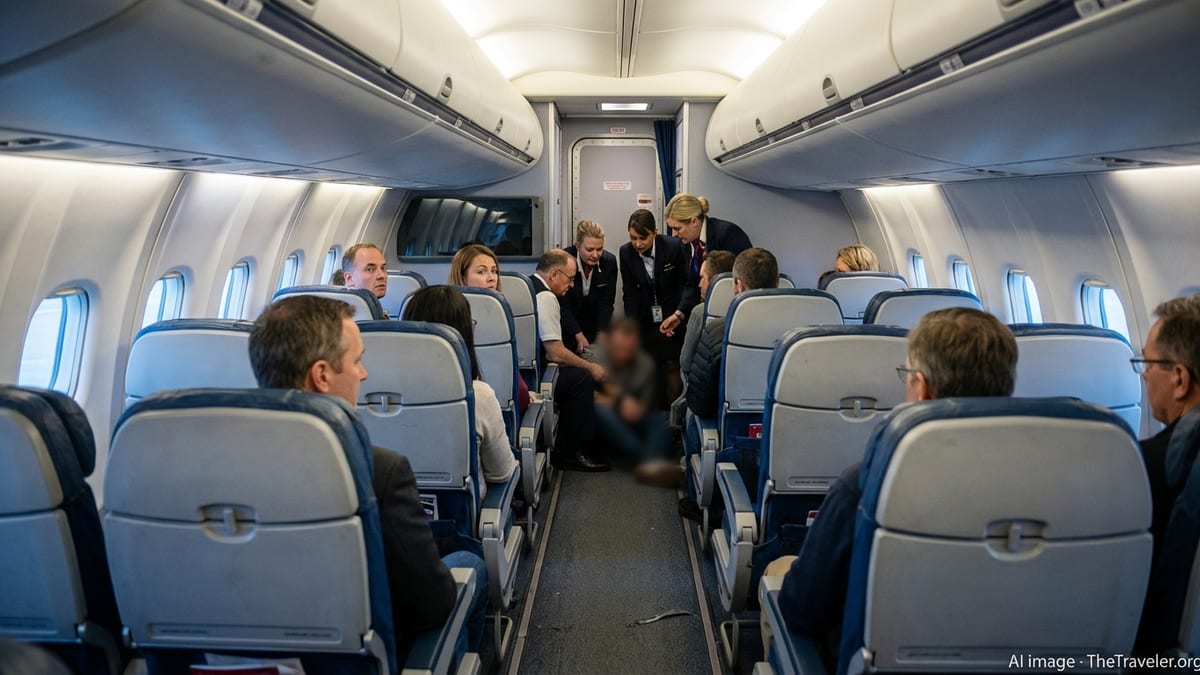
Video clips shared with local stations show crew members attempting to calm an agitated man as he shouts and struggles near the front section of the cabin, with other passengers looking on anxiously. In subsequent frames, multiple travelers appear to pin the man to the floor of the aisle as zip ties or restraints are applied to his wrists.
Another passenger, who later spoke from his home city after continuing his journey, said he helped pull the man away from the victim of the alleged assault and assisted in holding him down until cabin crew could secure him. He recalled seeing the man banging or kicking near the front of the cabin and said he believed the individual might have been in the midst of a mental health crisis.
Airline Response Highlights Zero Tolerance on Unruly Behavior
In its public comments following the diversion, Delta stressed that it maintains a zero tolerance stance toward disruptive and abusive conduct onboard its aircraft. The carrier apologized to customers for what it called a “delay in their travels” and emphasized that the decision to return to Houston was made out of an abundance of caution for the safety of passengers and crew.
Once on the ground, the man was taken into custody by Houston police and placed on a mental health hold, according to local reports quoting law enforcement officials and passengers. Authorities have not yet announced formal criminal charges, but at least one traveler who said he was punched during the altercation has indicated he intends to pursue legal action.
The airline has not disclosed whether the man will be added to Delta’s internal “no fly” list, a step that carriers sometimes take after serious in-flight incidents. However, industry practice suggests the passenger is highly unlikely to be welcomed back on board with the airline, particularly given that an emergency was declared and another traveler was reportedly injured.
Delta executives have also reportedly reached out directly to several passengers who intervened during the incident, thanking them for their quick actions. One traveler said he received a courtesy call from senior leadership and an upgrade on his onward journey after assisting crew in restraining the man.
Law Enforcement and FAA Open Investigations
The Federal Aviation Administration has confirmed it is investigating the disturbance on Flight 2557, as it does with all reported cases of serious unruly passenger behavior. Federal officials will review cockpit voice recordings, incident reports from the crew, and statements from passengers to determine precisely what transpired during the short time the aircraft was in the air.
Houston police also opened an inquiry after officers boarded the aircraft at Hobby and escorted the man off in restraints. Investigators will be examining whether the alleged assaults meet thresholds for state or federal criminal charges, including potential counts related to interference with a flight crew, which can carry significant penalties in the United States.
Authorities will also be weighing whether the individual’s mental state at the time of the flight affects how and where any case might be prosecuted. Several passengers have told reporters that the man appeared disoriented and “not mentally there,” fueling speculation that the event may ultimately be treated as a mental health episode as well as a security incident.
Such investigations can take weeks or months, particularly when multiple agencies are involved and when accounts from those onboard initially diverge. For now, officials have confirmed only that the aircraft returned safely, no life-threatening injuries were reported, and there is no indication of a broader security plot linked to the episode.
Context: Rising Tensions and Unruly Passenger Cases
The Houston diversion comes against the backdrop of a multi-year rise in unruly passenger incidents across the United States. The FAA has tracked hundreds of such cases annually since 2020, ranging from mask-related disputes to intoxication, interpersonal conflicts, and outright violence directed at crew and fellow travelers.
Although the total number of disruptive episodes has eased from the peaks seen during the height of the pandemic, regulators say the rate remains well above historical norms. The agency has maintained a zero tolerance enforcement policy introduced in early 2021, under which passengers accused of serious misconduct can face steep civil penalties in addition to possible criminal prosecution.
Airlines have likewise invested in enhanced de-escalation training for flight attendants and have encouraged crews to be proactive about reporting problematic behavior before it escalates into physical confrontation. Many carriers have also expanded internal “no fly” lists, effectively banning passengers involved in serious incidents from future travel on their networks.
For travelers, the Houston case serves as a reminder that disruptive behavior by just one individual can reverberate through an entire flight, resulting in diversions, missed connections, and a heightened sense of anxiety in the cabin. It also illustrates the continuing pressure on front-line aviation staff to manage both safety and customer service amid unpredictable circumstances at 30,000 feet.
Safety, Perception, and the Limits of the Flight Deck Threat
The dispute over whether the cockpit was truly at risk on Flight 2557 taps into a powerful and enduring sensitivity in commercial aviation. Since the early 2000s, reinforced cockpit doors, strict access protocols, and frequent crew training have made an actual breach of the flight deck exceedingly rare on large U.S. airliners.
In this case, the available information suggests the man moved toward the front of the aircraft, banged or kicked near the front of the cabin, and expressed a desire to speak with the pilot, but was stopped before reaching or compromising the flight deck door. Even so, for passengers seated nearby, the distinction between “approaching” and “breaching” can feel academic in the heat of the moment.
Security experts note that any aggressive movement toward the cockpit is treated seriously, even if the individual cannot realistically overcome locked, reinforced doors and coordinated crew response. The pilot’s emergency declaration, captured in air traffic control audio, reflects a protocol designed to err on the side of caution whenever the cockpit could be perceived as under threat.
For airlines, however, it is equally important to avoid overstating the danger. Words such as “cockpit breach” carry significant weight with regulators, insurers, and the traveling public, which helps explain Delta’s insistence on clarifying that no access attempt succeeded or even reached the door itself. The nuance matters for both risk assessments and public confidence.
Implications for Travelers Flying Through Houston and Beyond
From a practical standpoint, the disruption on Flight 2557 produced relatively limited long-term operational impact. Hobby Airport continued to function normally, and there were no widespread delays or security alerts affecting other flights. Travelers on the affected service were rebooked or continued to Atlanta with a modest delay once the aircraft was cleared to depart again.
For passengers connecting through Atlanta and other hubs, the incident is a reminder to build in extra time where possible, especially for early-morning departures when weather, mechanical checks, or security events can ripple through schedules. It also underscores why crews ask passengers to report unusual behavior promptly, so that issues can be addressed at the gate or early in the flight rather than after they become emergencies.
Airlines and airports in Houston, Atlanta, and across the country have sought to reassure customers that this latest episode does not indicate any systemic vulnerability. Instead, they present it as an example of existing systems working as intended: a potential threat was reported, the cockpit remained secure, passengers and crew acted decisively, and the aircraft returned safely.
Still, for those on board, the experience of watching a fellow traveler become violent and having to restrain him in the confined space of a narrow-body jet may linger long after they have reached their destinations. As commercial aviation continues to rebound and cabins fill up again, managing passenger behavior remains one of the most human and unpredictable variables in modern air travel.