

More news on this day
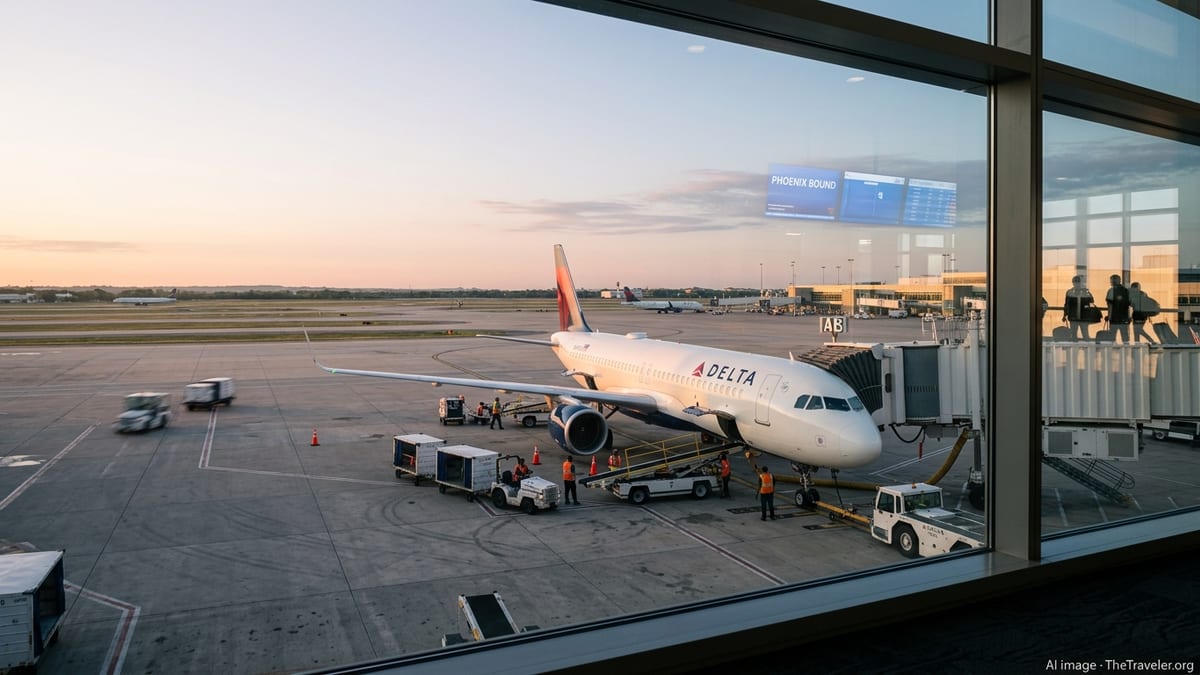
Delta Air Lines is sharpening its Central Texas strategy with new nonstop flights between Austin, Texas and Phoenix, Arizona, positioning the busy Sun Belt corridor as a high-priority option for both business and leisure travelers in 2026.
Get the latest news straight to your inbox!
A High-Demand Corridor Gets a Premium New Player
Publicly available route maps and airport schedules show that Austin–Bergstrom International Airport already has substantial service to Phoenix–Sky Harbor from established competitors, reflecting strong two-way demand between the two metros. Phoenix ranks among Austin’s busiest domestic markets by annual passengers, supported primarily by large network and low-cost carriers. Against that backdrop, Delta’s decision to introduce its own nonstop service in 2026 signals confidence that the corridor can support additional capacity while rewarding a more premium-focused product.
Industry observers note that both Austin and Phoenix have seen sustained population and job growth, particularly in technology, advanced manufacturing and professional services. That trend continues to generate high-yield weekday traffic alongside robust weekend and holiday leisure travel. By adding a branded nonstop option, Delta is aiming squarely at travelers who value schedule reliability, frequent-flyer benefits and seamless connections across its network, especially via hubs in cities such as Salt Lake City and Atlanta.
For consumers, the entry of another full-service carrier on a route that is already well served by rivals can also create more pricing discipline and schedule variety. Published commentary from aviation analysts suggests that incremental competition on short- to medium-haul business routes often leads to more fare options, including competitive basic economy levels coupled with higher-end cabin choices, something that could appeal to the diverse mix of travelers moving between Central Texas and Arizona.
Strategic Expansion of Delta’s Austin Focus
Delta has been steadily expanding at Austin–Bergstrom over the past several years, progressively adding new nonstop destinations and increasing frequencies on existing routes. City and airport documents released since 2024 describe the airline’s growth as a shift from a smaller focus city operation toward a more substantial presence, with additional gates, lounge investments and new domestic and international links. Announced service to markets such as Denver, Columbus, Kansas City and seasonal leisure destinations has already broadened Delta’s reach from Austin into both business and vacation segments.
The introduction of Austin–Phoenix nonstop service fits neatly into this broader pattern. Phoenix is a key western connection point, with strong onward links across the Mountain West and to the West Coast. By competing in this market, Delta can keep more Central Texas customers within its own ecosystem, offering one-stop access to secondary cities while maintaining nonstop convenience on the core trunk segment itself.
Network data released by Austin officials indicates that Delta has climbed into the top tier of carriers at AUS by daily departures, trailing only the dominant low-cost operator but outpacing several legacy competitors on growth. As the airline layers in more point-to-point nonstops that bypass its traditional hubs, Austin is emerging as a testing ground for how far Delta can push a hybrid hub-and-focus-city model without formally designating the airport as a full-scale hub.
Business Travelers Gain Time-Saving Connectivity
For business travelers, the new Austin–Phoenix nonstop is being framed in industry commentary as a productivity play. Instead of connecting through another hub or relying on limited-time options with competitors, Central Texas executives and remote workers heading to Greater Phoenix’s corporate campuses gain an additional nonstop choice that aligns with Delta’s loyalty, upgrade and operational reliability advantages.
Both metro areas host major operations for technology, semiconductor, aerospace and financial services companies, creating a steady flow of corporate and project-based travel. Reports from regional economic development groups highlight increasing cross-investment between Texas and Arizona firms, including joint ventures, conferences and site visits. A well-timed nonstop option helps reduce door-to-door travel time, particularly on early morning and late evening departures that allow same-day turnarounds.
Moreover, Delta’s ability to tie Austin–Phoenix into its broader network gives corporate travel managers more flexibility in negotiating volume contracts. Travelers based in secondary cities who connect into Austin on Delta can now reach Phoenix with a single connection under one carrier, an efficiency that can simplify policies and improve schedule resilience when irregular operations occur elsewhere in the system.
Leisure Demand Between Desert Cities Keeps Climbing
While weekday corporate demand underpins the route’s economics, leisure travelers stand to benefit significantly from the new flights. Tourism boards in both Texas and Arizona have been promoting year-round travel, with Phoenix marketing its golf, hiking and spa culture while Austin leans on live music, food, festivals and Hill Country escapes. Historically, peaks in winter escapes to Arizona and spring and fall events in Austin have created a pronounced seasonal travel pattern in both directions.
Published travel data for Austin shows that Phoenix consistently ranks among its top domestic destinations by passenger volume, suggesting a broad base of visitors that spans family travel, sports tourism and short weekend getaways. Delta’s entry, with its tiered cabins and bundled vacation products, brings additional choices for travelers looking to combine mileage earning with flexible fare types and amenity-rich aircraft.
Travel industry coverage also points to the growing role of remote and hybrid workers, who increasingly plan stays of a week or longer in secondary Sun Belt cities. Nonstop service between Austin and Phoenix makes it easier for these travelers to structure work-from-anywhere periods without sacrificing reliable flight options home, potentially smoothing demand patterns outside of peak holidays.
What Delta’s Move Signals for 2026 and Beyond
Although route details like exact start dates and final timetables are subject to schedule filings and potential adjustments, the decision to make Austin–Phoenix a nonstop option in the 2026 time frame underscores how Delta views Central Texas as a long-term growth market. Airport planning documents and airline statements about upcoming gate and lounge investments indicate that Delta is preparing for a larger operational footprint at AUS that extends well beyond a handful of point-to-point flights.
Aviation analysts note that adding capacity on thick, competitive routes such as Austin–Phoenix is often a precursor to deeper integration of a city into an airline’s overall network strategy. As Delta locks in more recurring business demand and grows brand loyalty locally, it gains leverage to introduce additional spokes, seasonal experiments and even future international services tied to that same customer base.
For travelers, the competitive landscape on the Austin–Phoenix corridor in 2026 is poised to be more dynamic than at any time in recent memory. With multiple carriers vying for share and at least one of them elevating the product mix with fresh nonstop service, passengers stand to gain from more choice, potentially sharper pricing and a broader set of connections across North America and beyond.