

More news on this day
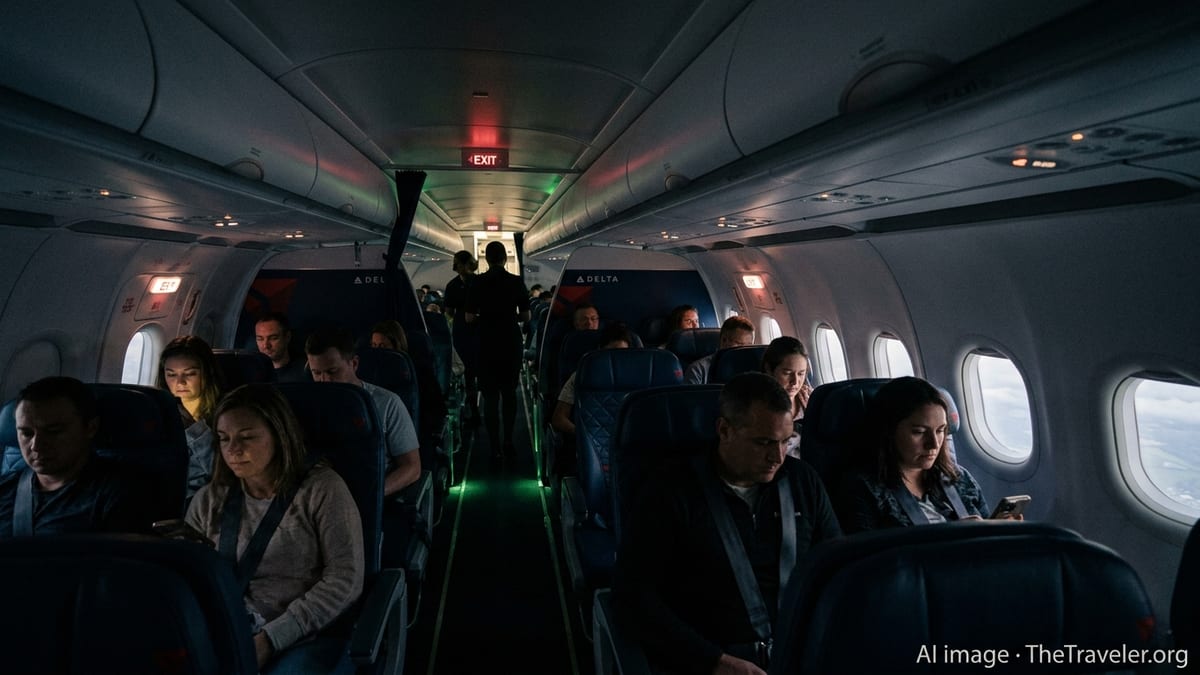
When a Delta Air Lines widebody diverted to Dallas Fort Worth International Airport after an onboard systems issue, many passengers fixated on a deeply unsettling detail: parts of the cabin went dark. The incident, which ended safely, has stirred wider questions about what happens when aircraft power systems falter, why everything from mood lighting to seat outlets can suddenly cut out, and how multiple backstops are designed to keep passengers safe even when the lights go off.
Get the latest news straight to your inbox!
A Mid-Pacific Diversion That Ended in Dallas
According to publicly available flight-tracking data and aviation incident summaries, a Delta Air Lines Airbus A330-300 operating from Los Angeles to Honolulu on November 28, 2025 diverted to Dallas Fort Worth after the crew reported an issue linked to a floor panel heater in the forward cabin. The flight, operating as DL837, turned east toward Texas rather than continuing over the Pacific, a choice consistent with standard diversion practices that prioritize nearby major airports with extensive maintenance and emergency capabilities.
Reports from aviation outlets indicate that the aircraft landed without injuries and taxied under its own power to a gate in Terminal E, where fire services and maintenance teams met the jet as a precaution. While the technical trigger was described in some coverage as a localized heater fault, passengers also reported power irregularities in the cabin, including lighting disruptions and inoperative in-seat systems, before the diversion.
These kinds of incidents are classified as precautionary emergencies rather than accidents. The airframe remained controllable, engines were operating, and key flight instruments were powered throughout. Still, the combination of an unscheduled descent, emergency vehicles on standby, and a cabin that may not look or feel normal can sharply raise passenger anxiety, particularly when lights or screens abruptly shut off.
Dallas Fort Worth’s role in this event was largely operational. As one of the country’s busiest hubs, it offers long runways, robust fire and rescue coverage, and on-airport maintenance capability. For airlines, those attributes make DFW an attractive option when a technical issue occurs far from an aircraft’s home base or intended destination.
How Aircraft Power Systems Feed the Cabin
Modern airliners rely on a layered electrical architecture. Under normal conditions, engine-driven generators supply alternating current, which is then converted and distributed to everything from flight computers and hydraulic pumps to passenger-facing systems like lighting, galleys, in-flight entertainment and seat power. On the ground and during engine start, an auxiliary power unit, or APU, provides electricity and air-conditioning.
Publicly available technical guidance from manufacturers and training material used in pilot communities describe how nonessential cabin services are typically placed on so-called shed or load-managed buses. In an abnormal situation, the electrical system can automatically disconnect these buses to preserve power for critical avionics, flight controls and navigation equipment. From a passenger’s perspective, that can mean an instant loss of mood lighting, reading lights, screen power and galley equipment even though the aircraft remains under full control.
Redundancy is built in at multiple levels. If one generator fails, others take over; if both engines are affected, the APU or a deployable ram air turbine can power essential systems. In extreme scenarios, batteries back up critical instruments for a limited time. Design standards require that the flight deck retain adequate power for safe control and navigation even if the cabin looks unusually dark or quiet.
In practical terms, that hierarchy of needs explains why passengers might see overhead bins, panels and windows lit by emergency strips or minimal work lights while cockpit systems that are invisible from the cabin continue to operate normally. To an anxious traveler, darkness may signal a loss of control; in reality, it often reflects a planned shedding of nonessential loads so that key systems remain fully powered.
Why Cabin Lights Go Dark During Emergencies
Even when there is no electrical fault, sudden lighting changes are a routine part of aviation safety procedures. Airline safety manuals and training syllabi describe how crews dim or extinguish main cabin lights for takeoff and landing at night so that passengers’ eyes can adjust to outside conditions. In an evacuation or rejected takeoff, this helps travelers see emergency lighting, exit signs and ground hazards more clearly through the windows and along the floor.
In an in-flight emergency or precautionary diversion, crews may similarly reduce or switch off general lighting to focus attention on illuminated exits and floor path markers. Regulations require these markers to remain visible and self-powered long enough to guide passengers during an evacuation. That can create an eerie scene: a quiet cabin, minimal lighting, and glowing strips on the floor, even though the basic integrity of the aircraft is not in question.
When a technical problem drives the decision, automation can amplify that effect. If the electrical system senses an imbalance or overload, shedding may occur in stages, with galley power and mood lighting disconnecting before more essential circuits. Passengers might experience flickering, partial blackouts, or areas of the cabin that seem unaffected next to rows that are completely dark, depending on how the cabin wiring is zoned.
For travelers, understanding that this behavior is often intentional and protective can help put such moments in context. A darkened cabin is not an omen that pilots have lost control. More often, it is a sign that systems are preserving power where it matters most and that crews are following checklists developed through years of engineering analysis and safety investigation.
Recent Scrutiny of Delta’s Technical Reliability
The DFW diversion sits against a broader backdrop of heightened attention to aircraft reliability across the industry. Over the past two years, publicly reported Delta events have included pressurization abnormalities, turbulence-related diversions and isolated smoke or fumes incidents, all of which have drawn media coverage even when they resulted in no serious injuries.
Separate reporting has examined Delta’s program to replace auxiliary power units on more than 300 Airbus aircraft after industry-wide concerns that certain units could allow oil fumes into cabin air. According to that coverage, the program began several years ago and has been nearing completion, reflecting a wider push to address so-called fume events that have affected multiple airlines and manufacturers.
Analysts note that such technical stories often land in the spotlight because of Delta’s size and profile rather than because its operations are uniquely risky. Operating thousands of flights per day ensures that even rare events will occasionally occur. Aviation safety statistics from government and industry bodies consistently show that commercial air travel in the United States remains one of the safest modes of transportation, with serious accidents extremely uncommon relative to the number of flights operated.
Still, headline-grabbing diversions and images of emergency vehicles lining a runway can shape public perception. For travelers connecting through large hubs like DFW, it can be difficult to reconcile the rational safety record with the visceral experience of an emergency landing, especially if the cabin environment feels unfamiliar or unsettling.
What Passengers Can Expect If the Lights Go Out
For passengers caught in a similar situation, the first noticeable change is often a shift in the cabin atmosphere rather than a single announcement. Reading lights may shut off, seat outlets may stop charging devices, and video screens may freeze or reboot. If the issue is electrical, these are typical signs that nonessential systems have been disconnected or are being reset.
In more serious scenarios, cabin crew members move quickly through the aisles, checking seat belts and securing loose items. Publicly available training materials emphasize that crews are trained to continue verbal briefings even if the public-address system is unreliable, using megaphones or direct voice instructions where necessary. Emergency lighting along the floor, at exit signs and near doors is designed to activate automatically if normal lighting fails.
As the aircraft descends toward a diversion airport like DFW, passengers may notice a faster than usual rate of descent, additional turns, or flaps and landing gear extended earlier than expected. These actions are consistent with standard emergency descent and landing profiles described in pilot training resources. Inside the cabin, however, the continued lack of normal lighting and inflight services can make the situation feel more critical than it may be from a flight-operations standpoint.
Travelers concerned about future flights can take practical steps to feel more prepared. Reviewing the safety card, identifying the nearest two exits, and noting the layout of floor path lighting can make it easier to orient in low visibility. Keeping seat belts fastened when seated and stowing loose items for takeoff and landing are simple measures that align with longstanding safety recommendations.