

More news on this day
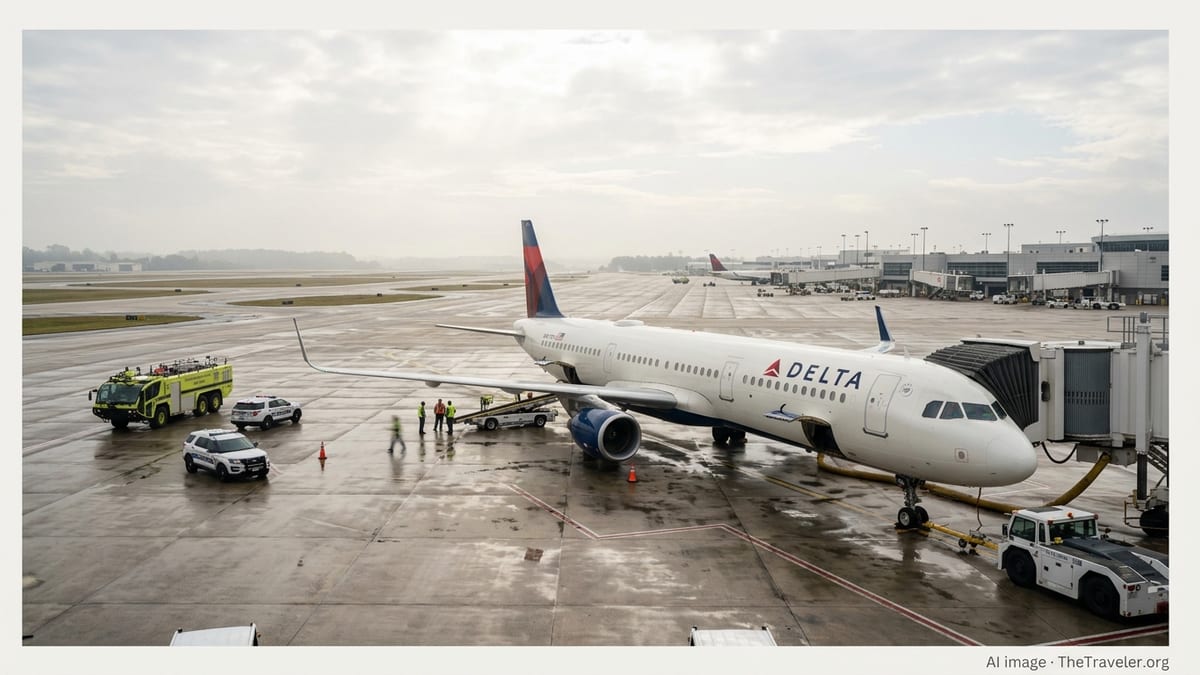
Delta Air Lines Flight DL1182, operating between Atlanta and Tallahassee, made an urgent mid-air diversion back to Atlanta, with reports indicating an in-flight issue that prompted a priority return and emergency landing procedures.
Get the latest news straight to your inbox!
Unexpected Turn on a Short-Haul Route
The flight, a short regional service connecting Hartsfield-Jackson Atlanta International Airport and Tallahassee International Airport, departed Atlanta as scheduled before the crew initiated a diversion while en route to Florida. Publicly available flight-tracking data suggests that the aircraft leveled off briefly before turning back toward Atlanta, a common profile when crews decide it is safer to return to a major hub than to continue to a smaller destination.
Initial information posted by aviation enthusiasts and flight-tracking observers indicates that the aircraft declared an in-flight emergency and requested priority handling on approach to Atlanta. While specific technical details have not been formally outlined in public documents at this stage, the diversion pattern and rapid return to the hub are consistent with crews exercising caution in response to a potential mechanical, medical, or systems-related concern.
Onboard, passengers would have experienced an otherwise routine climb-out from Atlanta followed by a change in course once the decision to divert was made. In similar events, announcements typically focus on reassuring travelers that the situation is under control while explaining that a diversion is being made out of an abundance of caution.
Emergency Landing Procedures and Airport Response
When a commercial flight such as DL1182 diverts and treats its arrival as an emergency, standard airport and airline protocols are activated. This often includes coordinating with air traffic control to secure a direct routing back to the airport, prioritizing the incoming aircraft in the landing sequence, and positioning airport fire and rescue units along the runway as a precaution.
Publicly accessible aviation guidance outlines that an emergency landing does not necessarily mean that an aircraft is in immediate danger, but rather that the crew has determined that special handling is warranted to mitigate risk. In many cases, flights land uneventfully, with the heightened response serving as a safety buffer rather than a reaction to an imminent failure.
At large hubs such as Atlanta, the presence of extensive maintenance facilities and medical services is a key factor in diversion decisions. Crews returning a flight like DL1182 to Atlanta can access more robust engineering support and a wider range of ground resources than may be available at a smaller regional field, which can speed inspections, repairs, and passenger reaccommodation.
Impact on Passengers and Operations
For travelers on board DL1182, the diversion likely resulted in disrupted itineraries, missed connections, and extended time on the aircraft or in the terminal. Published accounts from similar Delta diversions in recent weeks describe passengers facing long waits for rebooking, hotel vouchers, or alternative routings when tightly scheduled networks experience unexpected interruptions.
On a high-frequency route between Atlanta and Tallahassee, an unplanned emergency return can quickly ripple through the day’s schedule. Aircraft rotations may need to be adjusted, crews can approach or exceed duty-time limitations, and subsequent flights may depart late or be reassigned different aircraft. For connecting passengers, particularly those using Atlanta as a gateway to longer-haul flights, a relatively short diversion can translate into substantial onward delays.
Despite the inconvenience, safety professionals frequently emphasize that such diversions are a visible sign of safety systems working as intended. The preference to land early and investigate any perceived anomaly, rather than press on with even minor uncertainties, aligns with the conservative risk posture that underpins modern commercial aviation.
Safety Context and Traveler Confidence
The incident involving DL1182 comes amid sustained public attention on airline safety, in part due to other high-profile diversions and emergency landings involving major carriers in recent years. Aviation safety records, however, continue to show that serious accidents remain rare, and that precautionary returns and emergency declarations overwhelmingly result in safe outcomes for all on board.
Publicly available data from regulators and industry groups highlights that pilots are trained to treat system warnings, unusual vibrations, or cockpit indications conservatively, even when the underlying technical issue later proves minor. Returning to a hub such as Atlanta, with full maintenance capability and runway options, is viewed as a rational step in maintaining that safety margin.
For frequent travelers, the experience of an abrupt course change, emergency landing preparations, or the visible presence of fire and rescue vehicles can be unsettling. Travel analysts often recommend that passengers focus on crew instructions, keep seatbelts securely fastened, and allow additional buffer time in itineraries when connecting through busy hubs where weather or operational disruptions can compound the effects of an unscheduled return.
What Comes Next for Flight DL1182
Following an event like the emergency diversion of DL1182, airline procedures typically call for a detailed technical inspection of the aircraft before it returns to service. Maintenance records, cockpit data, and crew reports are reviewed to pinpoint the triggering issue and to determine whether components need repair, replacement, or further engineering evaluation.
Passengers affected by the disruption are usually rebooked on later flights or alternate routings between Atlanta and Tallahassee or to their ultimate destinations. Publicly available accounts from past diversions suggest that compensation can vary, ranging from meal or hotel vouchers to travel credits, depending on the length and cause of the delay and the airline’s customer-relations policies.
In the broader operational picture, the DL1182 diversion stands as another example of how modern airline networks balance efficiency with strict safety protocols. For travelers, it is a reminder that even on short regional segments between neighboring states, airlines and crews are prepared to interrupt the routine rhythm of the route to prioritize safety whenever in-flight conditions call for it.