

More news on this day
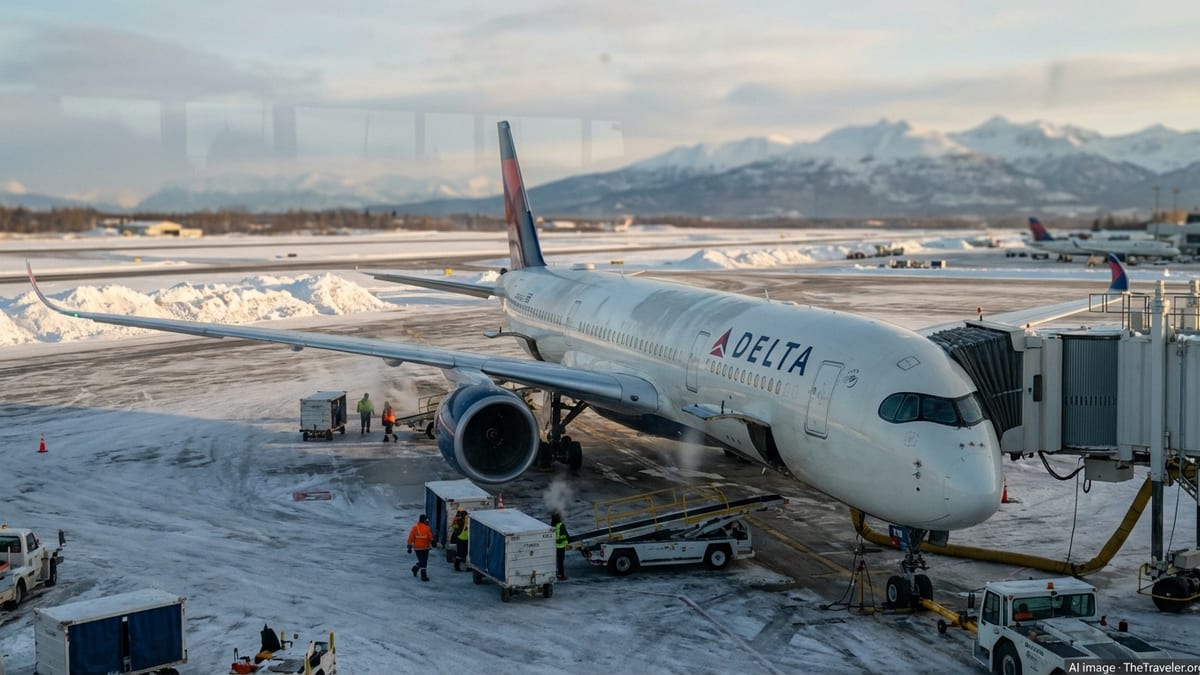
A long-haul Delta Air Lines service from Seoul to Minneapolis was forced to make an unscheduled emergency landing in Anchorage on February 17, 2026, after a medical emergency on board prompted the crew to divert the Airbus A350 over the North Pacific.
Transpacific Flight Cut Short by Midair Medical Crisis
Delta Air Lines Flight DL170, operating the daily Seoul Incheon to Minneapolis Saint Paul route, was several hours into its transpacific journey when a medical situation unfolded in the cabin that required urgent attention. The flight, operated by an Airbus A350-900, had departed Seoul later than scheduled but was cruising normally at high altitude when the incident occurred.
According to operational data, the aircraft was flying at about 39,000 feet over the North Pacific with a typical long-haul ground speed when the crew advised controllers of the need to divert. The nature of the medical emergency has not been publicly disclosed, in keeping with passenger privacy standards, but airline communications indicated that rapid access to hospital care was necessary.
The decision to break off the aircraft’s planned routing toward the American Midwest immediately shifted the flight path north and east toward Alaska. Within a relatively short period, the A350 left its usual transpacific track and began descending toward Anchorage, one of the primary diversion airports for flights crossing the North Pacific.
Safe Diversion to Anchorage After Cabin Alert
Anchorage, long established as a critical diversion point for transpacific operations, quickly became the focus of Flight DL170’s revised plan. Air traffic controllers cleared the widebody jet for priority handling as it approached the region, while the airport’s emergency and medical services were placed on standby ahead of arrival.
Despite the unplanned change of course, the flight’s descent and approach were reported as routine from an operational standpoint. The Airbus A350 completed its diversion and landed safely in Anchorage, where it taxied to a stand so that medical teams could board and attend to the affected passenger.
Initial indications suggested no technical issue with the aircraft itself, and there were no reports of injuries to other travelers or crew members connected to the diversion. For most passengers on board, the event transformed a long but standard intercontinental crossing into a tense and uncertain experience, albeit one that ended with a controlled and uneventful touchdown.
Crew Response Underscores Safety Protocols
The handling of the incident by Delta’s cockpit and cabin crews highlighted the rigid protocols that govern in-flight medical situations on long-haul services. Once alerted to the emergency, the crew coordinated with medical professionals on the ground via established communications channels while simultaneously preparing the cabin for a potential diversion.
Cabin crew members, trained in advanced first aid and in managing passenger distress, worked to stabilize the situation as much as possible during the cruise phase. Meanwhile, pilots weighed the aircraft’s position, fuel, weather, and runway options before concluding that Anchorage provided the fastest realistic access to medical care.
Industry standards dictate that when a serious condition is suspected, the requirement to seek immediate professional treatment outweighs schedule considerations and operational cost. The response on Flight DL170 mirrored that guidance, with the diversion executed as soon as it was deemed necessary rather than waiting to reach the original destination in Minnesota.
Impact on Passengers and Ongoing Travel Plans
For travelers bound for Minneapolis and onward connections across the United States, the diversion to Alaska introduced hours of disruption and uncertainty. Passengers were held on board while medical personnel reached the affected traveler, after which the airline began the process of determining whether the aircraft could continue to its intended destination or if a replacement service would be required.
Delta initiated standard care procedures at Anchorage, which typically include assistance with rebooking, meal vouchers where applicable, and updated travel information. As the situation unfolded, customers received details on revised timings and re-accommodation options, with particular focus on those with tight connections in Minneapolis.
For many passengers, an emergency diversion to an unplanned stop such as Anchorage can be disorienting, particularly on overnight or ultra-long-haul flights. However, reports from on board indicated that the cabin remained calm, with crew members providing regular announcements and reassurance as ground teams worked through the operational puzzle created by the unscheduled arrival.
Anchorage’s Strategic Role in North Pacific Aviation
The event once again underscored Anchorage’s strategic role within global aviation, especially for transpacific services linking East Asia with North America. Situated near traditional great-circle tracks used by carriers, the Alaskan gateway offers long runways, extensive support infrastructure, and experienced emergency responders familiar with handling intercontinental diversions.
For aircraft like the Airbus A350 operating at heavy long-haul weights, the availability of a suitably equipped airport within reach during an unexpected event is critical. Anchorage’s position, combined with its 24-hour operations and robust maintenance and handling capabilities, makes it one of the preferred diversion fields for both passenger and cargo flights crossing the Bering Sea region.
While the majority of intercontinental flights complete their journeys without incident, carriers plan their routes with several potential alternates identified in advance. The use of Anchorage by Flight DL170 followed that long-standing planning framework, demonstrating how contingency infrastructure quietly supports the safety of global air travel every day.
Medical Emergencies on Long-Haul Flights Under Scrutiny
Although mechanical diversions often draw headlines, medical issues are among the most common reasons a long-haul jet will abandon its original routing. On ultra-long sectors such as Seoul to Minneapolis, passengers may be airborne for more than 12 hours, increasing the likelihood that preexisting health conditions or sudden illnesses manifest mid-flight.
Airlines equip international aircraft with enhanced medical kits, automated external defibrillators, and detailed response checklists, and they maintain access to ground-based medical advisory services to guide in-flight decisions. Despite these supports, there are limits to what can be safely managed at altitude, particularly when symptoms suggest time-sensitive conditions such as cardiac events or severe respiratory distress.
As commercial aviation rebounds and long-haul volumes increase, events like the diversion of Flight DL170 refocus attention on passenger preparedness, including carrying necessary medications, staying hydrated, and seeking medical advice before flying when underlying conditions exist. The incident also reinforces the importance of cooperation between airlines, airports, and medical facilities along major intercontinental corridors.
Delta’s Safety Record and Operational Resilience
Delta Air Lines, one of the largest carriers serving the transpacific market, has built its brand around a strong safety culture and operational reliability. While diversions can be costly and logistically complex, the company’s handling of Flight DL170 aligns with the principle that passenger well-being takes precedence over schedule integrity.
The carrier operates the Seoul to Minneapolis route primarily with modern Airbus A350 aircraft, whose extended-range capabilities and advanced avionics are designed to support safe operations on some of the world’s longest commercial routes. In this case, those capabilities were supplemented by clear decision-making from the cockpit and a well-rehearsed support apparatus on the ground.
Beyond the immediate event, the diversion serves as a reminder to travelers that even on well-established, routinely flown routes, crews must be prepared to adapt quickly to unforeseen developments. For Delta, the focus in the aftermath is on assisting affected passengers, reviewing the course of events, and reinforcing internal learnings to apply to future operations.
What Comes Next for the Flight and Its Passengers
Following the emergency landing in Anchorage, Delta teams coordinated the next steps necessary to return passengers to their original itineraries. Depending on aircraft scheduling, crew duty limits, and maintenance considerations, options typically include continuing the same aircraft to Minneapolis after a delay or transferring passengers to another flight, either direct or via connecting hubs.
Travelers were expected to receive updated information from both airport agents and digital channels as plans solidified. For some, that may mean a late arrival into Minneapolis and missed onward flights; for others, overnight accommodation in Anchorage or an alternate U.S. gateway may be arranged to complete their journeys.
While the experience was undoubtedly disruptive, industry analysts noted that the outcome illustrated the aviation sector’s layered safeguards. A serious concern in the cabin led to decisive action, timely medical intervention, and a safe landing, with the operational and commercial consequences to be managed in the hours and days that follow.