

More news on this day
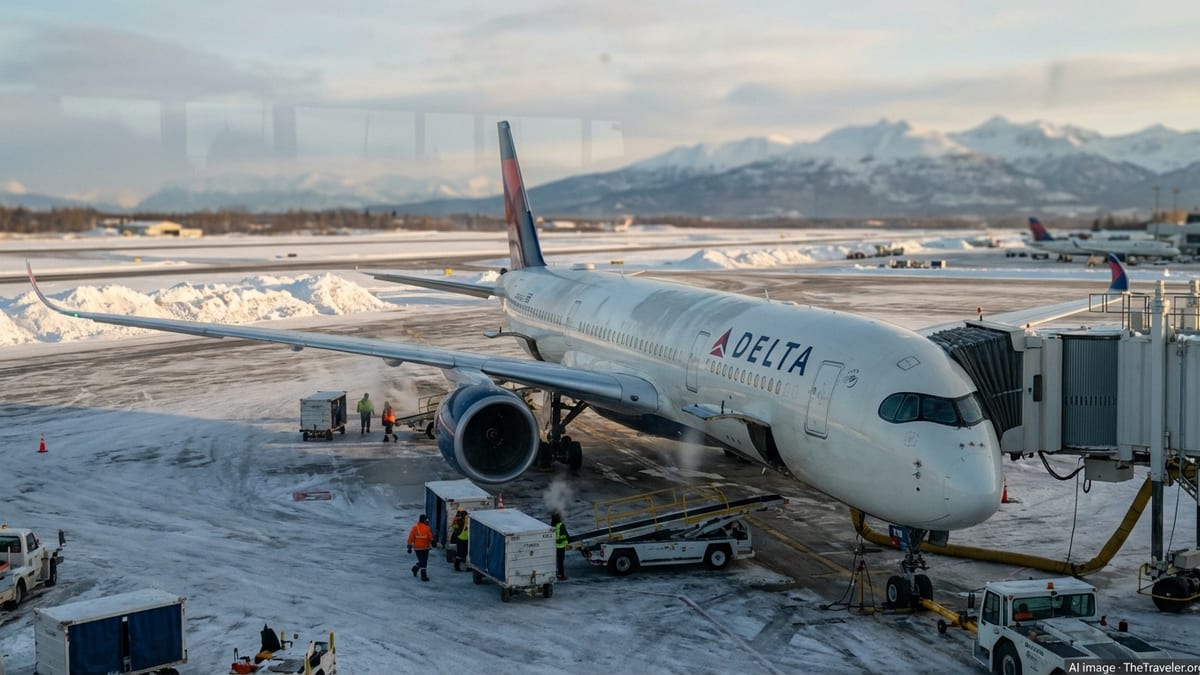
Passengers on Delta Air Lines Flight DL170 from Seoul to Minneapolis faced an unexpected detour when the long haul service diverted to Anchorage for a precautionary emergency landing, turning a routine transpacific crossing into an unplanned Arctic stopover.
Transpacific Flight Diverts Over North Pacific
Delta Air Lines Flight DL170, a regularly scheduled long haul service from Seoul Incheon to Minneapolis St. Paul, diverted to Anchorage after the crew reported an in-flight issue while crossing the North Pacific. The Airbus A350 was operating the west to east route that ordinarily tracks over the Bering Sea before descending across Alaska and Canada toward the U.S. Midwest.
The aircraft instead turned toward Anchorage, a key diversion airport on North Pacific routes, and made what officials described as a controlled, precautionary landing. The decision transformed a nonstop journey of more than 6,200 miles into a two stage trip that left passengers spending additional hours on the ground in Alaska as Delta and airport authorities coordinated the next steps.
Anchorage sits along a corridor heavily used by transpacific flights, and its facilities are routinely prepared to accept widebody aircraft that must divert for medical issues, technical checks or weather concerns. For travelers aboard DL170, the remote Alaskan city became an unexpected waypoint between Asia and the upper Midwest.
What Passengers Onboard Experienced
According to accounts shared after landing, the diversion unfolded calmly but decisively. Cabin crew suspended regular in flight service as the flight deck informed passengers that the aircraft would be heading to Anchorage instead of continuing directly to Minneapolis. Travelers reported that crew emphasized the move was precautionary and that the aircraft remained under full control.
For many on board, the initial announcement was met with a mix of concern and resignation common to long haul diversions. Some passengers prepared for potential onward disruptions by checking connections and informing contacts on the ground, while others focused on the immediate guidance from crew, including remaining seated with belts fastened as the jet commenced its descent toward Anchorage.
Once on the ground, passengers described a relatively orderly disembarkation process, with airport staff and Delta representatives guiding travelers into the terminal. While the unexpected stop created uncertainty around subsequent connections, the priority in the first hours remained ensuring that everyone had clear information, access to facilities and reassurance about safety.
Delta’s Operational Response in Anchorage
Anchorage’s Ted Stevens Anchorage International Airport is well established as an emergency and technical stop for long haul flights linking Asia and North America. For Delta, the diversion of DL170 activated a familiar but complex playbook that touches aircraft checks, crew scheduling, ground support and customer care in quick succession.
Once the A350 reached the gate, maintenance teams coordinated with the flight crew to assess the reported issue. Long range aircraft such as the A350 are engineered with extensive redundancy, but any anomaly that prompts a diversion must be fully investigated before the jet can either continue its journey or be removed from service for deeper inspection.
At the same time, Delta’s operations and customer service teams began working through the knock on effects of the delay. That process typically includes securing additional staffing in the terminal, arranging refreshments and, when necessary, organizing hotel accommodations for passengers whose onward travel is significantly disrupted. Rebooking efforts for those with missed connections in Minneapolis also began as schedulers evaluated available capacity on later departures across the domestic and international network.
Anchorage’s role as a long haul diversion point meant that the airport was equipped to handle the sudden arrival of a full widebody load of travelers. Still, scaling up services on short notice for an entire transpacific flight requires rapid coordination between airline staff, airport authorities and service providers from catering to security.
Impact on the Seoul to Minneapolis Route
Flight DL170 is a cornerstone of Delta’s transpacific schedule, providing one of the few nonstop links between South Korea and the U.S. upper Midwest. The route, operated with Airbus A350 aircraft, is timed to connect corporate travelers, students and leisure passengers into the airline’s Minneapolis hub, where they disperse to destinations across the United States and Canada.
An unscheduled diversion such as the one affecting DL170 introduces immediate operational ripple effects. The aircraft’s arrival into Minneapolis is delayed or canceled outright, reducing available widebody capacity on a heavily trafficked corridor. That in turn can force last minute rebookings on later flights, including alternate routings via West Coast gateways such as Seattle or Detroit, as Delta works to keep travelers moving.
In the days following an event like this, schedulers often have to rebalance aircraft rotations to ensure that subsequent Seoul departures operate on time and with the correct equipment. For an aircraft type like the A350, which is integral to Delta’s long haul network, temporarily losing a frame to extended maintenance can place additional pressure on fleet planning, particularly during busy travel periods.
Safety Protocols and Diversion Practices
The diversion of DL170 highlights a core principle of long haul aviation: when there is doubt, caution prevails. Modern aircraft routing across the North Pacific are planned with multiple diversion options, with Anchorage among the most prominent for flights along more northerly tracks. Flight plans are built to ensure that at almost any point along the route, a suitable airport is within reach in the event of a medical emergency, technical concern or deteriorating weather ahead.
Airlines and regulators require that crews be fully trained in diversion procedures, including fuel management, alternate airport planning and passenger communication. On routes like Seoul to Minneapolis, the aircraft’s sophisticated flight management systems continuously calculate diversion options so that the crew can pivot to Anchorage or other alternates without hesitation if conditions warrant.
For travelers, an emergency or precautionary landing often feels dramatic, but industry data show that such diversions are comparatively rare relative to the number of transpacific flights operated each day. When they do occur, they are typically executed within well rehearsed frameworks that prioritize safety and conservative decision making over schedule adherence.
Passenger Rights, Care and Rebooking Options
After an event that forces a long haul diversion, one of the most pressing concerns for travelers is how, and when, they will reach their final destination. Airlines such as Delta generally commit to rebooking affected passengers on the next available services, whether on the same carrier or, when necessary, on partner airlines that can offer comparable itineraries.
In Anchorage, Delta staff worked through passenger lists to identify those with tight or missed connections in Minneapolis and those ending their journey in the Twin Cities. While exact arrangements vary case by case, customers delayed by significant disruption are typically eligible for meal vouchers, hotel accommodations if overnight stays are unavoidable, and rebooked travel at no additional fare cost.
Passengers whose plans were tightly linked to specific arrival times, such as business meetings, tours or onward international departures, faced the greatest inconvenience. Many turned to messaging apps and mobile tools during the Anchorage layover to adjust ground arrangements, contact family or employers and explore alternative options. Delta’s mobile app and airport agents formed parallel channels for updating itineraries and issuing new boarding passes once replacement flights were confirmed.
Travel insurance can also play a role in recovery from such disruptions. Policies that cover trip interruption or delay may reimburse certain out of pocket expenses, including additional accommodation, meals or missed prepaid arrangements at the destination, provided travelers keep documentation of timing and receipts.
Anchorage’s Strategic Role in Transpacific Aviation
While for passengers on DL170 Anchorage represented an unforeseen stop, for the aviation industry the Alaskan hub occupies a long standing strategic position on polar and transpacific routes. Its geographic location makes it a natural midpoint between major Asian cities and destinations across the continental United States, particularly those in the Midwest and East.
Historically, Anchorage served as a refueling and technical stop for many cargo and passenger services that lacked the range to fly nonstop across the Pacific. Advances in aircraft efficiency have reduced the need for scheduled stops, but the airport has retained and modernized facilities designed to handle large long haul jets on short notice, including extended runways, deicing infrastructure, and around the clock operations.
For diversion scenarios, that infrastructure is critical. Widebody gates, trained ground handlers, customs and immigration staff and maintenance support enable Anchorage to absorb unexpected arrivals such as DL170 with minimal delay. Airlines factor that capability into their contingency planning, knowing that a diversion to Anchorage can significantly reduce complexity compared with more remote alternatives that lack comparable facilities.
The airport’s role as an occasional but vital safety net underlines why North Pacific carriers, including Delta, continue to maintain operational relationships and procedures tailored specifically to Anchorage, even as scheduled services increasingly bypass the city en route between Asia and the U.S. heartland.
Broader Context for Delta’s Long Haul Network
The disruption to DL170 comes at a time when Delta continues to refine and expand its international network, with Seoul serving as one of its primary Asian gateways in partnership with Korean carriers. The Seoul Minneapolis route is part of a broader transpacific portfolio that connects North America to key markets including Tokyo, Shanghai and Taipei, as well as an expanding set of transatlantic and leisure focused long haul destinations.
Operational incidents such as diversions are factored into Delta’s long term planning, with redundancy in fleet deployment and hub connectivity intended to absorb irregular operations while maintaining overall schedule integrity. In practice, however, any event affecting a heavily utilized aircraft type like the A350 can create short term challenges as schedulers weigh maintenance needs, passenger rebooking requirements and the commitments of other long haul routes.
For travelers, the experience of an emergency landing or precautionary diversion is both disorienting and memorable, yet it also offers a glimpse into the layered safety culture that underpins modern air travel. On DL170, the crew’s decision to seek an alternate airport and the coordinated response on the ground in Anchorage demonstrated how that culture translates into concrete actions aimed at protecting passengers, even at the expense of punctuality.
As Delta reviews the circumstances surrounding the diversion and regulators examine any technical findings, the Seoul Minneapolis route is expected to continue operating as a central link in the carrier’s Asia to Midwest network. For many future passengers, Anchorage will remain an unseen point far below the flight path rather than an unplanned stop, a reminder of the backup options that quietly support every nonstop journey across the Pacific.