

More news on this day
A Delta Air Lines flight from Sao Paulo to Atlanta was forced to make an emergency return to Sao Paulo/Guarulhos International Airport on Sunday night after a reported engine fire shortly after takeoff, with the aircraft landing safely and all passengers able to disembark without serious injury, according to early reports.
Get the latest news straight to your inbox!
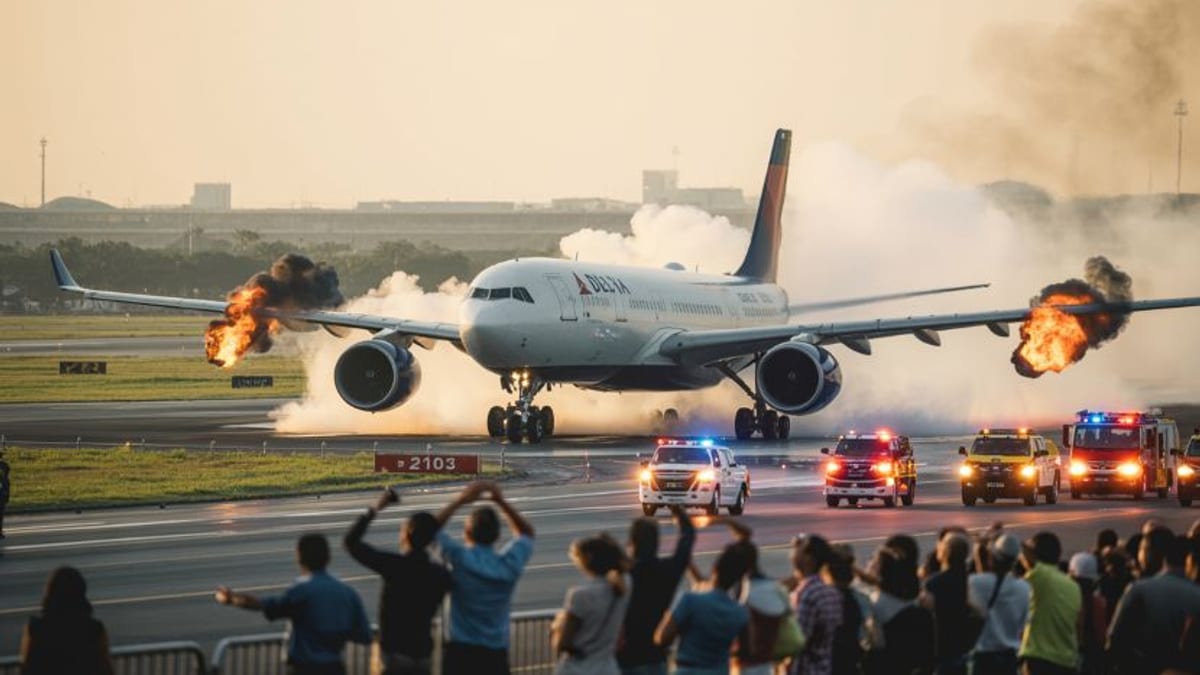
Image by Travel And Tour World
Engine Failure Moments After Departure
Publicly available flight information indicates that the incident involved Delta Flight 104, operated by an Airbus A330-300 departing Sao Paulo/Guarulhos International Airport on the evening of Sunday, March 29, 2026, local time. The aircraft was headed to Atlanta when, seconds after liftoff, witnesses reported a loud bang from the left side of the jet followed by visible flames.
Video clips and passenger accounts shared on social media platforms appear to show bursts of flame and sparks coming from the left engine as the aircraft climbed away from the runway. Some recordings capture multiple flashes consistent with engine surges before the fire subsided as the crew initiated standard emergency procedures.
Tracking data published by aviation monitoring websites suggests the aircraft remained in the immediate vicinity of Guarulhos, climbing only briefly before entering a wide left-hand circuit to set up for an emergency landing. The entire airborne phase of the flight appears to have lasted only a matter of minutes.
Aviation-focused outlets and enthusiast forums report that the aircraft involved is registered N813NW, a widebody jet typically used for long haul transcontinental services. The flight was reportedly carrying fuel for a journey of around ten to eleven hours to the United States when the malfunction occurred.
Emergency Landing and Airport Response
According to published coverage in Brazilian media, the flight crew declared an emergency and requested an immediate return to Guarulhos after indications of a serious malfunction in the left engine. Airport emergency services were deployed along the runway and taxiways ahead of the aircraft’s arrival.
Reports indicate that the crew conducted a controlled circuit and landed the aircraft back at Guarulhos with the remaining engine providing thrust. Initial accounts suggest the landing was stable and on a standard runway, rather than on an auxiliary or shorter strip, reflecting the crew’s decision to prioritize a safe, fully prepared arrival.
Local news descriptions and passenger posts suggest that fire crews followed the aircraft along the runway and inspected the left side of the jet after it came to a stop. Visual evidence circulating online appears to show scorch marks and soot around the affected engine, though the full extent of technical damage to the powerplant and wing structure has not yet been detailed in official documentation.
Airport operations at Guarulhos appear to have experienced temporary disruption, with some departures and arrivals delayed while the runway and surrounding safety areas were inspected. Subsequent traffic flow gradually normalized as the aircraft was secured and moved for further technical evaluation.
Passenger Experience and Onboard Conditions
Passengers posting on social networks and discussion forums describe a tense few minutes in the cabin as the loud bang and flashes outside the window were followed by a noticeable change in engine noise and the scent of smoke or burning fuel. Many report that cabin lights remained on and that the aircraft leveled off quickly after the initial climb.
Accounts shared publicly suggest that the crew made announcements to inform travelers of a technical issue and the decision to return to Sao Paulo. While some passengers reported anxiety and visible distress among those seated over the wing and near the affected engine, descriptions also indicate that the situation inside the cabin remained orderly, with no reports of serious injuries.
Once on the ground, the aircraft reportedly taxied to a remote stand or designated parking position where fire services carried out external checks before passengers disembarked. Social media posts indicate that customers were later assisted with rebooking and accommodation as Delta worked to rearrange onward travel to Atlanta.
Some travelers described spending the night in Sao Paulo while waiting for alternative flights, reflecting the challenge of accommodating an entire long haul manifest at one of Brazil’s busiest international hubs with limited spare widebody capacity on short notice.
What Is Known About the Aircraft and Investigation
Data made available by aviation tracking and fleet registries identifies the aircraft as an Airbus A330-300, a twin engine widebody frequently used on Delta’s South America to United States routes. The reported registration, N813NW, is part of a long serving fleet that has operated similar transcontinental sectors for several years.
Early analyses shared by aviation specialists online point to a severe engine failure on the left side, with the visible fire and sparks likely associated with the rapid disruption of turbine components and subsequent fuel ignition. At this stage, there is no formal technical report detailing whether the event involved a contained failure within the engine casing or if any debris exited the nacelle.
Under international practice, Brazilian aviation authorities are expected to review the incident in coordination with technical agencies and the airline. Investigators typically examine flight data recorder and cockpit voice recorder information, maintenance records, and physical evidence from the damaged engine to determine the root cause and to assess whether any wider safety actions are necessary.
Published commentary from aviation safety observers notes that the safe return of the aircraft to Guarulhos, despite being heavy with fuel for a long haul flight, reflects standard training for crews to handle engine fires and failures on or shortly after takeoff. Detailed findings, however, are likely to emerge only after a more extensive technical review.
Impact on Travelers and Broader Safety Context
The incident adds to a period of heightened attention on air travel reliability in Brazil, where recent weeks have seen a mix of weather related disruptions and scattered technical issues affecting multiple airlines at major hubs such as Sao Paulo and Rio de Janeiro. For passengers, the episode underscores how quickly a routine long haul departure can turn into an unscheduled overnight stay and a complex rebooking process.
Travel industry analysts often note that modern commercial aircraft are designed to continue flying safely on a single engine, particularly twin engine widebodies like the Airbus A330 that routinely operate long overwater segments. Engine fire scenarios similar to the one reported in Sao Paulo are part of recurrent simulator training, and crews are required to rehearse procedures for rejecting takeoff, returning to the departure airport, and performing single engine landings.
For future travelers on the busy Sao Paulo to Atlanta corridor, current information suggests that the risk profile of international flying remains statistically very low, even with high profile incidents that generate striking images and intense social media coverage. The safe outcome in this case, with no serious injuries reported, is likely to be highlighted in any official summaries as an example of redundancy and training working as intended.
As investigators collect data and the airline reviews operational details, more information is expected to emerge about the precise sequence of technical failures and the timeline of the crew’s actions. For now, the focus for affected passengers remains on continuing their interrupted journeys, while the aviation sector examines yet another reminder of the importance of rigorous maintenance and emergency preparedness on long haul routes.