

More news on this day
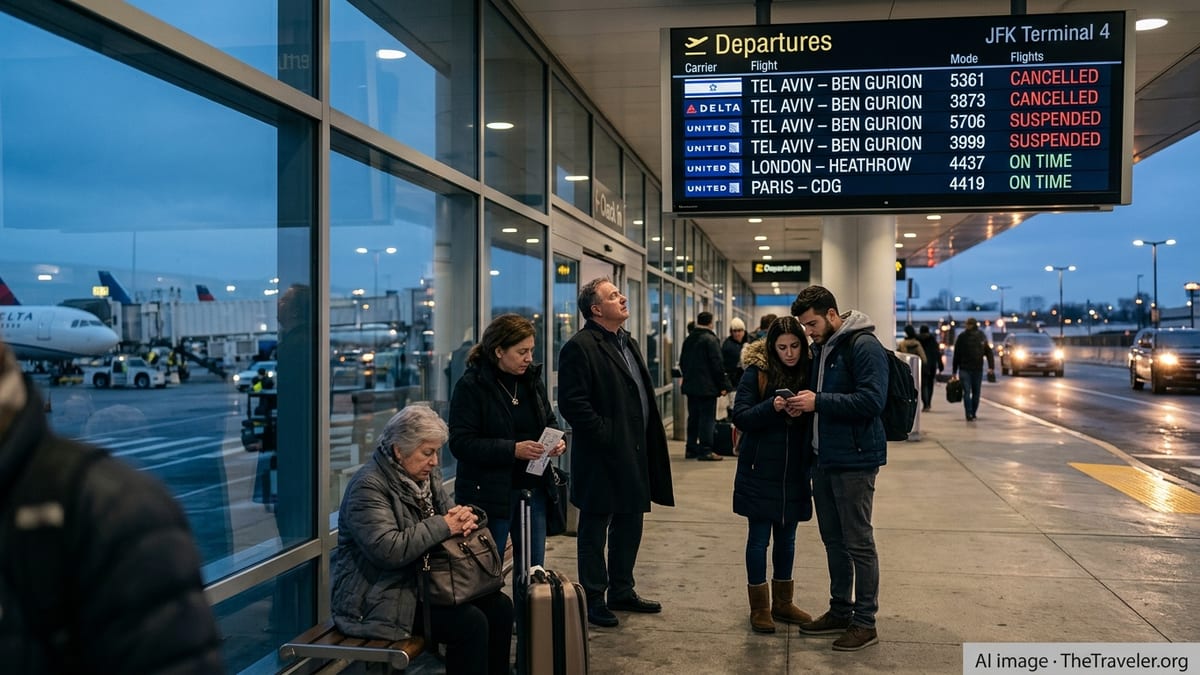
Delta Air Lines has suspended nonstop flights from New York, Atlanta and Boston to Tel Aviv, with the carrier pointing to heightened security risks and an uncertain operating environment in Israel.
Get the latest news straight to your inbox!
Latest Suspension Extends a Pattern of Caution Around Israel Routes
The latest pause in service affects Delta’s flights from New York’s John F. Kennedy International Airport, Hartsfield-Jackson Atlanta International Airport and Boston Logan International Airport to Tel Aviv’s Ben Gurion Airport. Publicly available airline and industry schedule data indicate that nonstop operations on these routes are currently off the board, with future resumptions framed as tentative rather than fixed.
According to published coverage from aviation-focused outlets, Delta had previously outlined plans to rebuild its Tel Aviv network in stages, with New York resuming first and Atlanta and Boston following at later dates. That schedule has now been overtaken by events on the ground, as evolving security assessments around Israel and Gaza continue to reshape how US and European carriers serve the market.
The decision aligns Delta with other major global airlines that have repeatedly scaled back or suspended Tel Aviv services during periods of heightened tension. While some carriers have restored limited frequencies, most continue to review the situation week by week, adjusting capacity in response to government advisories and insurance considerations.
Industry analysts note that Tel Aviv remains one of the most security-sensitive long-haul destinations in the world. When risk levels rise, airlines often react quickly by trimming schedules, rerouting aircraft and leaning on codeshare partners that maintain more robust security infrastructures in Israel.
Security Concerns Drive Network Changes Across US Carriers
Reports from international news outlets and aviation data providers show that the latest suspension is rooted in risk management rather than aircraft or staffing constraints. Airlines operating into Israel face heightened scrutiny around airspace conditions, missile defense activity and the potential for sudden escalations affecting approach paths into Ben Gurion Airport.
In prior conflicts, including earlier Gaza-related flare-ups, various US and European airlines have temporarily halted Tel Aviv flights following changes in government guidance or after incidents near the airport. Historical records highlight similar pauses by major US carriers in 2014, when rocket fire near Ben Gurion prompted a wave of cancellations and a short-lived prohibition on US airline operations.
Current conditions in and around Israel have again triggered a more conservative posture. Publicly accessible aviation security briefings and risk maps indicate that while Ben Gurion continues to operate, the perceived threat level remains above what some international carriers consider acceptable for routine service.
For Delta, suspending flights from all three US gateways consolidates its exposure and simplifies scheduling. Aircraft that would have been deployed on Tel Aviv routes can be reassigned to transatlantic or domestic services, while the airline continues to monitor whether the situation stabilizes enough to justify a phased return.
Impact on Travelers From New York, Atlanta and Boston
The suspension is being felt most directly by travelers in key US hubs with strong business, family and religious ties to Israel. New York’s metropolitan area, home to one of the world’s largest Jewish communities, has long supported multiple daily flights to Tel Aviv across several airlines. The loss of Delta’s nonstop from JFK narrows options and is contributing to higher fares on remaining services.
In Atlanta, where Delta is headquartered, the pause removes a direct Southeast link to Israel that had been promoted as a convenient connection for both corporate and leisure travelers. Passengers now face longer itineraries via European or US gateways, often involving additional security checks and extended layovers.
Boston-area travelers are likewise seeing reduced nonstop choice. Prior announcements about building out Boston to Tel Aviv as part of a broader international growth strategy have effectively been put on hold, with itineraries re-routed through partner hubs in Europe or via other US cities still offering limited Israel service.
Travel agents and booking platforms report that passengers holding Delta tickets to Tel Aviv are being re-accommodated on alternative routings or refunded, depending on fare rules and individual preferences. Many itineraries are now being rebuilt around carriers that continue to operate into Israel, including the country’s flag airline and select European networks.
Airline Response: Codeshares, Rebookings and Flexible Policies
Publicly available information on Delta’s customer guidance shows that the airline is directing affected passengers to manage changes through its website, mobile app and contact centers. Standard disruption protocols typically include no-fee rebooking within a defined travel window, fare differences for later dates, or refunds if the flight is cancelled by the carrier.
Industry briefings indicate that Delta is also leaning on its alliance and codeshare partners to preserve connectivity between the United States and Israel. In previous suspensions, the airline has relied on joint itineraries with foreign carriers that maintain Tel Aviv operations, allowing customers to travel on a mix of Delta and partner flights under a single ticket.
For travelers, this often means connecting in European hubs such as Paris, Amsterdam or Rome, or in other US gateway cities served by airlines still flying to Israel. While total travel time can increase, these routings help maintain a vital air bridge for family visits, business travel and religious tourism during periods when nonstop US-carrier service is curtailed.
Consumer advocates note that passengers should review fare conditions and any relevant travel waivers carefully before making changes. In security-related suspensions, airlines may adjust rebooking rules over time as the situation evolves, with more generous options typically available closer to the date of disruption.
What Comes Next for US–Israel Air Travel
Looking ahead, analysts monitoring airline schedules caution that the timeline for restoring Delta’s Tel Aviv routes from New York, Atlanta and Boston will depend on a combination of political and commercial factors. Improvements in the security environment, clearer government advisories and stabilized insurance costs are all viewed as prerequisites for a meaningful restart.
Capacity decisions will also hinge on demand. While underlying interest in travel to Israel remains strong, booking patterns have become more volatile, with many passengers waiting until closer to departure to commit. Airlines are responding by publishing tentative schedules while retaining flexibility to cut or add frequencies as conditions change.
Some aviation commentators point out that Delta’s cautious approach mirrors a broader trend among global carriers that are prioritizing operational resilience and risk reduction over rapid expansion into high-threat regions. In this context, Tel Aviv has become a bellwether for how airlines balance commercial opportunity with safety considerations.
For now, travelers in New York, Atlanta and Boston planning trips to Israel are likely to face a more fragmented route map and higher prices than in previous years. Industry observers suggest that those with firm plans should book early, monitor airline and government advisories regularly and remain prepared for further schedule adjustments as the security picture continues to evolve.