

More news on this day
Hundreds of Delta Air Lines passengers were left stranded across the United States on Saturday as the carrier preemptively scrubbed more than 60 flights and logged over 500 delays ahead of a powerful snowstorm forecast to slam the East Coast and ripple across its nationwide network.
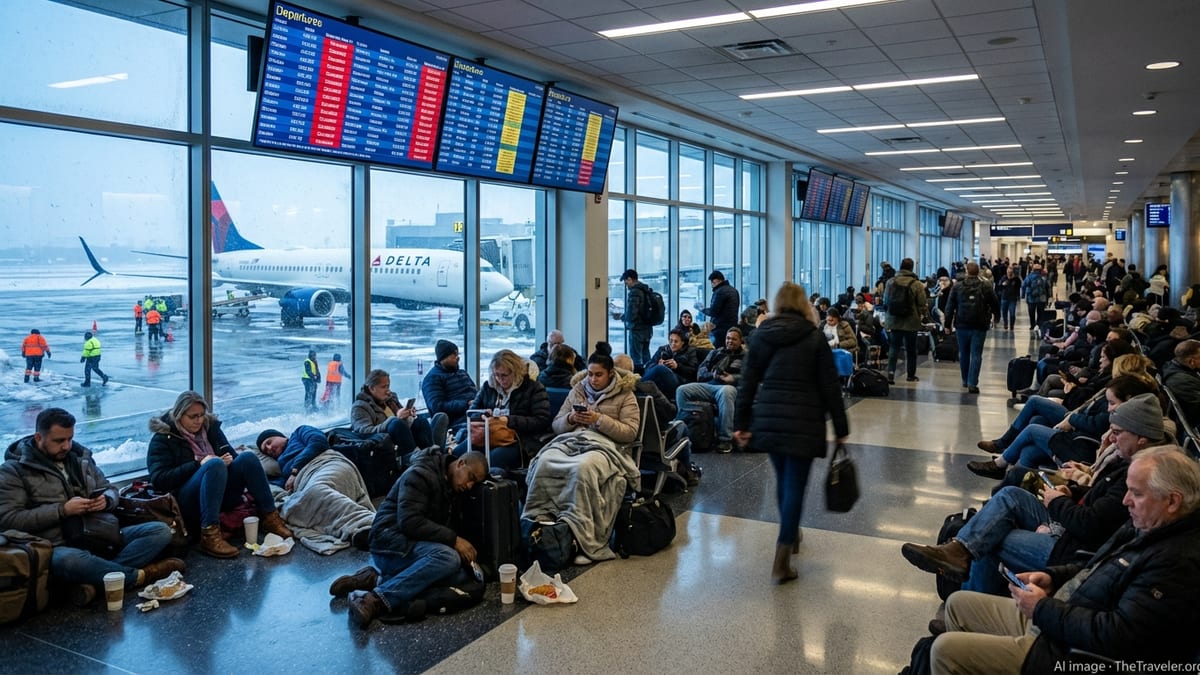
Winter Storm Hernando Threatens Fresh Wave of U.S. Travel Chaos
The latest wave of disruptions comes as meteorologists warn that Winter Storm Hernando is set to bring heavy snow, strong winds and hazardous conditions from the Mid‑Atlantic through New England beginning Sunday, just weeks after earlier systems produced one of the worst mass cancellation days since the pandemic. With Boston, New York and other Northeastern hubs squarely in the storm’s path, airlines are thinning schedules in advance to avoid last‑minute operational breakdowns.
Delta said it began processing cancellations at key East Coast airports on Saturday afternoon, targeting flights into and out of Boston Logan, New York’s John F. Kennedy and LaGuardia, and other affected cities. The airline framed the cuts as a safety‑first measure and a way to keep remaining flights running more reliably once snow and low visibility move in.
While the most severe weather is expected in the Northeast, the interconnected nature of U.S. airline networks means the impact is being felt well beyond the storm zone. Aircraft and crews scheduled to operate in Boston and New York typically cycle through other major hubs such as Atlanta, Los Angeles and Seattle, leading to rolling delays and missed connections even where skies remain clear.
Major Hubs from Atlanta to Seattle Feel the Strain
At Hartsfield‑Jackson Atlanta International Airport, Delta’s largest hub, long lines formed at check‑in counters and rebooking desks as travelers learned that their Sunday and Monday flights were either canceled outright or likely to be significantly delayed. Many passengers reported receiving overnight schedule‑change notices as the carrier worked to reposition aircraft and build slack into its system before conditions deteriorate.
On the West Coast, operations at Los Angeles International and Seattle‑Tacoma remained less directly affected by weather on Saturday but were nonetheless hampered by the knock‑on effects of aircraft and crew no longer available from the East. Several morning departures to Boston and New York left late or without all connecting passengers, leaving some travelers in California and the Pacific Northwest unexpectedly stranded between legs of cross‑country journeys.
In Florida, Orlando International Airport saw a steady stream of frustrated Delta customers waiting to speak with agents after learning that flights to Northeastern cities had been pulled from the schedule. Although Central Florida was not in the storm’s direct path, local officials had already activated contingency plans for passenger comfort, anticipating spikes in stranded travelers as winter weather disrupted the nation’s main hubs.
Boston and New York Brace for the Worst of the Disruptions
Boston and the New York City area were expected to bear the brunt of Hernando’s snowfall, with forecasters warning of rapidly deteriorating conditions and the potential for airport ground stops. Airlines, including Delta, have been steadily trimming departures and arrivals to minimize the number of aircraft and passengers exposed to the storm at its peak.
At Boston Logan, early cancellations mounted through the day as Delta and other carriers cut mainline and regional flights ahead of heavy accumulation on runways and taxiways. Travelers arriving at the airport found departure boards riddled with scrubbed services to Atlanta, Detroit, Minneapolis and a host of smaller Northeastern cities, as airlines consolidated passengers onto the limited number of flights still operating.
New York’s LaGuardia and JFK airports, which saw staggering disruption during a previous January storm, again emerged as flashpoints. Flyers reported difficulty securing alternative seats until midweek, particularly on high‑demand routes along the busy Northeast corridor. With the Federal Aviation Administration already cautioning of potential delays due to low clouds and precipitation, many passengers chose to abandon travel altogether and request credits for future trips.
Passengers Describe Long Lines, Limited Answers and Rising Costs
For affected travelers, the statistics translated into hours in line, scrambled itineraries and unexpected expenses for hotels, meals and ground transportation. In Atlanta, some Delta customers described winding queues stretching through the check‑in hall as agents attempted to rebook entire planeloads of passengers from a single canceled flight onto already crowded alternatives.
At Los Angeles International, families bound for winter vacations in Boston and New York said they were offered options that involved multiple connections or delays of more than 24 hours. Others were encouraged to accept travel credits and rebook for later in the week, a difficult choice for those with limited vacation time or fixed return dates.
In Seattle and Orlando, travelers caught mid‑journey faced an even murkier picture, unsure whether to continue to connecting hubs that were already experiencing disruption or to halt their trips altogether. Some opted to rent cars and drive to secondary airports in search of open seats, while others booked last‑minute hotel rooms near terminals in hopes of catching early‑morning departures.
Delta’s Response: Waivers, Proactive Cancellations and Recovery Plans
Delta emphasized that the operational disruption is largely the result of deliberate, proactive cancellations rather than on‑the‑spot decisions at the gate. By thinning schedules ahead of time, the airline aims to keep remaining flights on a more predictable timetable and avoid boarding passengers only to remove them when conditions change.
The carrier has issued a travel waiver for a broad swath of East Coast airports, allowing customers with tickets dated for February 22 and 23 to change to alternate flights without additional fees, provided they travel within a specified window. The policy covers major hubs such as Boston and New York as well as a string of regional airports throughout the Mid‑Atlantic and New England.
Delta has also highlighted its automatic rebooking tools, which assign affected travelers to the next available flight where space permits. Customers are being encouraged to use the airline’s app to review and modify these new itineraries instead of queuing at airport counters, a strategy that carriers increasingly rely on during large‑scale weather events to reduce crowding and speed up recovery.
System Under Pressure After a Season of Extreme Winter Weather
The latest round of cancellations arrives on the heels of a turbulent winter travel season that has repeatedly tested the resilience of U.S. airlines. A massive January storm already triggered more than ten thousand cancellations across the industry in a single day, with Delta and its rivals forced to scrub large portions of their schedules at major hubs.
Industry analysts note that the concentration of airline networks in a handful of megahubs such as Atlanta and New York magnifies the effect of each weather event. When storms close or slow these key nodes, the resulting delays and cancellations cascade across the country, affecting travelers who may be flying between cities far from the storm’s center.
This season’s storms have led carriers, including Delta, to refine their playbook for preemptive schedule cuts and rapid recovery. Investments in predictive technology and crew‑reassignment tools have shortened the time needed to restore normal operations after past weather events, but severe systems like Hernando still cause unavoidable pain for passengers with time‑sensitive plans.
What Stranded Travelers Can Do Right Now
Travel advisers say that passengers affected by winter weather disruptions should first check their flight status and any automatically issued rebooking options before heading to the airport. In many cases, the fastest solutions are available through airline mobile apps or websites, which tap directly into the same inventory used by call centers and airport agents.
For those who must travel on a specific day, experts recommend widening the search to include nearby airports, early‑morning departures and connecting itineraries that route through less affected hubs. Flexibility with departure time and routing can markedly improve the chances of securing a seat when large numbers of flights into the Northeast are constrained.
Passengers who decide to cancel their trip outright should review applicable waivers and credit policies carefully, particularly for basic economy tickets that ordinarily carry strict restrictions. Many airlines temporarily relax these rules during major weather events, allowing travelers to retain the value of their tickets for future use even when refunds are not available.
Ongoing Outlook: More Turbulence Likely as Storm Moves Through
With Winter Storm Hernando still approaching the coast, aviation officials warned that Sunday and Monday are likely to bring additional rounds of cancellations and extensive delays, particularly at Northeastern airports. As the system passes and crews and aircraft gradually return to position, carriers will work through the backlog of displaced passengers, a process that can take several days.
For now, Delta customers across Atlanta, Los Angeles, New York, Seattle, Orlando, Boston and other affected cities face an uncertain few days of travel. As airlines juggle safety concerns, staffing constraints and packed holiday‑season loads, the latest disruption underscores how quickly winter weather can upend even the most carefully planned journey.