

More news on this day
Delta Air Lines has introduced an emergency travel waiver for customers traveling through Atlanta, responding to days of extraordinarily long security lines and record-breaking TSA wait times at Hartsfield-Jackson Atlanta International Airport during the ongoing partial shutdown of the U.S. Department of Homeland Security.
Get the latest news straight to your inbox!
Waiver Aims to Give Atlanta Travelers More Flexibility
According to Delta’s online advisory, the emergency travel waiver applies to tickets touching Atlanta over a defined period during the current disruption, allowing eligible passengers to rebook once without a change fee if they adjust travel within specific date and fare-class restrictions. Publicly available information indicates that the waiver is targeted at departures and connections scheduled during peak congestion at TSA checkpoints, when wait times have stretched well beyond typical busy-season levels.
The waiver is primarily designed for travelers who have not yet begun their trips and are concerned about clearing security in time, particularly those with early-morning departures and tight connections through Delta’s largest hub. The policy gives customers additional options to move flights to less congested times of day, different travel dates, or, in some cases, alternate airports in the carrier’s network, subject to seat availability.
Standard ticket rules such as fare differences and original cabin of service still apply in most cases, but the removal of change fees during the waiver window significantly lowers the financial barrier for travelers trying to avoid the worst of the disruption. Customer-facing guidance emphasizes that passengers should verify eligibility using their confirmation number on Delta’s website or mobile app before making changes.
Delta routinely issues waivers for severe weather and large-scale operational events, but the latest measure linked to prolonged security delays at a single airport underscores how deeply the current federal funding impasse has affected ground operations at Hartsfield-Jackson.
Record-Breaking TSA Wait Times at the World’s Busiest Hub
Hartsfield-Jackson Atlanta International Airport, which typically handles more passengers than any other airport worldwide, has been grappling with unprecedented screening bottlenecks since mid-March. Published coverage of nationwide impacts from the partial Homeland Security shutdown notes that TSA staffing shortfalls and elevated callout rates have driven wait times at major U.S. hubs to levels rarely seen in recent years, with Atlanta identified among the most constrained checkpoints.
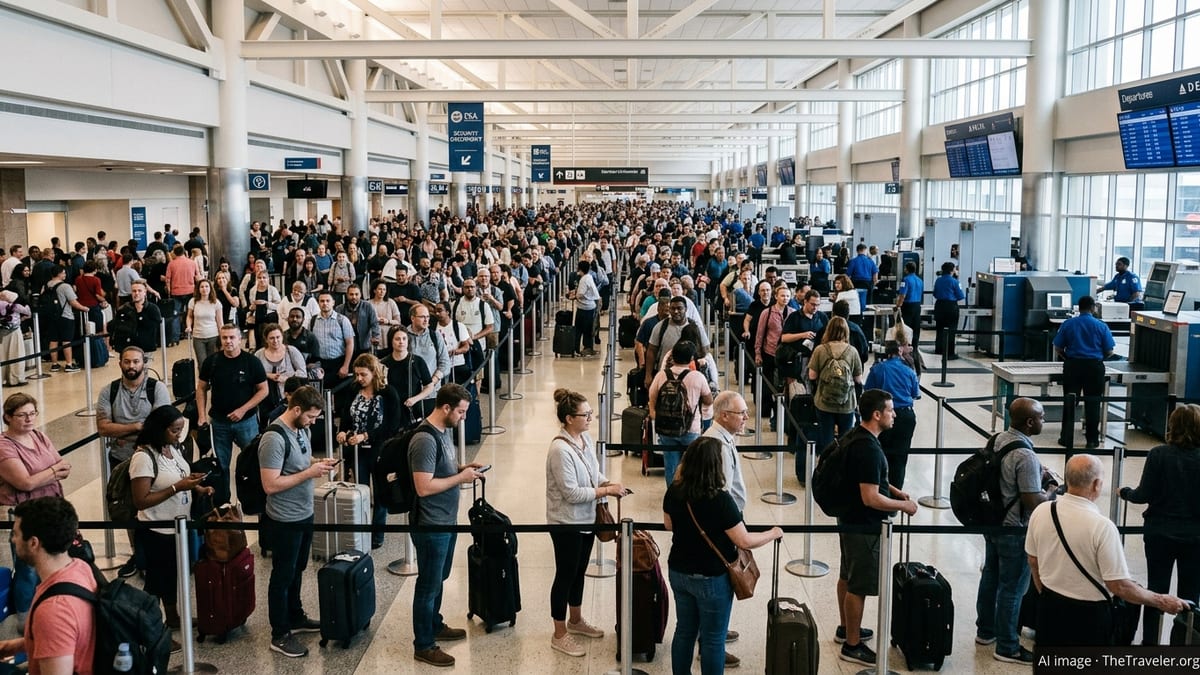
Over the past week, local reporting and crowdsourced accounts have described pre-dawn lines snaking out of security areas, general screening waits stretching well beyond 90 minutes, and some evening periods when travelers reported spending more than two hours in line. Separate national tallies of TSA staffing trends indicate that hundreds of officers have resigned or left their posts since the shutdown began in mid-February, intensifying existing labor shortages just as spring break travel pushes volumes higher.
At Atlanta, the impact has not been uniform throughout the day. Reports indicate that early morning and Sunday afternoon banks of departures have been particularly strained, with some carriers and airport messaging urging travelers to arrive at least three to four hours before flight time during the most congested periods. By contrast, some mid-day and late-evening windows have seen comparatively shorter lines, leading to a patchwork experience that can be difficult for travelers to predict.
Airport and airline staff have been redeployed to assist with wayfinding, queue management and passenger communication around the terminals, while federal authorities have shifted personnel and resources between airports to try to stabilize the system. Even with these interventions, the combination of record passenger throughput and reduced staffing has left many travelers facing unfamiliar delays at the checkpoint.
Shutdown Fallout Drives Security Staffing Crisis
The surge in Atlanta’s TSA wait times is unfolding against the backdrop of a wider national dispute over funding for the Department of Homeland Security. National news reports describe how the partial shutdown, which began on February 14, has left tens of thousands of federal employees, including TSA officers, facing delayed pay and prolonged uncertainty over their employment conditions.
Data highlighted in recent coverage show that more than 450 TSA officers nationwide have left their jobs since the shutdown started, while daily callout rates at some of the largest airports have climbed to several times their usual levels. Hartsfield-Jackson has appeared frequently on lists of the most affected facilities, alongside major hubs such as Houston’s George Bush Intercontinental and New York’s John F. Kennedy International.
To help relieve pressure at airport checkpoints, the federal government has redeployed personnel from other agencies. Immigration and Customs Enforcement officers have been dispatched to more than a dozen airports, including Atlanta, to provide support with line management and crowd control tasks that do not involve direct screening. Publicly available information shows that some TSA PreCheck and CLEAR lanes have operated on a reduced schedule or closed temporarily on peak days as managers consolidate limited staff on the main screening lines.
Security experts note that these stopgap measures can only partially offset the effects of long-term understaffing, training backlogs and heightened stress among frontline personnel. For travelers, the most visible outcome has been longer queues, less predictable processing times and a higher risk of missed flights, even when arriving at the airport earlier than usual.
What the Waiver Means for Atlanta-Bound and Connecting Passengers
For Delta customers whose trips begin, end or connect in Atlanta, the emergency travel waiver provides an additional layer of protection in an already volatile environment. Passengers departing from Hartsfield-Jackson can use the waiver to move their flights away from periods with widely reported multi-hour lines, while those connecting through the hub can look for itineraries that allow more time to clear security between flights if they need to leave and reenter the sterile area.
Travel advisors recommend that passengers affected by the current conditions pay close attention to the exact terms of the waiver, which typically specify eligible travel dates, regions, and booking deadlines. In many cases, customers must rebook within a short window and complete new travel within a defined range of dates to avoid additional costs. Some discounted basic economy tickets may have more limited flexibility, although the waiver can still relax certain restrictions compared with normal rules.
Travelers using the waiver are encouraged, through airline and airport guidance, to consider carrying hand luggage only where possible, checking in online, and proceeding directly to security after arrival at the terminal. These steps can help reduce the risk of further delays at crowded check-in counters and bag drops, which are also experiencing heavier volumes as more passengers arrive earlier than usual.
For those who cannot or do not wish to change their flights, publicly available information suggests that arriving significantly earlier than pre-shutdown norms remains the most reliable strategy. In practice, that may mean allowing three hours or more for domestic departures during peak times at Atlanta, particularly for travelers without TSA PreCheck, CLEAR or priority security access.
Preparing for Spring Travel Amid Prolonged Disruption
The timing of Atlanta’s security crunch is especially challenging for travelers, as the spring break period is traditionally one of the busiest stretches of the year for Delta’s hub. Industry analysts point out that leisure travel demand remains robust, with many passengers locked into fixed holiday dates and less able to shift their plans in response to operational issues.
Airline scheduling data and booking trends indicate that high passenger loads are likely to continue into early April, even if a political resolution to the Homeland Security funding standoff is reached in the near term. That means the benefits of Delta’s waiver could extend beyond passengers immediately affected this weekend, particularly if TSA staffing takes time to normalize after pay and funding are restored.
For now, travel experts advise that passengers keep a close eye on their airline’s app or website in the days leading up to departure. Same-day notifications about gate changes, estimated security wait times and additional waivers for specific dates or time windows can help travelers adapt quickly if conditions at Atlanta’s checkpoints deteriorate further.
While the current wave of disruption has underlined the vulnerabilities of the U.S. aviation system to federal budget impasses, it has also prompted new collaborations between airports, airlines and local partners to share real-time data, ease bottlenecks and support front-line staff. For travelers passing through Atlanta in the coming days, understanding the emergency waiver and building extra time into their journeys remain the most practical tools for navigating the record-breaking queues.