

More news on this day
Delta Air Lines is accelerating its international push in 2026 with 11 new long-haul nonstop routes now on sale, expanding coastal gateways like New York, Los Angeles, Boston and Seattle while adding fresh links to Europe, the Middle East and Asia that reflect shifting leisure and business travel demand.
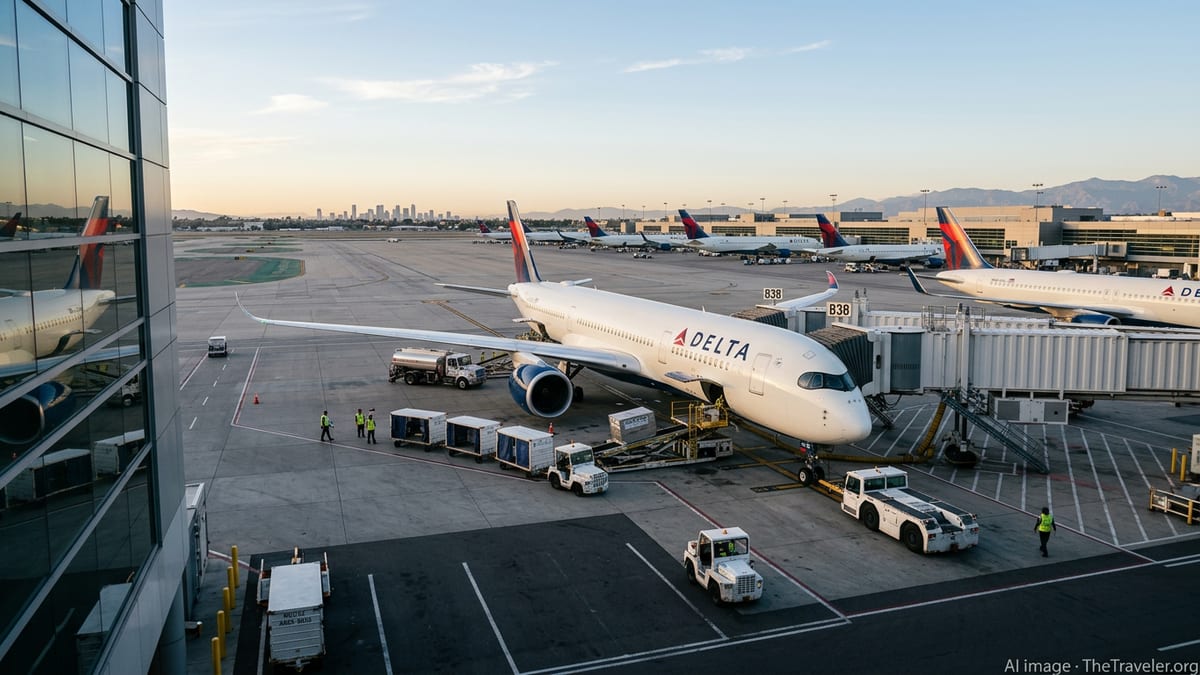
Largest Transatlantic Schedule in Delta’s History
Delta’s 2026 network will feature the carrier’s largest transatlantic schedule to date, with more than 650 weekly flights to nearly 30 European destinations in peak summer, and a slate of new nonstop links designed to capture booming demand for Southern Europe. The expansion underscores how quickly long-haul demand has rebounded, particularly from U.S. coastal hubs where airport slots and premium travelers give Delta a competitive edge.
New York remains the centerpiece of the growth. Delta will introduce nonstop service from John F. Kennedy International Airport to Porto, Portugal, as part of a broader focus on secondary European cities that have seen surging U.S. visitor numbers. Seasonal service to Mediterranean islands such as Sardinia and Malta from JFK further extends that strategy, giving American travelers more direct access to sun destinations that previously required a connection.
In addition to new destinations, Delta is layering capacity onto established transatlantic routes, driving up frequency and giving travelers more schedule choice. The airline has highlighted that nearly a third of its European departures in summer 2026 will target Southern Europe, an area where it sees enduring strength from both tourism and diaspora traffic. The goal is to keep Delta visible and relevant in markets where rivals from Europe and the Middle East are also vying for U.S. travelers.
Onboard, the airline is leaning heavily on its newest widebodies and refreshed cabins to differentiate on long sectors. Many of the new flights will feature Delta One Suites and the Delta Premium Select cabin, a premium economy product that the carrier is using to attract leisure passengers who are willing to pay more for additional space without stepping all the way up to business class.
Seattle and Boston Emerge as Long-Haul Gateways
While Atlanta and New York remain Delta’s largest hubs, the 2026 schedule signals growing ambition for Seattle and Boston as long-haul gateways. From Seattle-Tacoma International Airport, Delta will launch new nonstop flights to Rome and Barcelona in summer 2026, putting the Pacific Northwest within one flight of two of Europe’s most visited cities and sharpening competition with both European carriers and a growing slate of U.S. rivals.
The Seattle routes are scheduled several times a week and are aimed at both outbound U.S. leisure travelers and inbound European visitors who can connect across Delta’s domestic network in the Pacific Northwest. The flights also give Delta additional feed into partners and joint ventures, particularly for travelers heading onward to Alaska, the U.S. Mountain West and Western Canada.
On the opposite coast, Boston Logan International Airport will see new nonstop service to Madrid and Nice, with Barcelona upgraded to daily service for summer 2026 after strong performance in earlier seasons. The moves deepen Delta’s presence in a fiercely contested New England market and give Boston-origin passengers a wider range of nonstop European options without backtracking through New York.
Delta’s Boston strategy leans on a mix of business and leisure demand. Madrid brings strong corporate and financial traffic alongside tourism, while Nice and Barcelona skew toward high-yield leisure and cruise passengers heading for the Riviera and Western Mediterranean. Together, the three routes add heft to Boston’s role as a secondary transatlantic hub in Delta’s system.
New Links to the Middle East and Asia
Delta’s 2026 long-haul expansion is not limited to Europe. One of the most closely watched additions is a planned nonstop between Atlanta and Riyadh, which is expected to begin operating in October 2026. The route, to be flown with Airbus A350-900 aircraft, represents Delta’s first direct link to Saudi Arabia and signals a bolder approach toward fast-growing markets in the Gulf.
The Atlanta to Riyadh service is designed around a mix of corporate, governmental and visiting-friends-and-relatives traffic, while also enabling connections across Delta’s vast domestic network. By operating from its largest hub, the airline can draw travelers from smaller U.S. cities that currently require multiple connections to reach Saudi Arabia, strengthening its proposition against Gulf and European carriers that dominate flows to the region.
Across the Pacific, Delta is also adding fresh capacity. A new nonstop from Los Angeles to Hong Kong, scheduled to start in June 2026, will restore a direct connection between Southern California and one of Asia’s key financial centers. The airline plans to operate the route with A350-900s, offering lie-flat Delta One Suites and enhanced premium economy seating aimed at both corporate travelers and premium leisure passengers.
Together, the Riyadh and Hong Kong additions highlight Delta’s willingness to re-enter or open long-haul markets that carry strategic significance beyond immediate profitability. Both routes broaden the network for multinational corporate clients, while the modern widebody fleet gives the carrier more flexibility to right-size capacity as markets mature.
Strengthening Latin America and CES-Focused Long-Haul
Delta’s 2026 schedule also continues a quieter but meaningful shift in Latin America and event-driven flying. The airline has recently introduced daily nonstop service between Salt Lake City and Lima, Peru, operated by Boeing 767-300ER aircraft, creating Utah’s first nonstop link to South America. While launched in late 2025, the route becomes fully embedded in the 2026 schedule and illustrates how Delta is using its Intermountain hub as a springboard for selective long-haul growth.
The Salt Lake City to Lima flight is pitched to both leisure travelers headed for Machu Picchu and the Peruvian coast and to business customers from Utah’s growing technology and outdoor industries. It also gives Delta additional connectivity into South America that complements its broader joint venture and partner network in the region.
Meanwhile, Las Vegas will see a different kind of long-haul boost in early 2026 tied to the annual CES technology trade show. Delta is planning nonstop international service to Las Vegas from Shanghai, with additional capacity and returning nonstops from Amsterdam, Paris, Seoul and London during the event period. Although some of these flights are seasonal or short lived, they occupy valuable widebody aircraft time and demonstrate how closely Delta aligns its long-haul deployment with large global events.
For international visitors attending CES, the extra nonstops can significantly simplify travel, allowing them to bypass traditional U.S. gateways and arrive directly in Las Vegas. For Delta, the services provide high-yield traffic over a concentrated period, helping to offset the seasonality that often characterizes long-haul flying in early January.
Fleet, Product and Competitive Landscape
Underlying the 2026 route map is a steady infusion of new aircraft. Delta continues to take delivery of Airbus A330neo and A350-900 jets, which offer lower fuel burn, improved range and a more consistent onboard product. These aircraft are central to the launch of several of the new long-haul nonstops, especially on thinner or newly developing routes where efficiency is essential.
Across the new services, Delta is standardizing its premium offering, including refurbished Delta One Suites, upgraded economy cabins and expanded Wi-Fi coverage. The airline is betting that a consistent, elevated onboard experience will matter as it goes up against aggressive long-haul competition from United Airlines, American Airlines and a set of well-established European and Asian rivals.
From a competitive standpoint, Delta’s 11 new long-haul nonstops for 2026 collectively reinforce a strategy built around coastal strength, selective risk-taking in new markets and a focus on destinations where demand skews toward higher-yield leisure and premium passengers. The carrier is carving out a larger role for Seattle and Boston, leveraging Atlanta for global connectivity and using New York and Los Angeles to anchor its brand in two of the world’s most consequential aviation markets.
For travelers, the expansion means more nonstop options, fewer forced connections through crowded hubs and greater choice in aircraft and cabin products on intercontinental journeys. As these routes come online across 2026, they will help define how Delta positions itself in the next phase of global aviation recovery, where network breadth and product quality remain critical differentiators.