

More news on this day
Delta Air Lines is turbocharging its next growth phase with a bold 2026 strategy built around an expanded Airbus A321neo fleet, denser premium cabins and a slate of record‑setting long-haul routes that signal a sharp turn toward high-yield, comfort-focused travel.
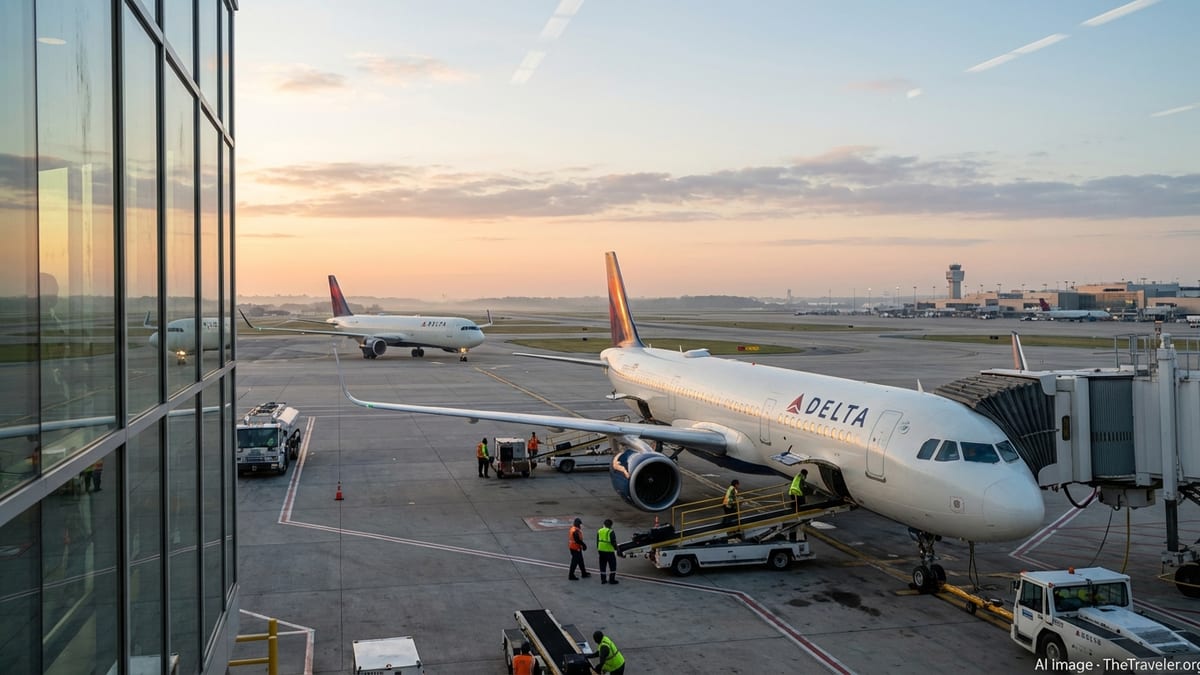
A321neo Becomes the Cornerstone of Delta’s Future Fleet
Delta is cementing the Airbus A321neo as the backbone of its narrowbody operation, locking in a future that leans heavily on fuel efficiency and a more premium onboard experience. The airline now has purchase commitments for 148 A321neos through 2027, with 80 already in service, and this week moved to exercise options for 34 additional jets that will begin arriving in 2029. Once these aircraft are delivered, Delta’s A321neo fleet will total 189 aircraft, making it the largest single fleet type in the carrier’s history and a central pillar of its cost and sustainability strategy.
The A321neo has quickly become Delta’s showcase for what it calls “premium at scale.” The standard 194-seat version features 20 domestic first class seats, 42 Delta Comfort+ extra-legroom seats and 132 main cabin seats, with memory-foam cushioning, large overhead bins, in-seat power and fast, free Wi-Fi. These details, typically reserved for long-haul widebodies, are now being rolled out across key domestic and short-haul international routes, giving the airline a more consistent product as it pushes deeper into higher-fare segments.
As additional A321neos arrive into the fleet in 2026 and beyond, Delta is expected to continue using the type to replace older, less efficient narrowbodies. Executives have framed the strategy as a way to pair lower fuel burn with a cabin that can support strong revenue performance, especially in markets that reward extra comfort and productivity-friendly amenities.
Temporary Super-Premium A321neo Layout Tees Up 2026 Reveal
In parallel with its mainline A321neo rollout, Delta is quietly preparing one of the most unusual cabin experiments in recent U.S. aviation history. Faced with certification delays for a new lie-flat Delta One business-class seat intended for a subset of A321neos, the airline has begun deploying a temporary configuration that pushes the premium trend to an extreme: 44 first class seats on a single-aisle jet, more than double the standard 20-seat first cabin.
This interim layout, installed on up to seven A321neo aircraft, reduces overall capacity to 164 seats while preserving 54 Comfort+ seats and 66 economy seats. The result is a domestic aircraft that is overwhelmingly skewed toward the front of the plane, tailored for routes where demand for upmarket seats outstrips supply. Industry analysts say the move allows Delta to keep new aircraft flying and earning revenue rather than sitting idle while it waits for regulatory sign-off on its next-generation lie-flat suites.
Delta has said only that these select A321neos will enter service with an “updated seat configuration designed with comfort in mind” and that more details will be shared in 2026. Behind the scenes, the airline is expected to pivot these jets to their ultimate role: a quad-class A321neo subfleet aimed at premium transcontinental and high-value medium-haul routes, with Delta One lie-flat suites, Premium Select premium economy, Comfort+ and standard economy. If approved on schedule, that configuration would give Delta one of the most sophisticated single-aisle premium products in the world.
Premium Cabins Expand From Coast-to-Coast to Deep Long-Haul
The A321neo experiment is part of a broader premiumization arc running through Delta’s entire network. On long-haul international and select long domestic routes, the airline continues to invest heavily in Delta One and Premium Select cabins, betting that leisure and business travelers will pay more for space and amenities after years of pandemic-era disruption.
Delta One, the carrier’s flagship business-class product, offers fully flat beds, upgraded bedding, and elevated dining, and is increasingly positioned as the default choice for overnight and ultra-long-haul routes. Premium Select, Delta’s dedicated premium economy cabin, sits between business and standard coach, with wider seats, extra legroom and enhanced service. Together, the two cabins allow Delta to segment demand more finely, capturing travelers who want a step up from economy on routes that can run 10 hours or longer.
By 2026, these premium cabins will headline several of Delta’s most ambitious services, including new and returning record-distance routes operated by widebody aircraft. The strategy is clear: use narrowbodies like the A321neo to create a rich tiered product on high-demand domestic and near-international routes, while widebodies carry the same premium ethos across oceans and continents.
Record-Breaking Routes Redraw Delta’s 2026 World Map
Nowhere is Delta’s appetite for long, premium-heavy flying more evident than in its 2026 route map. The airline is preparing to launch a 7,000-mile nonstop service between its Atlanta megahub and Riyadh, the capital of Saudi Arabia, in October 2026. Operated by Airbus A350-900 aircraft and featuring Delta One and Premium Select cabins, the route will be the only nonstop link between the United States and Saudi Arabia by a U.S. carrier, and one of the longest flights in Delta’s global network.
The Riyadh service is part of a broader strategic partnership with the kingdom’s aviation ambitions and is aimed at tapping into both business travel and a growing flow of leisure visitors as Saudi Arabia pursues its Vision 2030 economic diversification plan. For Delta, the flight will plug Riyadh into more than 150 onward destinations through Atlanta, reinforcing the carrier’s hub-and-spoke model while staking a claim in a market long dominated by Gulf rivals.
On the other side of the world, Delta is also turning back to some of the most demanding domestic and transoceanic markets. In December 2026, the airline plans to restore nonstop service between Boston and Honolulu using Airbus A330-300 aircraft, a route that will once again rank among the longest domestic flights anywhere. The widebody jets deployed on the route will carry Delta One lie-flat suites, Premium Select and Comfort+ seating, signaling that even U.S. mainland-to-Hawaii services are now being treated as full-scale long-haul experiences.
Across the Atlantic, Delta’s 2026 schedule builds on a record expansion into Italy and southern Europe, including seasonal flights from New York and other hubs to cities such as Catania, Naples and Rome. The airline is also adding links like New York to Porto and expanding its reach into Mediterranean leisure destinations, leaning on its premium cabins and upgraded narrowbody fleet to capture summer travelers seeking more comfort on overnight crossings.
A High-Stakes Bet on Premium Demand Through the Next Decade
Taken together, Delta’s A321neo investments, experimental cabin layouts and record-length routes amount to a high-stakes wager on the future of air travel: that passengers will continue to pay for comfort, space and seamless connectivity even as economic cycles shift. By 2026, the airline expects to be operating more long-haul and ultra-long-haul routes than at any point in its history, with premium seats making up a growing share of total capacity.
The A321neo is central to that equation, giving Delta the flexibility to deploy a highly efficient, premium-leaning aircraft on everything from business-heavy shuttle routes to cross-country flights that connect into its farthest-flung international services. As more aircraft join the fleet and the quad-class A321neo subfleet comes online, Delta will be able to offer a near-widebody experience on a single aisle, blurring the traditional boundaries between domestic and international products.
For travelers, the shift will be most visible in 2026 as newly configured A321neos appear on key routes and fresh long-haul links like Atlanta to Riyadh and Boston to Honolulu take flight. For Delta, it is the opening move in what could be a defining decade, with the A321neo at the center of a network designed around efficiency, reach and a clear tilt toward the premium end of the market.