

More news on this day
At 30,000 feet, Delta’s jets increasingly feel less like isolated tubes in the sky and more like fully connected offices, as the airline’s fast, free Wi‑Fi network matures into one of the most important tools in a business traveler’s arsenal in 2026.
A Milestone Moment for Always-On Business Travelers
What began as a bold pledge in 2023 has, by early 2026, reshaped the reality of flying for corporate road warriors. Delta’s Delta Sync Wi‑Fi, presented by T‑Mobile, now offers fast, free connectivity on more than 1,000 aircraft, representing roughly three quarters of the carrier’s fleet and covering the vast majority of its domestic network. For business travelers accustomed to rationing connectivity or filing expense reports for every session, the shift to frictionless access has been profound.
Delta executives frame connectivity as a core part of the product rather than a bolt-on perk. The airline’s onboard Wi‑Fi hub makes clear that free connections for SkyMiles members are available on most domestic and an expanding share of international flights, with streaming-quality speeds that allow travelers to work inside cloud-based tools, join audio conferences and upload large files instead of waiting until they reach a hotel or office. For corporate travel managers, this reliability is prompting a rethink of how flying time is budgeted and used.
The numbers illustrate how quickly expectations have moved. Since 2025, Delta has repeatedly highlighted that the majority of its more than 200 million annual customers now have access to fast, free Wi‑Fi at some point in their trip, and the fleet count continues to climb month by month. In practical terms, that means that for a typical business itinerary linking major U.S. cities, a traveler can reasonably expect to be online for nearly the entire journey, from gate pushback to arrival.
Industry analysts say that as business itineraries rebound and hybrid work becomes entrenched, connectivity has shifted from a nice-to-have amenity into a baseline requirement. For many corporate flyers, the choice of airline is now as much about whether they can reliably run a virtual meeting at cruising altitude as it is about legroom or lounge access, and Delta’s early lead in free, fast Wi‑Fi is increasingly central to its pitch to corporate accounts.
From Domestic Leader to Global Network of Free Wi‑Fi
Delta’s Wi‑Fi transformation initially focused on its U.S. mainline fleet, where Viasat-powered aircraft began offering free, streaming-capable connections to SkyMiles members at scale. By late 2025, the airline had crossed the 1,000-aircraft threshold for Delta Sync Wi‑Fi, covering all Boeing 737 and 757 jets, core Airbus narrowbodies and growing numbers of widebodies used on long-haul routes. For business travelers who built their schedules around domestic shuttles and coast-to-coast routes, the change was immediate and noticeable.
The next phase, unfolding through 2025 and into 2026, is global. Delta has been methodically extending fast, free connectivity across its transatlantic network, linking key business markets in Europe, Israel, West Africa, Latin America and South Africa. As of this year, the carrier says that the majority of its international flights already offer free Wi‑Fi for SkyMiles members, with trans-Pacific routes slated to complete the puzzle in 2026. That planned coverage will give business travelers something that scarcely existed a few years ago: a near-continuous, branded online experience between North America and most of the world’s major commercial hubs.
Regional jets, once a pain point for connectivity, are also being pulled into the fast lane. Delta has been upgrading more than 300 regional aircraft with streaming-capable systems, with modifications continuing into early 2026. Each newly upgraded jet comes online with Delta Sync Wi‑Fi, closing a long-standing gap for travelers who connect through smaller markets on the way to big corporate centers. For itineraries that combine regional hops with long-haul sectors, the consistency of service is becoming as important as sheer availability.
There are still pockets of variability depending on aircraft type and route, and some flights use legacy paid systems while upgrades proceed. But for corporate travel buyers evaluating network-wide reliability, the trajectory is clear: the majority of Delta’s domestic, transatlantic and regional operations now offer customers the same core proposition of fast, free connectivity tied to a loyalty login. In the global race to standardize free Wi‑Fi, Delta has moved from experimenter to benchmark.
Turning Aircraft into Flying Offices and Meeting Rooms
For business travelers, the biggest change is not simply that Wi‑Fi is free, but that it is fast and dependable enough to support modern workflows. Executives report being able to work inside cloud-based productivity suites, synchronize large decks or code repositories, and collaborate with colleagues in real time rather than downloading material in bursts when coverage allows. Many now plan their workdays around blocks of in-flight productivity, treating a three-hour sector as a focused sprint rather than dead time.
With speeds and stability approaching those of a terrestrial broadband connection in many cases, more travelers are experimenting with video-heavy communication tools. While airlines still encourage customers to be mindful of fellow passengers, high-quality audio conferencing and camera-off video calls are increasingly viable. For deal teams racing a deadline or founders preparing investor updates across time zones, the ability to review live documents in parallel at 35,000 feet can be the difference between closing a transaction and missing a window.
Not every business traveler wants to stay “always on,” but having the choice is transformative. Some use Delta Sync Wi‑Fi to clear backlogs of email before landing, freeing up evenings at their destination. Others rely on it to access secure corporate networks via VPN, a capability that Delta explicitly supports once passengers have connected to the onboard portal. The convenience also extends beyond laptops: many travelers move seamlessly between devices, starting a task on a tablet and finishing on a phone, with all of them logged in under the same SkyMiles account.
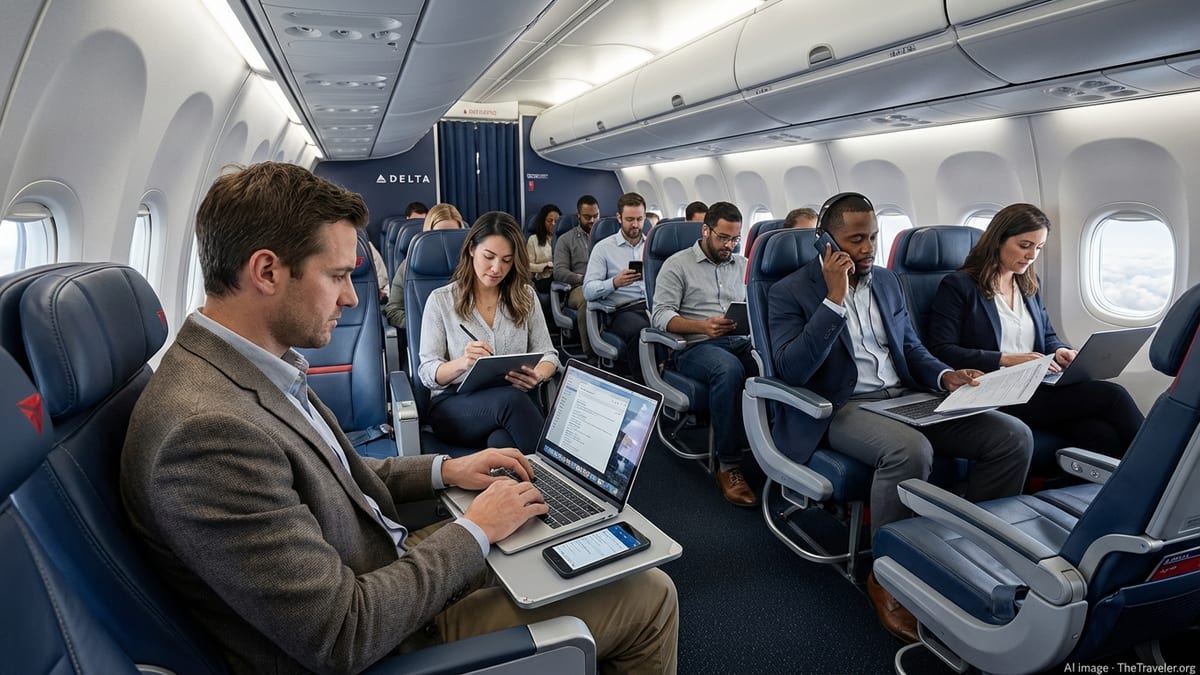
The cabin itself is subtly changing as connectivity normalizes. Seatbacks become less about pre-loaded content and more about acting as hubs alongside personal screens, while tray tables are increasingly crowded with phones, tablets, lightweight laptops and noise-cancelling headsets. Business travelers describe cabins on peak corporate routes as resembling co-working spaces in the sky, with rows of passengers toggling between slides, spreadsheets and messaging apps as they cross continents.
Loyalty, Data and a New Currency of Engagement
Behind the scenes, Delta’s push into free connectivity is deeply intertwined with the economics of loyalty. Access to fast, free Wi‑Fi is restricted to SkyMiles members, though enrollment is free and can be completed in minutes. That requirement has driven a surge in sign-ups and deeper engagement with Delta’s digital ecosystem, from its mobile app to co-branded credit cards. Analysts note that loyalty programs have become some of the most lucrative parts of major U.S. airlines’ businesses, and connectivity is now one of their most powerful recruitment tools.
Delta Sync, the personalized layer that sits atop the Wi‑Fi connection, is designed to capitalize on that engagement. Once logged in, customers can see tailored offers, curated content, streaming promotions and tie-ins with partners in entertainment, sports and retail. Previous announcements have pointed to collaborations with brands such as YouTube and gaming and fantasy platforms, creating a walled garden of perks that are available only when travelers are in the air and signed in with their SkyMiles credentials.
For corporate travelers, the experience feels less like a television channel and more like a travel-specific app store. Some may unlock trials of productivity tools or cloud storage services, while others might see targeted promotions for hotel partners or credit card upgrades aimed at frequent flyers. Every interaction generates data about preferences and behavior at a moment when customers are particularly attentive, and Delta can use that insight to refine both its onboard experience and its broader loyalty proposition.
The business case is compelling enough that competitors are racing to match it. American Airlines and United have both accelerated their own free Wi‑Fi strategies, tying access to their respective loyalty programs and working with different satellite partners. Industry observers say the competitive edge is shifting from simply offering free connectivity to how effectively airlines can use that connection as a channel to deepen relationships with high-value travelers and to drive ancillary revenue streams long after landing.
Shifting Corporate Travel Policies and Productivity Metrics
As free, fast Wi‑Fi becomes a given rather than a gamble, corporate travel managers are revisiting long-standing assumptions about the cost and value of flying time. Expense lines for in-flight connectivity are shrinking as airlines drop pay-per-session models in favor of loyalty-linked access. At the same time, some companies are now explicitly factoring in the ability to remain productive in the air when they evaluate carrier contracts, especially for employees who spend a large share of their working hours on the road.
Travel buyers report that reliable connectivity can influence route and airline selection for key corporate corridors. If staff can bill productive hours while in flight, the effective cost of travel decreases, even if fares themselves are comparable or slightly higher. This is particularly true for sectors of three hours or more, where a stable connection may allow an employee to complete most of a standard workday before landing. Delta’s network of free Wi‑Fi-equipped aircraft has therefore become a tactical advantage in negotiations over preferred-carrier status and volume-based discounts.
The impact extends to well-being and scheduling. Some firms are experimenting with guidelines that encourage employees to use connectivity for focused work during earlier segments so that they can decompress toward the end of long-haul flights. Others are incorporating connectivity expectations into flexible work policies, recognizing that an employee dialing into a weekly meeting from cruising altitude is no longer a novelty. At the same time, human-resources departments caution against assuming every hour spent on board is another office hour, emphasizing the need for boundaries so that connectivity does not slide into unhealthy always-available norms.
There are also compliance implications. With more employees accessing sensitive corporate systems from the sky, IT departments are updating security protocols, ensuring that VPNs function smoothly over satellite links and that data policies account for new threat surfaces. Delta and its technology partners stress that their networks are designed with encryption and isolation in mind, but as usage scales, corporate clients are paying closer attention to exactly how and where their data moves during flight.
Technical Backbone: Satellite Power and Fleet Integration
At the heart of Delta’s connectivity push is a complex blend of satellite technology, onboard hardware and custom software. The airline has leaned heavily on high-capacity satellite provider Viasat for much of its streaming-quality coverage, particularly across North America and the North Atlantic. These satellites supply the bandwidth that allows passengers to browse, stream and work in parallel without the bottlenecks that plagued earlier, ground-based inflight systems.
Each equipped aircraft carries a suite of antennas, modems and access points that must be carefully integrated with the airframe and certified by regulators. Engineers describe a delicate balancing act: installing hardware robust enough to deliver high-speed service in challenging atmospheric conditions, while minimizing additional weight and drag that would increase fuel burn. The process has to be repeated type by type across the fleet, which is why Delta has spent several years steadily retrofitting aircraft instead of flipping a single switch.
Software is just as critical as satellite capacity. The Delta Sync portal manages authentication, traffic shaping and content delivery, determining how bandwidth is shared among passengers and which services are prioritized at peak times. Optimizations target the specific needs of business travelers, ensuring that essential tasks like email, document syncing and virtual private network connections remain responsive even if multiple passengers are streaming video simultaneously.
Looking ahead, the final phase of Delta’s plan is extending the same consistently high performance across the Pacific and into regions where satellite coverage has historically been patchier. New satellite constellations and ground infrastructure promise to close those gaps over the next year. If timelines hold, long-haul routes linking the United States with key Asian business centers will soon join the list of flights where productivity expectations mirror those on domestic and transatlantic services.
A New Competitive Baseline for Business Travel
Free inflight Wi‑Fi is no longer an exotic selling point in the United States, but Delta’s scale and speed in rolling out fast, streaming-capable access have helped define what business travelers now consider the minimum acceptable standard. As rivals rush to equip their own fleets, the conversation among corporate flyers is shifting from “Is there Wi‑Fi?” to “Will it actually let me work the way I do on the ground?” On many routes in early 2026, Delta can credibly answer that question in the affirmative, if not yet universally.
For frequent flyers, this new baseline has subtle yet far-reaching consequences. It levels the playing field between short-haul and long-haul days, reduces the stress of missed emails and delayed responses, and gives traveling staff more control over how they allocate their energy. Senior executives can leave town without disappearing from key decision threads, while junior staff can use travel time to catch up on training or documentation instead of staying late after arrival.
As connectivity becomes ubiquitous, the frontier of differentiation will likely move toward reliability, personalization and the broader digital experience that surrounds the Wi‑Fi connection itself. For now, though, Delta’s near-global network of free, fast inflight connectivity has already changed what it means to travel for business: the sky is no longer a disconnected gap in the workday, but an extension of the office, accessible with a loyalty number and a tap on a screen.