

More news on this day
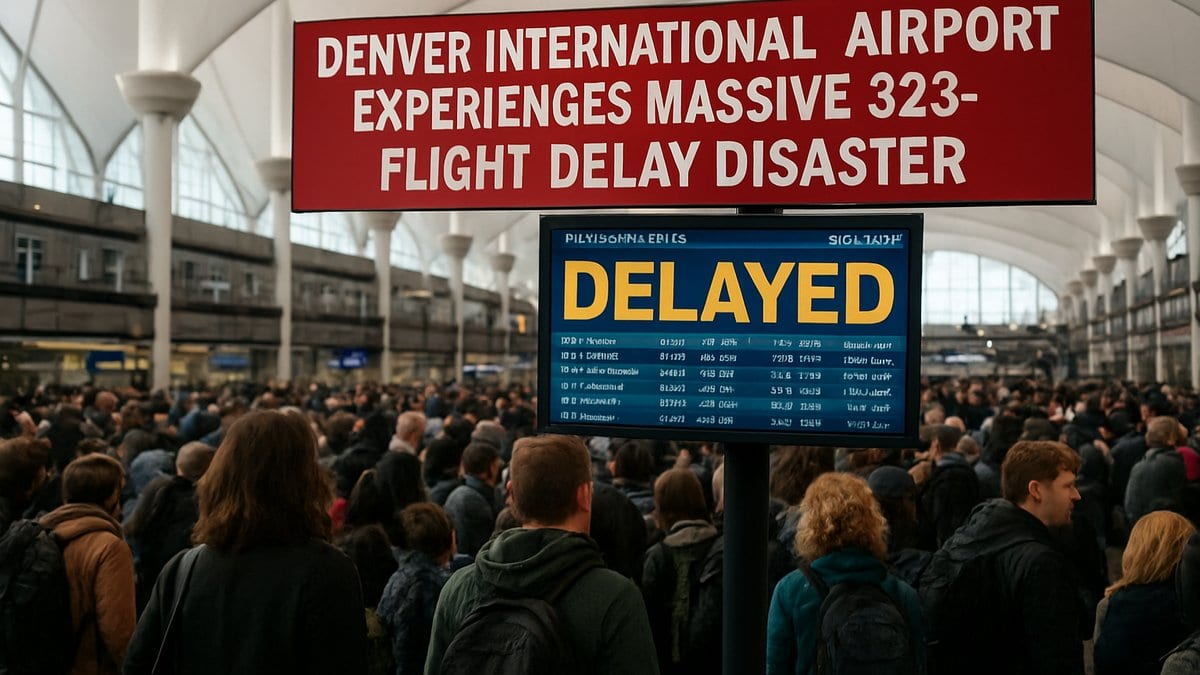
Denver International Airport experienced one of its most difficult travel days of 2026 as 323 flights were reported delayed, creating cascading disruption for passengers across the United States air system.
Get the latest news straight to your inbox!
One Day, 323 Delays and a Gridlocked Hub
The latest disruption at Denver International Airport unfolded amid an already strained spring travel period, with national aviation data indicating that the Colorado hub logged delays on 323 flights in a single operational day. Publicly available flight-tracking and airport status feeds show that departures and arrivals into Denver slowed sharply as storms and congestion rippled across multiple regions.
The elevated delay total placed Denver among the most affected major U.S. airports for the day, with hundreds of flights departing late enough to meet federal criteria for reportable delays. That definition typically counts a flight as delayed when it operates at least 15 minutes behind schedule, a threshold that many Denver services significantly exceeded as the disruption intensified.
The strain was visible in the terminal environment. Recent coverage from travel and aviation outlets has described packed gate areas, long queues at customer service desks and crowded roadways approaching the airport whenever delays spike. The latest episode followed a similar pattern, with travelers facing extended waits for both outbound and connecting flights.
Denver’s role as a central connecting hub magnified the impact. Known as one of the busiest airports in the country by passenger volume, any sustained operational slowdown at the facility quickly reverberates to smaller regional airports that depend on Denver-linked connections to maintain reliable schedules.
Weather, Power Problems and Airspace Congestion Collide
The 323-flight delay event did not arise from a single cause. Instead, data and published reporting point to an accumulation of operational stressors that have increasingly affected Denver through late winter and early spring. National meteorological summaries for March and early April highlight a series of strong storm systems that brought high winds, late-season snow, and thunderstorms to large parts of the central United States, complicating approach and departure procedures at high-elevation airports such as Denver.
On top of weather-related challenges, Denver has recently contended with a significant power outage inside the airport complex. Public posts and airline advisories in mid-March referenced a temporary loss of power that disrupted train operations, terminal services and baggage handling, prompting some carriers to issue travel waivers for affected dates. While that particular incident was limited in time, it underscored the vulnerability of tightly synchronized airport systems when even a single component fails.
Airspace congestion added another layer of difficulty. Federal aviation status boards in recent weeks have shown periods when arrival rates into Denver were reduced because of strong winds, runway configuration changes or volume restrictions. When the flow of inbound flights is slowed, aircraft are sometimes held on the ground at origin airports or placed into airborne holding patterns, both of which translate directly into delays that accumulate during the day.
Industry analyses of recent nationwide disruption days indicate that Denver often appears among a cluster of major hubs struggling simultaneously, making it harder for airlines to reposition aircraft and crew. In the latest incident, the 323 delayed flights in Denver formed part of a broader pattern of delays and cancellations across the U.S. network as carriers worked through a backlog of weather and operational constraints.
Passengers Face Missed Connections and Overnight Stays
For travelers, a day with more than 300 delayed flights at a single hub can quickly turn into a logistical ordeal. When departure banks push back by an hour or more, missed connections become unavoidable, particularly for itineraries that rely on Denver as a mid-continent transfer point between regional and long-haul routes.
Recent social media posts and forum discussions from passengers transiting Denver highlight recurring themes when delays peak: tight connections evaporate, same-day alternatives fill quickly, and hotel rooms near the airport become scarce. Some travelers report being rerouted through other hubs, while others opt to extend their trips by an extra day to secure a new itinerary that avoids the worst of the congestion.
The power outage that affected Denver in March offered a preview of what extended disruption can look like on the ground. Travelers described halted trains, backup at security checkpoints, and delayed baggage retrieval that compounded flight schedule issues. While that event was separate from the latest 323-delay day, both episodes reinforce how quickly the passenger experience can deteriorate when infrastructure or schedules falter.
Families traveling with children, people on tight business timelines and international passengers facing immigration and recheck procedures are often among those hardest hit. Even when airlines provide meal vouchers or hotel accommodations in certain cases, recovering from a missed connection can mean arriving at the final destination many hours or even days later than planned.
Structural Pressure on One of America’s Busiest Airports
Denver International Airport’s recurring delay spikes are unfolding against the backdrop of sustained growth. Recent statistics compiled by federal transportation agencies and airport planners confirm that Denver sits near the top of national rankings for passenger traffic, with airlines continuing to add routes and capacity through 2025 and into 2026.
That growth has supported regional economic development but also placed heavy pressure on airport infrastructure, ground services and staffing. Industry observers note that even on days without severe weather, gate availability, ramp staffing and baggage handling can become bottlenecks. When irregular operations hit, limited spare capacity in these areas makes it harder to absorb shocks without large-scale delays.
Analysts also point to the geographic characteristics of Denver’s location. At higher elevation and subject to frequent wind shifts and winter conditions, the airport often requires more conservative approach and departure procedures than some coastal hubs. Those constraints can limit runway throughput at the very times when demand is highest, particularly during peak travel seasons and holiday periods.
In response to mounting congestion, Denver has been pursuing multi-year terminal and gate expansion projects, while airlines have adjusted schedules, fleet assignments and staffing plans. However, the persistence of large delay events such as the 323-flight day suggests that the system remains finely balanced, with little margin when severe weather or infrastructure issues emerge.
What Travelers Can Learn from Denver’s 323-Delay Day
For passengers planning to fly through Denver in the coming weeks and months, the recent delay disaster offers several practical lessons. Travel experts and aviation data analysts routinely emphasize the importance of buffer time for connections at sprawling hubs, and Denver is no exception. Itineraries with short layovers can unravel quickly when the airport experiences arrival flow restrictions or ground holds.
Publicly available flight statistics show that certain city pairs, particularly those exposed to frequent storm tracks or mountain weather, see higher average delay minutes when disruptions occur. Travelers who can be flexible with departure times, route choices and connection points may reduce their risk by choosing flights scheduled earlier in the day or by routing through alternative hubs when storms threaten the central Rockies or Plains.
Monitoring airline apps, airport status pages and independent flight-tracking platforms has also become a central part of travel planning during volatile periods. On days like Denver’s 323-delay event, information about ground stops, gate changes and revised departure times often evolves rapidly, and passengers who stay informed are better positioned to rebook or adjust plans in real time.
Ultimately, Denver’s latest wave of delays underscores a broader reality of post-pandemic air travel in the United States. With high passenger volumes, complex weather patterns and infrastructure that is still catching up to demand, even a single day of compounded disruption can ripple across the network. For many travelers, that means building more resilience into itineraries and preparing for the possibility that the journey through Denver may take longer than the schedule suggests.