

More news on this day
A transatlantic Delta Air Lines flight from New York to Tel Aviv was forced into an emergency diversion to Dublin after an Israeli deportee allegedly faked a heart attack midair to avoid arrest, prompting a rapid-response operation involving authorities in both Ireland and Israel and raising fresh questions about how high-risk passengers are monitored on commercial routes.
Mid-Atlantic Medical Alarm Becomes Criminal Ruse
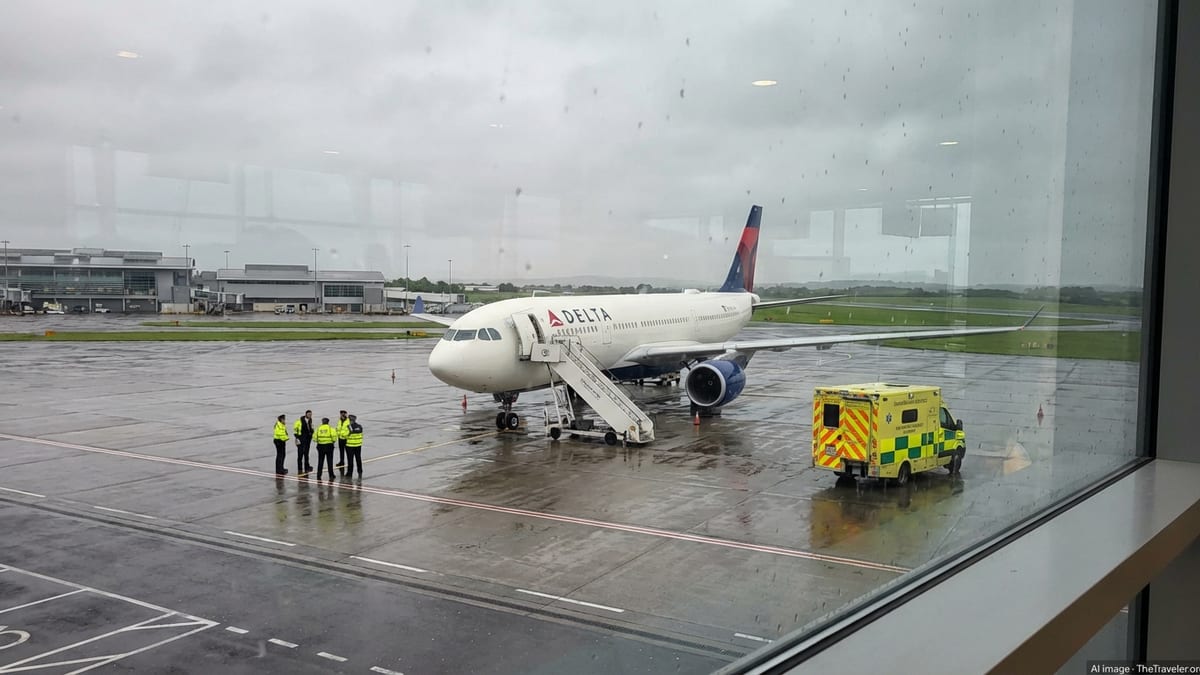
The widebody Delta jet had already crossed much of the Atlantic when the crew declared a medical emergency, reporting a male passenger suffering what appeared to be a serious cardiac event. Following standard protocol and in coordination with air traffic control, the pilots requested priority handling and diverted toward Dublin, one of the closest major airports with advanced medical facilities.
On the ground, Irish emergency services and airport responders treated the incident as a life-threatening situation. Paramedics boarded shortly after the aircraft’s heavyweight landing and transferred the passenger to a local hospital for assessment. For fellow travelers, it appeared to be an all-too-familiar story of a long-haul flight interrupted by a sudden health crisis.
Within days, however, reports from Israeli and aviation outlets revealed a dramatically different narrative. The passenger, identified as an Israeli national being deported from the United States and wanted on fraud-related charges in Israel, was alleged to have staged the heart attack in a calculated attempt to avoid returning to his home country and the arrest that awaited him there.
According to those reports, the man had previously been intercepted by United States authorities after entering the country illegally from Canada and was being sent back to Israel under escort. The in-flight collapse, once viewed through a criminal lens, suggested a last-ditch gambit to secure an unscheduled stop on European soil and slip through the cracks of international custody.
Ireland’s Rapid Response and Legal Tightrope
The surprise diversion placed Irish authorities at the center of a cross-border law enforcement puzzle. On arrival at Dublin Airport, officers from the Garda National Immigration Bureau coordinated closely with medical teams as the passenger was transported to hospital and evaluated. Once clinicians established that he was medically stable, the question shifted from health to jurisdiction.
Irish officials moved quickly to clarify the man’s status. He was not arriving as a regular passenger seeking entry, but as a deportee in transit between two other states, with an active arrest warrant and Interpol notice connected to alleged offenses in Israel. That unusual profile meant immigration rules, extradition considerations and airline responsibilities were all in play at once.
Rather than allowing him to disembark into the country, Irish authorities treated him as an inadmissible traveler and refused him landing permission. After confirming his legal position, they arranged for his return to the United States under supervision, effectively closing off the escape route he had sought to create with the midair ruse.
The episode has been cited by Irish legal and aviation observers as a case study in how small states sitting on major transatlantic corridors must be ready to respond to complex incidents that blend medical urgency, immigration control and international policing in a matter of hours.
Israel’s Pursuit of a Fugitive and Security Concerns
In Israel, the case has reignited scrutiny of a fugitive who has been linked in local reporting to a string of alleged financial crimes, including conspiracy to defraud and the use of forged documents. Officials there have long sought his return to face trial, and his deportation from the United States was viewed as a significant step toward resolving a protracted investigation.
The apparent attempt to derail that process by faking a heart attack has provoked criticism of the safeguards surrounding deportation flights, particularly when high-risk or high-profile individuals are involved. Questions have been raised in Israeli media about why a wanted suspect was able to move through the cabin with limited visible restraint and interact with crew in a way that allowed a convincing medical performance.
Security analysts note that while air marshals, escorts and other measures can be used on sensitive flights, they are often calibrated to balance safety, civil liberties and operational costs. Incidents like this, they argue, could push authorities in Israel and partner countries to reassess when more stringent controls are justified, especially on long-haul routes where diversion options are limited and disruptions are costly.
For Israeli travelers and airlines already operating in a heightened security environment, the case adds another layer of complexity. It highlights how individual acts can impose disproportionate strain on an aviation system already tasked with defending against a wide spectrum of threats, from disruptive passengers to terrorism.
Impact on Passengers and Transatlantic Travel Operations
For the passengers on board the diverted Delta flight, the incident translated into hours of uncertainty, missed connections and disrupted plans across Europe and the Middle East. Medical diversions are part of the accepted risk of long-distance air travel, but learning that the episode may have been triggered by an elaborate deception has sparked anger among some flyers and commentators.
Operationally, an emergency diversion of a fully loaded widebody is a complex and expensive maneuver. Air traffic managers must prioritize the inbound aircraft, airports must reposition staff and equipment, and airlines are left to arrange refueling, duty-time adjustments for crews and overnight accommodations or rebooking for stranded travelers. When the catalyst is not a genuine medical need but an alleged criminal ploy, the financial and logistical burden on carriers and airports becomes even more contentious.
Industry experts say episodes like this are likely to feed into ongoing discussions between airlines, regulators and law enforcement about sharing risk assessments on specific passengers, particularly deportees or individuals traveling under escort. Yet privacy laws and passenger rights frameworks in the United States, Ireland and Israel impose strict limits on how much pre-emptive information can be shared among agencies and commercial operators.
Despite the frustrations, safety specialists emphasize that cabin crew and pilots acted correctly by treating the situation as a real medical emergency. In-flight teams are trained to err on the side of caution, and any reversal of that principle in response to rare abuses could put genuinely ill passengers at risk on future journeys.
What This Means for Future Ireland–Israel Air Links
The diversion underscores the pivotal geographic role Ireland plays on the North Atlantic crossing, particularly as a go-to diversion airport for flights linking North America with Israel and other destinations in the eastern Mediterranean. Dublin’s experience handling this case is likely to be closely studied by carriers operating similar routes, including those with regular services into Tel Aviv.
Travel advisers say that while the incident is dramatic, it does not signal a broader safety concern for tourists flying between the United States, Ireland and Israel. Commercial aviation remains one of the safest modes of transport, and diversions of any kind, whether for weather, technical issues or medical reasons, are statistically rare.
However, the story is already influencing traveler perceptions. Some passengers have taken to social platforms to describe unease at sharing cabins with deportees or escorted individuals, even though such arrangements are tightly regulated and make up a tiny fraction of total journeys. Airlines may respond with clearer communication policies that explain how these cases are handled without compromising security or privacy.
For now, officials in Dublin and Tel Aviv are both keen to present the outcome as a qualified success. A potential escape bid was foiled, passenger safety was preserved, and vital air links between Ireland, Israel and the United States remained open, even as this unusual diversion exposed the intricate web of cooperation required to keep global travel moving when one man’s desperate plan plays out at 35,000 feet.