

More news on this day
The ghostly remains of Derwent village have re-emerged from the depths of Ladybower Reservoir in the Peak District, with exposed stone walls, bridge abutments and old field boundaries drawing unprecedented visitor numbers to this corner of Derbyshire.
Get the latest news straight to your inbox!
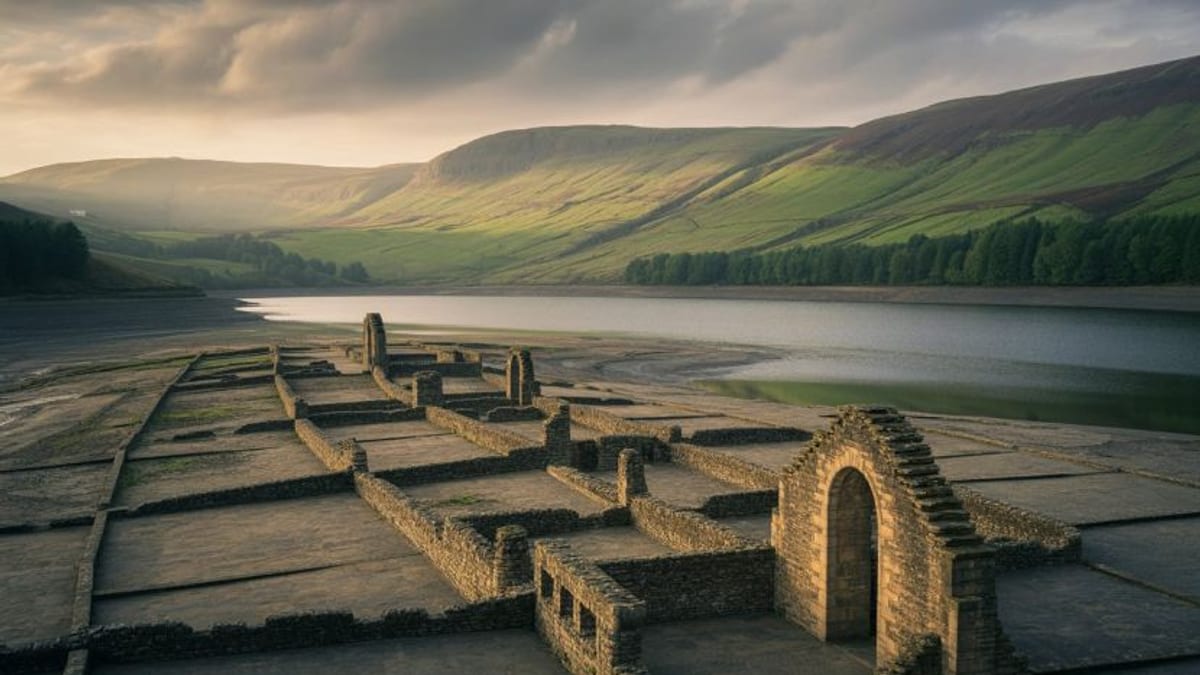
Image by Travel and Tour World – Tourism, Airline, Destination, MICE, Gobal Travel Market, Hotel news that you will find only over here.
A Lost Village Resurfaces in a Dry Spell
Derwent, one of two villages flooded in the 1940s to create Ladybower Reservoir, periodically reappears when water levels fall. Recent dry conditions and sustained demand on water supplies have once again exposed substantial sections of the former settlement, including building foundations, trackways and fragments of the old church site. Publicly available information on reservoir levels indicates that late summer and autumn 2025 brought one of the most striking reappearances since 2018, when similarly low levels first drew large crowds to glimpse the ruins.
Historical accounts describe how Derwent’s stone cottages, farms and the church of St John and St James were demolished or abandoned before the reservoir was filled. Although some structures were removed, extensive ground plans and lower walls remained on the valley floor. When the water recedes, these outlines cut through the mud like a grid, making the shape of the old village unusually legible to today’s visitors.
Reports from walking guides, local tourism bodies and recent online coverage suggest that this latest exposure has been especially pronounced along the former village streets near the old river crossing. On clearer days, visitors have been able to pick out the lines of garden walls, gateway posts and culverts that would usually sit several metres underwater.
The reappearance is part of a long pattern. Records show that Derwent has resurfaced in notable drought years such as 1976, 1995, 2003, 2018 and again in 2022 and 2025, each time reinforcing its reputation as one of Britain’s most evocative “drowned villages.”
Tourism Frenzy Around Ladybower and Derwent Dam
The renewed visibility of Derwent’s ruins has coincided with a broader surge in visitor numbers across the Peak District. Visitor survey snapshots for 2025 highlight Ladyblower Reservoir and Derwent Dam among the most frequently named destinations inside the national park, indicating their central role in the region’s tourism economy.
Travel guides now routinely list the Upper Derwent Valley as a headline attraction, presenting the chance to see the exposed village as an added draw alongside established highlights such as the vast dam walls, the reservoir “plugholes” and views from nearby edges and moorland plateaus. Walking routes from Fairholmes Visitor Centre marketed as family friendly or accessible are channelling even more people directly towards the village site when water levels are low.
Social media posts and user-generated travel content have amplified the effect, with recent images of cracked mud, tumbled stonework and long-submerged roads circulating widely. These images frame Derwent as a rare spectacle, encouraging day-trippers from cities such as Sheffield, Manchester and Nottingham to make spontaneous journeys to see the ruins before they disappear underwater again.
Local commentary shared in walking forums and community discussions points to noticeably busier weekends, particularly during dry spells and school holidays. Visitors are being attracted not only by the atmospheric sight of the ruins but also by the wider combination of history, reservoir scenery and relatively straightforward walking terrain.
Strain on Infrastructure and Landscape
The tourism boom generated by Derwent’s return is not without challenges. Reports from local communities around Ladybower and the Upper Derwent Valley highlight growing pressure on parking, roads and fragile habitats, particularly at peak times. Long-standing concerns about congestion on narrow access lanes have been sharpened by the latest wave of curiosity around the resurfaced village.
Online accounts from residents and regular walkers describe full car parks early in the day and improvised parking along verges, farm entrances and minor roads when capacity is exceeded. These patterns echo wider debates within the Peak District about the impact of mass visitation on rural communities, with the Ladybower and Derwent area frequently cited as a hotspot.
Conservation and nature reports for the Upper Derwent have also underlined the ecological sensitivity of reservoir margins. When water levels fall, exposed mud and shingle can provide important feeding and nesting opportunities for specialist plants and bird species. A sudden influx of visitors moving across these areas risks trampling vegetation and disturbing wildlife at precisely the moment when new habitat is created.
Publicly available information from the national park authority and partner organisations continues to stress the importance of using official car parks, following marked paths and heeding seasonal signage. As Derwent’s ruins pull in new audiences, these messages are increasingly central to efforts to balance access with protection of the valley’s natural and historic environment.
Shaping the Narrative of the Peak District
Derwent’s dramatic reappearance has added a fresh chapter to the Peak District’s evolving tourism story. Once promoted mainly for moorland vistas, limestone dales and traditional villages, the national park is now frequently portrayed as a landscape where climate patterns, water management and cultural memory intersect in visible ways. The resurfacing of a drowned village in a popular reservoir encapsulates that shift.
Travel features, blogs and regional media coverage over the past year have drawn connections between low reservoir levels, changing weather patterns and the spectacle of the emerging ruins. In this framing, Derwent becomes both a heritage attraction and a visual reminder of environmental stress, further sharpening visitor interest.
The village also dovetails with the long-standing fascination surrounding Derwent and Howden dams as practice sites for the Second World War Dambusters raids. Many visitors now combine walks to see the resurfaced remains with stops at the massive dam walls, information panels and viewpoints that interpret the area’s military, engineering and social history.
This layering of narratives has helped to reposition the Upper Derwent Valley as one of the most symbolically charged corners of the Peak District. For tourism bodies seeking to diversify the region’s appeal, Derwent’s ghostly return offers powerful imagery but also raises questions about how to manage a site that appears and disappears with the weather.
Managing the Rush: What Visitors Should Expect
In practical terms, visitors drawn by news and images of the resurfaced village are being encouraged, through publicly available guidance, to plan ahead. Information from national park and tourism channels emphasises that water levels fluctuate, meaning the extent of visible ruins can change quickly from week to week. Expectations of a fully intact village street are likely to be disappointed; what emerges is an archaeological landscape of walls, platforms and trackways, often coated in mud.
Recent walking guides recommend starting from Fairholmes Visitor Centre at the northern end of Ladybower, where parking, toilets and information boards are concentrated. From here, circular trails follow well-surfaced tracks along the reservoir edge towards Derwent Dam and the former village site, with options for longer loops into adjacent valleys or up to vantage points overlooking the water.
Travel advice compiled over the last two seasons highlights the value of arriving early on fine weekends or considering midweek visits to avoid the heaviest crowds. Visitors are also reminded that conditions underfoot on exposed reservoir beds can be slippery and uneven, and that venturing onto soft mud or unstable remains is strongly discouraged in publicly available safety guidance.
As the current dry spell eventually breaks and Ladybower begins to refill, much of Derwent will slip from view once more. For now, its reappearance has reenergised interest in the valley, sharpened debate about the environmental and social cost of rising visitor numbers, and further cemented the Upper Derwent as one of the Peak District’s most compelling and contested landscapes.